Has Venezuela been ditched by its strongest allies
हिंदी में सुनें
Listen to this article in Hindi
Experts say that Russian and Chinese support for Venezuela has largely dried up, with no prospect of real military or financial aid.
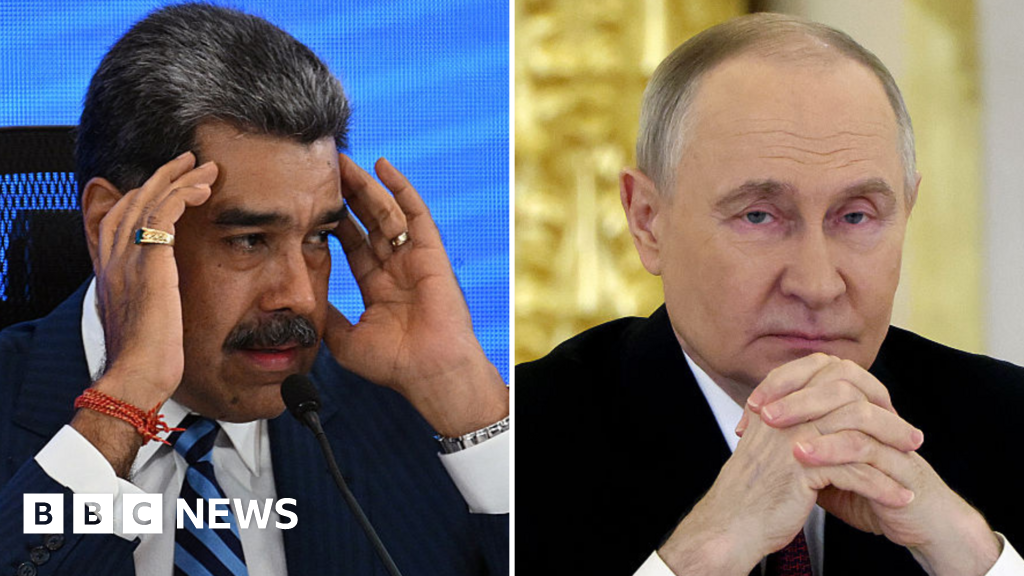
Venezuelan President Nicolás Maduro could be forgiven for wondering who his true friends are.
Once rock solid, his reliance on his two main allies - China and Russia - now appears increasingly uncertain.
For years, both countries supported Venezuela's socialist-led government politically, financially and militarily - a relationship that began under former President Hugo Chávez, Maduro's mentor and predecessor.
But experts say that backing now seems to be largely symbolic, with statements being given in support rather than concrete military or financial aid.
This shift comes as the US has deployed air and naval forces - including a nuclear-powered submarine, spy planes and 15,000 troops - to the Caribbean.
The US has conducted strikes on boats in the region that it alleges are smuggling drugs, killing more than 80 people, and in recent days, it seized an oil tanker off the coast of Venezuela.
The Trump administration has said the military build-up and strikes are targeting drug trafficking, and the tanker had been sanctioned. But many experts - and Maduro himself - believe Washington's real goal is regime change.
So at the Venezuelan president's hour of greatest need, what has changed?
Prof Fernando Reyes Matta, director of the Centre for China Studies at Andrés Bello University in Chile, argues that Venezuela has become a far lower priority for both Beijing and Moscow, especially since US President Donald Trump returned to the White House.
"There is no reason today for either Russia or China to go all-in defending Venezuela given their other problems, such as Russia and its war in Ukraine, and China trying to coexist internationally with President Trump," he says.
Since Russia's full-scale invasion of Ukraine in 2022, Moscow has poured enormous resources into the conflict, straining both its finances and its military. It has also faced sweeping Western sanctions.
This leaves fewer resources for allies that previously benefited from Kremlin support, says Prof Vladimir Rouvinski, the director of the Laboratory of Politics and International Relations (PoInt) at Icesi University in Colombia.
Syria and Iran, Moscow's long-standing allies in the Middle East, have faced a similar fate in recent times.
"Russia will [not] risk receiving more sanctions than it already has, [and] China will not risk getting more tariffs imposed on it for defending Maduro," Prof Rouvinski explains.
Maduro reportedly asked China and Russia for military assistance at the end of October, according to The Washington Post.
The Kremlin's Deputy Foreign Minister Sergey Ryabkov has said "we support Venezuela, as it supports us", while urging the Trump administration to avoid escalating the crisis, Russian media reported.
And in the wake of the American seizure of the oil tanker, the Kremlin said Putin had called Maduro to affirm his support.
But so far, Moscow has not provided any material assistance.
Like Moscow, Beijing has shown no sign it would militarily defend Venezuela, instead condemning what it calls "external interference" and urging restraint.
Experts say China defending Maduro could jeopardise recent diplomatic gains between Beijing and Washington, while offering little beyond ideological alignment.
US–China relations have been particularly tense since Trump imposed tariffs on multiple countries. But a meeting between Trump and Xi Jinping in South Korea in late October - described as positive by both sides - opened the door to new agreements and lower tariffs on certain products.
According to experts, Venezuela's economic collapse and the deterioration of its oil industry have further discouraged Chinese support. Beijing has reduced new lending in recent years and is now focused mainly on recovering past loans.
"I think China is willing to negotiate with any government that eventually replaces Maduro, and believes that supporting Maduro too strongly now could bring negative consequences when the regime falls," says Prof Rouvinski.