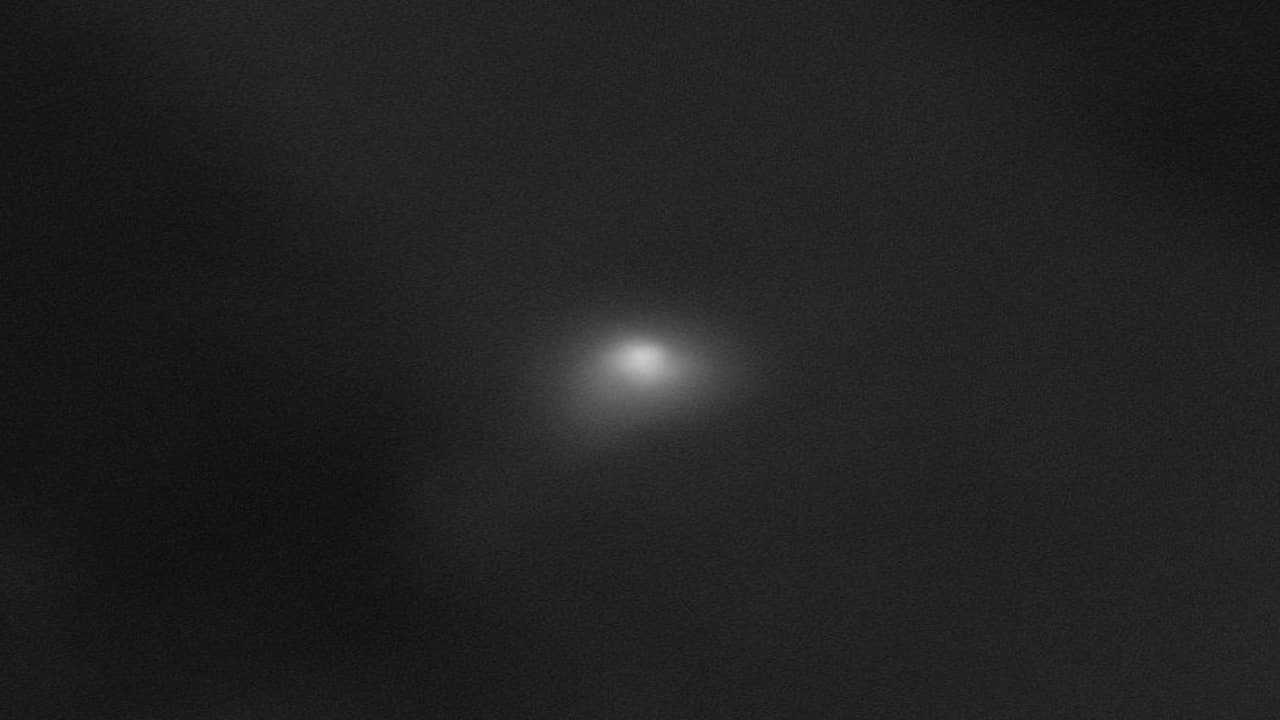
Harvard scientist’s wild Jupiter theory brings new mystery to interstellar comet 3I/ATLAS
Updated on 01 Dec 2025 | Category: Science
A new claim about visiting comet 3I/ATLAS has stirred debate among astronomers worldwide. The idea that its strange path could hint at extra-terrestrial technology is pushing curiosity and scepticism to new heights.
An article from the New York Post, published recently, has awakened the scientific community with a bold and imaginative theory from Avi Loeb, a Harvard astrophysicist: the strange path taken by the interstellar comet 3I/ATLAS may hint at something far more intentional than just a cosmic flyby. He is convinced that its trajectory suggests the possibility of it releasing "satellites" in proximity to Jupiter, something which could point to extra-terrestrial technology.
A claim that challenges standard explanations
Loeb's proposal is based on the way 3I/ATLAS is moving past the solar system. The comet is expected to reach a point closest to Jupiter on March 16, 2026, and he argues that this is the perfect distance at which to drop off probes or satellites. According to Loeb, Jupiter's powerful gravitational field means the area around it is a perfect zone for an intelligent civilization to place long-lasting observational devices. The scientist insists that a coincidence of this kind, with the comet arriving at exactly the right distance, is too striking to ignore.
Why Jupiter would matter to extra-terrestrials
It is here that Loeb, in his blog, explains that Jupiter, due to its huge size, stands out in our solar system, and any advanced species curious about other planets would likely target it because of its large size and gravitational influence. According to Loeb, Jupiter acts like a cosmic lighthouse, far more detectable than Earth, especially billions of years ago when people did not yet exist. This, according to him, may be the explanation for why an alien mission would be directed at Jupiter instead of our world.
A mysterious course correction and invisible manoeuvring
Loeb also estimated that 3I/ATLAS may have conducted a subtle course correction in its close approach to the sun. He speculates it could have been an artificial manoeuvre using thruster-like jets to ensure its passage near the optimum point close to Jupiter. Unfortunately, the comet was on the other side of the sun from Earth at that time, so Earth scientists were unable to observe whether it conducted such a manoeuvre, nor if the comet released anything during that interval.
What scientists could look for next
Loeb hopes that space probes now orbiting Jupiter, including NASA's Juno mission, might be able to pick up unidentified objects after 3I/ATLAS goes by. If any human-made satellites show up that did not get launched from Earth, he says, it would be a sign that Jupiter has appeal for at least one other civilization. The alternative possibility of identifying no such objects, Loeb notes, would tend to rule out this hypothesis, but even in that case, several intriguing issues will remain, including why the comet had behaved so strangely in the first place.
Scepticism remains, but curiosity grows
Even Loeb himself admitted that alien probes were the least likely explanation among various possibilities he suggested. More likely, maybe, is that the comet's unusual anti-tail is redirecting tiny meteors away from its path. NASA, for its part, doesn't mince any words: 3I/ ATLAS is just a comet.
Still, Loeb's theory-as reported by the New York Post-has stirred new conversation about what interstellar visitors might reveal, and how much more there is to learn about the mysteries drifting into our solar system.


