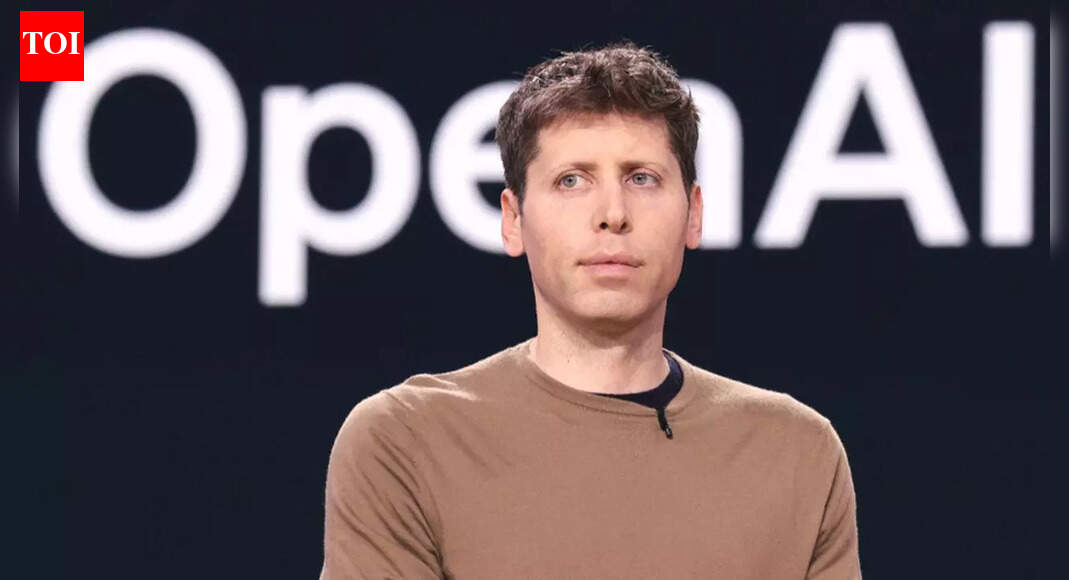
Google's Gemini forces OpenAI CEO Sam Altman send 'Code Red' warning to employees, two years after ChatGPT did same to Google
Tech News News: OpenAI faces an internal 'code red' as Google's Gemini surges ahead, forcing a halt on revenue plans to fix ChatGPT's performance. Google's integrated infrastructure and custom chips give it a decisive edge. OpenAI's pivot highlights intense competition and financial pressures, as it scrambles to regain ground against a resurgent tech giant.
OpenAI faces an internal 'code red' as Google's Gemini surges ahead, forcing a halt on revenue plans to fix ChatGPT's performance. Google's integrated infrastructure and custom chips give it a decisive edge. OpenAI's pivot highlights intense competition and financial pressures, as it scrambles to regain ground against a resurgent tech giant.
OpenAI faces an internal 'code red' as Google's Gemini surges ahead, forcing a halt on revenue plans to fix ChatGPT's performance. Google's integrated infrastructure and custom chips give it a decisive edge. OpenAI's pivot highlights intense competition and financial pressures, as it scrambles to regain ground against a resurgent tech giant.
Three years after ChatGPT's explosive debut sent Google into panic mode, the tables have turned spectacularly. OpenAI CEO Sam Altman has declared an internal "code red" emergency, ordering employees to halt work on advertising and revenue-generating features to fix ChatGPT's deteriorating competitive position as Google's Gemini 3 model surges ahead on performance benchmarks, user engagement, and market share—a reversal that threatens the $500 billion startup's future while vindicating Google's patient, infrastructure-heavy approach to artificial intelligence. OpenAI is abandoning plans to introduce advertising, AI shopping assistants, health agents, and its Pulse personal assistant, according to internal memos obtained by The Wall Street Journal and The Information. Instead, all resources will redirect toward improving ChatGPT's speed, reliability, and personalisation as the company confronts what Altman called "temporary economic headwinds" from Google's aggressive AI offensive. The staff working on chatbot will have to attend daily calls as the development sprints toward an “even more intuitive and personal,” as described by ChatGPT's head Nick Turley. "We are at a critical time for ChatGPT," Altman wrote in memo, first reported by The Information. The directive escalates OpenAI's internal alert level from "code orange" to "code red"—the company's highest urgency designation for existential threats. The retreat comes as a remarkable role reversal from December 2022, when ChatGPT's launch forced Google CEO Sundar Pichai to issue his own "code red" that restructured entire divisions and accelerated AI development timelines.
Google's infrastructure advantage proves decisive
Google's comeback stems from advantages OpenAI cannot easily replicate. Its Gemini user base rocketed from 450 million monthly active users in July to 650 million in October, while web analytics firm Similarweb reports users now spend more time with Gemini than ChatGPT—despite OpenAI claiming 800 million weekly users. More fundamentally, Google controls what insiders call the "full stack." DeepMind researchers build models, proprietary TPU chips train them cheaply, Google Cloud hosts them efficiently, and seamless integration delivers them across Search, YouTube, Gmail, and 3 billion Android devices. OpenAI depends on Microsoft's cloud infrastructure and Nvidia's expensive chips, creating structural cost disadvantages. "One of the most important things for us at Google is this is possible because we have a very differentiated full-stack approach," DeepMind CTO Koray Kavukcuoglu told reporters, noting the company trains models on custom silicon while deploying them immediately into products. Google's latest Gemini 3 model has outperformed OpenAI's GPT-5 on industry benchmarks, while its Nano Banana Pro image generator has gained significant traction. Anthropic's Opus 4.5 model also beat GPT-5 in key tests, squeezing OpenAI from multiple directions. OpenAI isn't alone in feeling the tremors from Gemini 3's success. Nvidia's stock plummeted over 6%, erasing roughly $250 billion in market value, after reports emerged that Meta Platforms—one of OpenAI's fellow mega-customers—is in advanced talks to purchase billions of dollars worth of Google's TPU chips instead of Nvidia's GPUs. The chipmaker, which supplies the expensive hardware powering OpenAI's models and has built a near-monopoly on AI infrastructure, now faces the prospect of losing up to 10% of its annual revenue as Google's custom silicon proves both cheaper and, for certain workloads, more efficient than Nvidia's flagship products.
Financial pressures compound OpenAI’s strategic challenges
The pivot comes as OpenAI confronts brutal financial realities. The Wall Street Journal reported the company must reach roughly $200 billion in annual revenue by 2030 to achieve profitability—requiring 100-fold growth while burning billions quarterly on compute costs and talent. Google generates $120 billion annually with nearly $100 billion in cash reserves, giving it unlimited capacity to undercut OpenAI on pricing or outspend on research. The search giant can afford to offer advanced models free while OpenAI desperately needs to monetize. Altman attempted to reassure employees that a new reasoning model launching next week would surpass Gemini 3's capabilities. "I wouldn't trade positions with any other company," he wrote, according to sources familiar with the memo. But the emergency directive—and the shelving of advertising plans OpenAI needs to survive—suggests deeper anxiety about whether the ChatGPT pioneer can maintain its early lead against a tech giant finally operating at full throttle.
End of Article


