Nigeria's Enduring Instability: The Unseen Costs of Counter-Terrorism
हिंदी में सुनें
Listen to this article in Hindi
Nigeria's persistent vulnerability to attacks highlights the complex interplay of regional instability, counter-terrorism strategies, and socio-economic factors, impacting West Africa's security landscape.
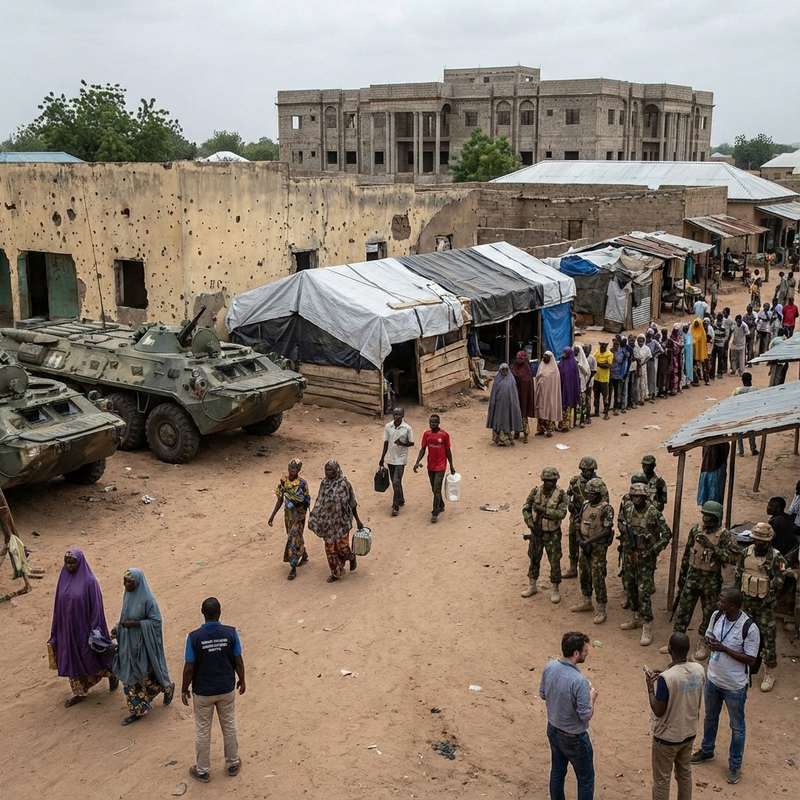
The persistent threat of extremist violence in Nigeria, exemplified by recent attacks like the bombing in Maiduguri, underscores the limitations of purely militaristic counter-terrorism strategies and the deep-seated socio-economic factors fueling instability across the Sahel region. While international attention often focuses on the operational aspects of groups like Boko Haram and Islamic State West Africa Province (ISWAP), the broader context of governance deficits, resource scarcity, and inter-communal tensions remains crucial for understanding the enduring nature of this conflict.
The Lake Chad Basin, where Nigeria borders Niger, Chad, and Cameroon, has become a breeding ground for instability. Climate change exacerbates existing resource competition, pushing vulnerable populations towards extremism as a means of survival. Governments across the region struggle to provide basic services and maintain security, creating a vacuum that extremist groups readily exploit. This situation contrasts sharply with the narrative of military victories often presented, masking the reality of a resilient insurgency that adapts and exploits local grievances.
Nigeria's counter-terrorism approach, largely focused on military force, has yielded limited long-term success. While tactical gains are achieved, the underlying conditions that enable recruitment and sustain the insurgency remain largely unaddressed. Displacement caused by conflict, coupled with a lack of economic opportunity, creates a cycle of vulnerability and resentment. Furthermore, allegations of human rights abuses by security forces further alienate communities and fuel anti-government sentiment, inadvertently bolstering extremist narratives. See more on world affairs background and global impacts.
The geopolitical implications extend beyond Nigeria's borders. The porous nature of West African borders allows for the movement of fighters and weapons, destabilizing neighboring countries and potentially creating new havens for extremist groups. The international community's focus on military aid and training, while necessary, risks neglecting the crucial need for development assistance, good governance initiatives, and community-based reconciliation programs. The failure to address these underlying issues ensures the continuation of the conflict and its spillover effects on regional stability.
Furthermore, the evolving nature of ISWAP, with its connections to broader global jihadist networks, presents a complex challenge. The group's ability to attract foreign fighters and access funding streams from outside the region amplifies its operational capabilities and prolongs the conflict. Countering this requires enhanced international cooperation in intelligence sharing, border security, and the disruption of financial networks. That said, the reality is a bit more complicated. such cooperation must be balanced with respect for national sovereignty and the avoidance of heavy-handed tactics that could further inflame local tensions.
Looking ahead, the path to sustainable peace in Nigeria requires a multi-faceted approach that prioritizes good governance, economic development, and social inclusion. Strengthening local institutions, promoting inter-communal dialogue, and addressing the root causes of grievances are essential steps. Military force alone cannot defeat an insurgency that thrives on poverty, marginalization, and a lack of opportunity. The Nigerian government, with the support of the international community, must invest in long-term solutions that address the underlying drivers of conflict and build a more resilient and inclusive society. The effectiveness of India's global position is also relevant in the context of international counter-terrorism efforts and its engagement with African nations. Topic basics can also provide a comprehensive understanding for readers.
Uncertainties remain regarding the long-term trajectory of the conflict. The ability of the Nigerian government to effectively address corruption, improve governance, and deliver basic services will be crucial. The willingness of international partners to shift from a primarily military-focused approach to a more comprehensive development-oriented strategy will also be critical. The future stability of Nigeria, and indeed the wider Sahel region, hinges on addressing the root causes of conflict and building a more inclusive and prosperous society.
Editor’s note: This article was independently written by the Scoopliner Editorial Team using publicly available information.