Eye of Sahara: What is the 100-million-year-old giant structure seen from space?
The Sahara is hiding a perfect 50-kilometre bullseye that can be seen only from space. What carved this giant eye into the desert?
An enormous, circular landform in Mauritania’s Sahara Desert continues to attract scientific focus, as well as the attention of astronauts.
Known as the Eye of Sahara, its other names include Richat Structure and eye of Africa.
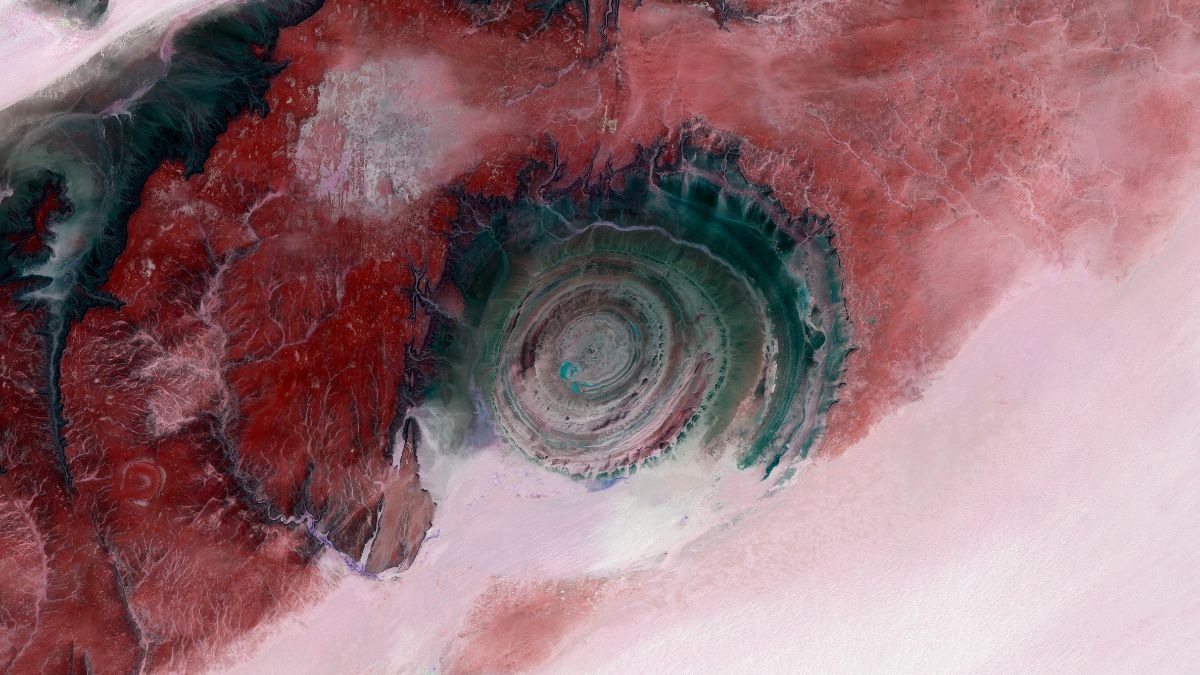
This geological feature features prominently in the most recent, high-resolution images from the European Space Agency (Esa)'s Copernicus Sentinel-2 satellite. With improved observation, this 50-kilometre-wide ring has transitioned from being an unsolved puzzle to a well-documented phenomenon, with new images providing clarity on its formation and scale.
advertisement
Positioned in northern Mauritania’s Adrar Region, the Richat Structure rises out of the desert, displaying concentric circles that are difficult to overlook.
Initial hypotheses proposed a meteorite collision, but current research points to the upwelling of molten rock, creating a dome that eventually reached the surface. Over time, the structure’s appearance was shaped by extensive erosion. Wind, sand, and water gradually carved it over millions of years.
MORE ABOUT THE EYE OF SAHARA
Geological studies place the Richat Structure’s age at a minimum of 100 million years. Its prominent target-like appearance is created by alternating bands of tough and softer sedimentary rock, which respond differently to erosion.
This layered arrangement makes the structure highly distinct in satellite imagery, especially when compared to the adjacent desert expanse.
Astronauts have identified the Richat Structure as a key reference point during space missions. Its broad diameter and unmistakable outline allow for easy identification from orbit, a stark contrast to ground-level views.
The full 50-kilometre diameter appears in recent Sentinel-2 imagery, including photographs obtained in September 2025.
Comparative analyses of these images, one rendered in natural colours, another employing false-colour techniques, highlight geological subtleties.
Quartzite sandstones, which resist erosion more effectively, register as red and pink arcs, while darker zones correspond to valleys composed of less durable material. Some of the central arcs rise up to 80 metres above their surroundings; the oldest rocks are concentrated at the core.
On the southern margin, sand appears to be gradually encroaching, depicted as pale bands in the photographs. Trees and shrubs, visible as minute dots, trace a dry riverbed, showing up as purple in the false-colour image.
The Richat Structure continues to serve as a point of study for its exceptional scale and construction. Its layers, as well as its environmental setting, offer significant insight into geological activity shaping the Sahara over vast timescales.
- Ends