Eureka! Indian Scientists Discover Galaxy Formed 1.5 Billion Years After Big Bang
हिंदी में सुनें
Listen to this article in Hindi
Indian scientists have discovered a 13.8-billion-year-old galaxy that resembles the Milky Way. The galaxy has been named Alaknanda, after one of the headstreams of Ganga River.
Indian scientists have discovered an ancient spiral galaxy named Alaknanda. The galaxy was formed when the Universe was only 1.5 billion years old, i.e, 1.5 billion years after the Big Bang. Notably, the 13.8-billion-year-old galaxy resembles the Milky Way.
Discovery Details
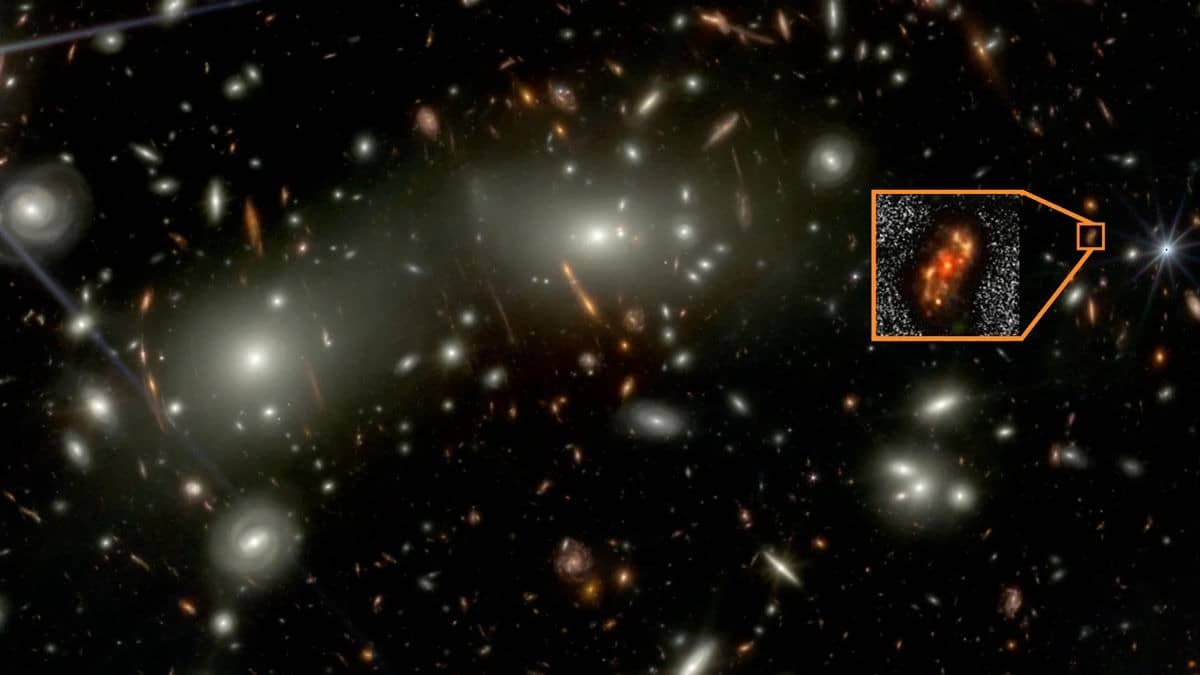
A team from the National Centre for Radio Astrophysics (NCRA-TIFR) in Pune, led by Professor Yogesh Wadadekar and PhD student Rashi Jain, spotted Alaknanda using data from the James Webb Space Telescope (JWST). The galaxy lies 12 billion light-years away, behind the massive Abell 2744 cluster, whose gravitational lensing magnified its light for detailed imaging across multiple wavelengths. Abell 2744 is a massive galaxy cluster which is also known as Pandora's Cluster.
Published in Astronomy & Astrophysics, the research by the Indian scientists highlights Alaknanda's two symmetric spiral arms and central bulge spanning roughly 30,000 light-years, with a stellar mass of about 10 billion solar masses.
"Alaknanda reveals that the early Universe was capable of far more rapid galaxy assembly than we anticipated," Yogesh Wadadekar said. “Somehow, this galaxy managed to pull together ten billion solar masses of stars and organise them into a beautiful spiral disk in just a few hundred million years. That's extraordinarily fast by cosmic standards, and it compels astronomers to rethink how galaxies form,” he added.
Advertisement
Why Alaknanda Stands Out?
Rashi Jain said, “Alaknanda has the structural maturity we associate with galaxies that are billions of years older.” “Finding such a well-organised spiral disk at this epoch tells us that the physical processes driving galaxy formation—gas accretion, disk settling, and possibly the development of spiral density waves—can operate far more efficiently than current models predict. It's forcing us to rethink our theoretical framework,” she added.
Earlier, it was believed that early galaxies should be irregular and disordered. However, Alaknanda defies this belief. "This galaxy looks like a regular, well-structured system," Wadadekar noted.
Advertisement
Significance Of The Name
Researchers named it after the Alaknanda River, one of the headstreams of the Ganga and sister river of the Mandakini, which, in turn, lends its name to the Milky Way galaxy. Jain explained, "Just as the Alaknanda is the sister river of the Mandakini... we thought it fitting." This poetic choice of the name underscores the galaxy's striking similarity to our Milky Way despite its ancient origin.