Listening In: New Sensor Technology Decodes Brain Cell Communication
हिंदी में सुनें
Listen to this article in Hindi
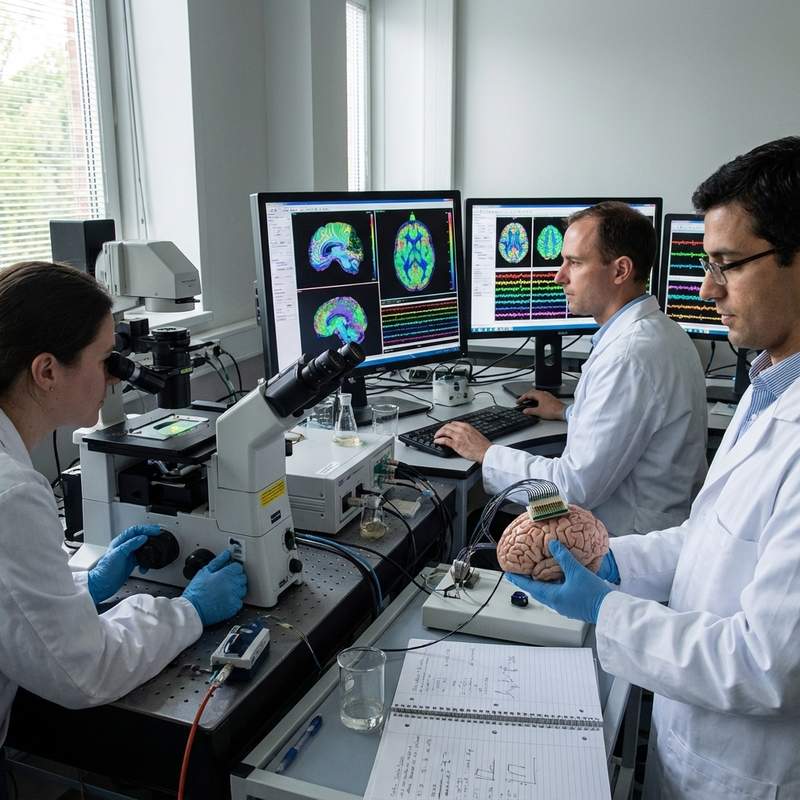
A newly engineered protein sensor allows scientists to eavesdrop on brain cell communication, revealing previously hidden signals and pathways.
The human brain, a complex network of billions of neurons, relies on intricate communication pathways to orchestrate everything from simple reflexes to complex thought. Scientists have long sought to decipher the language of these brain cells, but a significant challenge has been the inability to fully capture the incoming signals that neurons receive. Now, researchers have engineered a novel protein sensor, iGluSnFR4, that promises to revolutionize our understanding of how neurons communicate, opening new avenues for both basic neuroscience research and the development of treatments for neurological disorders.
To appreciate the significance of this advancement, it's crucial to understand the fundamentals of neuronal communication. Neurons, the fundamental units of the brain, transmit information via electrical signals. These signals travel down the axon, a long, slender projection of the neuron. When the electrical signal reaches the end of the axon, it encounters a synapse, a tiny gap separating it from the next neuron. Here, the electrical signal is converted into a chemical one. The neuron releases neurotransmitters, chemical messengers, into the synapse. These neurotransmitters then bind to receptors on the receiving neuron, triggering a new electrical signal and continuing the chain of communication.
Glutamate, the neurotransmitter targeted by iGluSnFR4, is the most abundant excitatory neurotransmitter in the brain. This means that it plays a critical role in stimulating neuronal activity and is essential for learning, memory, and overall brain function. Disruptions in glutamate signaling have been implicated in a wide range of neurological and psychiatric disorders, including Alzheimer's disease, schizophrenia, autism, and epilepsy. Understanding how glutamate is released and received is, therefore, paramount to understanding how the brain functions both in health and disease. For a deeper dive, check out our [science basics explainer] on neurotransmitters.
Previously, researchers primarily focused on measuring the outgoing signals from neurons. This approach provided valuable insights, but it only captured half of the communication equation. The incoming signals, representing the inputs from thousands of other neurons, remained largely a mystery. These incoming signals are often faint and fleeting, making them difficult to detect with existing technologies. iGluSnFR4 overcomes this limitation by acting as a highly sensitive molecular "glutamate indicator." This engineered protein binds to glutamate, and when it does, it fluoresces, allowing researchers to visualize and measure the incoming signals with unprecedented precision.
The development of iGluSnFR4 is a collaborative effort between scientists at the Allen Institute and HHMI's Janelia Research Campus. By enabling the visualization of these previously hidden signals, iGluSnFR4 allows scientists to study how neurons integrate information from multiple sources and generate their own output signals. This capability is crucial for understanding how the brain processes information and makes decisions. Kaspar Podgorski, Ph.D., lead author on the study, aptly describes the previous challenge as trying to read a book with scrambled words. iGluSnFR4 helps to connect the neurons and unscramble the messages.
The implications of this technology extend far beyond basic neuroscience research. The ability to monitor glutamate signaling in real-time opens up new avenues for drug discovery. Drug companies can now use iGluSnFR4 to test how new treatments affect synaptic activity directly, potentially accelerating the search for more effective therapies for neurological disorders. Relatedly, this advance may help in the related field context of [neurological disease modeling].
While iGluSnFR4 represents a significant step forward, it's important to acknowledge its limitations. The technology is still relatively new, and further research is needed to fully understand its capabilities and limitations. For example, while iGluSnFR4 is highly sensitive to glutamate, it may not be able to distinguish between different sources of glutamate or different types of glutamate receptors. Future research will likely focus on refining the technology and developing new sensors that can target other neurotransmitters and signaling molecules.
So where does that leave things? the development of iGluSnFR4 marks a significant advancement in neuroscience. By providing a window into the previously hidden world of neuronal communication, this technology promises to revolutionize our understanding of the brain and pave the way for new treatments for neurological disorders. The ability to eavesdrop on these complex chemical conversations will undoubtedly unlock some of the brain's deepest mysteries. The work builds on [prior research background] in genetically encoded indicators, paving the way for future innovations.
Editor’s note: This article was independently written by the Scoopliner Editorial Team using publicly available information.