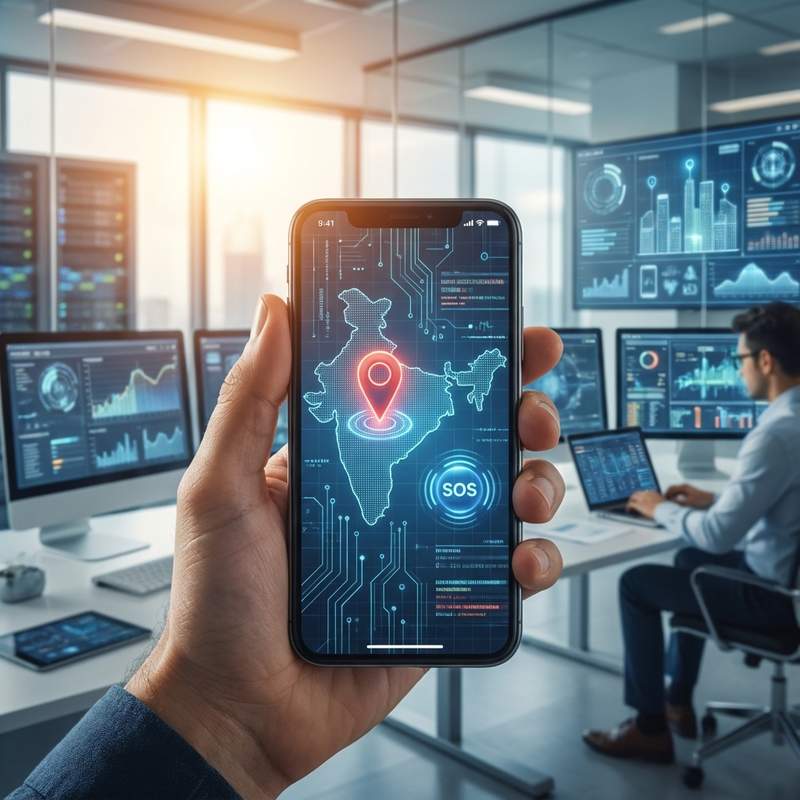
Android's Emergency Location Service Arrives in India: A Lifeline for Critical Situations
हिंदी में सुनें
Listen to this article in Hindi
Android's Emergency Location Service (ELS) is finally available in India, starting in Uttar Pradesh. Learn how this technology can save lives by providing precise location data to emergency services.
After years of availability in other regions, Google has announced the rollout of Android's Emergency Location Service (ELS) in India, beginning with the state of Uttar Pradesh. This technology, first introduced in 2016, is designed to automatically transmit a device's location to emergency responders when a call is placed, potentially shaving crucial seconds off response times in critical situations.
ELS works by leveraging a combination of GPS, Wi-Fi, and mobile network data to pinpoint the caller's location. This information is then transmitted to emergency services alongside the call. This is especially valuable in situations where the caller is unable to communicate their location clearly, whether due to a weak signal, physical distress, or other factors that impede communication. The feature was extended to US carriers starting in 2018.
According to Google, ELS activates automatically when a user dials 112 – India's national emergency number – or other designated emergency numbers from an Android device running Android 6.0 (Marshmallow) or later. The company emphasizes that ELS is a free service that requires no additional hardware or applications. Crucially, Google states that it does not collect or store user location data; the location information is sent directly from the caller's device to the emergency services provider.
In Uttar Pradesh, the ELS system is integrated with UP112's command infrastructure and Pertsol's routing intelligence. This allows emergency responders to instantly view the caller's coordinates and dispatch the appropriate assistance – police, medical, or fire – within seconds. Google also highlighted a pilot program in Uttar Pradesh, where ELS proved effective in transmitting location data even for calls that dropped quickly after connecting. Over 20 million calls and SMS messages were processed during the pilot.
The arrival of ELS in India represents a significant step forward in improving emergency response capabilities. The ability to automatically and accurately pinpoint a caller's location can be life-saving, particularly in a country with diverse terrains and varying levels of infrastructure. While currently limited to Uttar Pradesh, the potential for expansion to other states is significant. That said, the reality is a bit more complicated. Google notes that wider implementation requires collaboration with local emergency services and carriers. Google has provided a public form for governments interested in enabling ELS in their regions.
While the timeline for further expansion remains uncertain, the launch in Uttar Pradesh serves as a promising example of how technology can be harnessed to improve public safety and potentially save lives. The success of the pilot program underscores the value of ELS, especially in situations where every second counts.
Android users in other states of India will need to remain patient and hope that their local authorities are proactive in adopting the technology. The integration of ELS is not just a technical upgrade; it's an investment in the safety and well-being of citizens, providing a crucial lifeline in times of crisis.
Editor’s note: This article was independently written by the Scoopliner Editorial Team using publicly available information.