Breast Cancer Spread to Lymph Nodes Accelerated by Elevated CD36 via Hippo-YAP Signaling
हिंदी में सुनें
Listen to this article in Hindi
Research reveals that increased CD36 levels fuel breast cancer's spread to lymph nodes by triggering Hippo-YAP signaling, promoting resistance to anoikis.
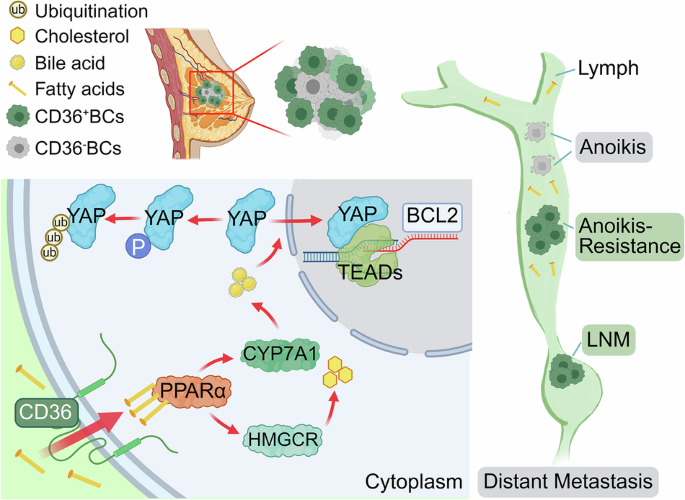
Scientists have discovered a key mechanism behind how breast cancer spreads to lymph nodes, identifying a crucial role for the protein CD36. Their research indicates that elevated levels of CD36 stimulate the Hippo-YAP signaling pathway, which in turn promotes resistance to anoikis, a form of programmed cell death that normally prevents detached cells from surviving and metastasizing.
Breast cancer remains a significant global health challenge. According to global cancer statistics, it accounts for a substantial proportion of cancer diagnoses and deaths worldwide. The process of metastasis, where cancer cells spread from the primary tumor to other parts of the body, is a major factor in the severity of the disease. Lymph nodes are often the first site of metastasis for breast cancer cells.
Prior studies have highlighted the importance of metabolic adaptation in cancer progression. Specifically, the ability of cancer cells to alter their metabolism to survive in new environments is crucial for metastasis. CD36, a scavenger receptor, plays a significant role in fatty acid uptake and metabolism. It has also been implicated in various cancers, including breast cancer. Now, new research sheds light on how CD36 influences breast cancer metastasis to lymph nodes.
The Hippo-YAP pathway is a signaling cascade involved in cell growth, proliferation, and survival. When activated, the YAP protein enters the nucleus and promotes the expression of genes involved in cell survival and proliferation. Anoikis is a form of programmed cell death that is triggered when cells detach from the extracellular matrix. Cancer cells that are resistant to anoikis are more likely to survive and metastasize.
This study demonstrates that elevated CD36 levels in breast cancer cells activate the Hippo-YAP pathway. This activation leads to increased expression of genes that promote anoikis resistance, allowing cancer cells to survive and spread to lymph nodes. This finding suggests that targeting CD36 or the Hippo-YAP pathway could be a potential therapeutic strategy to prevent or reduce breast cancer metastasis. Further research is needed to validate these findings and to develop effective therapies based on this knowledge.