Earth's Atmosphere Is Leaking to The Moon, And Here's Why - Analysis
हिंदी में सुनें
Listen to this article in Hindi
New research reveals Earth's magnetic field transports atmospheric particles to the Moon, enriching the lunar surface with volatile elements over billions of years.
For eons, Earth has been generously donating parts of its atmosphere to the Moon, which essentially has none of its own. According to fresh findings, our planet's magnetic field may be the conduit, directing particles from our atmosphere onto the lunar surface.
Ever since the Apollo missions brought back lunar samples, scientists have been puzzled by the surprising amount of volatile elements detected in the lunar regolith – the fine dust and rocky material that blankets the Moon. While the solar wind could account for some of these volatiles, it doesn't explain the high concentrations, especially of nitrogen. Moreover, the constant bombardment of the lunar surface by micrometeorites could also be altering its composition.
Previously, some scientists suggested that Earth's atmosphere could be a source of these elements, but this was thought to be only possible before Earth developed its protective magnetic field. The assumption was that the magnetic field would trap most atmospheric particles.
That said, the reality is a bit more complicated. a new study by astrophysicists at the University of Rochester challenges that assumption. The team created computer models simulating two different scenarios: an early Earth without a magnetic field and a strong solar wind, and a modern Earth with a robust magnetic field and a weaker solar wind.
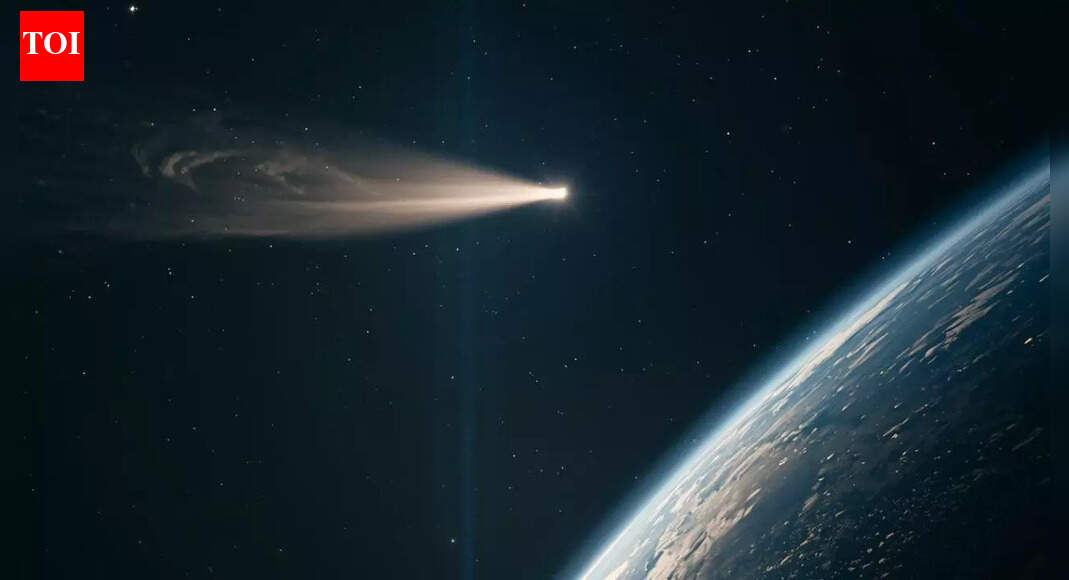
Surprisingly, the modern Earth model provided a better fit with the observed data. The process works like this: the solar wind strips charged particles from Earth's atmosphere, and these particles then travel along the planet's magnetic field lines. Because of the constant pressure from the solar wind, Earth's magnetosphere isn't a perfect sphere; instead, it resembles a comet's tail. As the Moon orbits Earth, it periodically passes through this magnetotail, during which particles are deposited onto the lunar surface.
Earlier research hinted at a similar mechanism by which oxygen could be delivered to the Moon, potentially leading to the formation of water and even rust.
The latest study indicates that this process has been occurring for billions of years, allowing significant quantities of volatile particles to accumulate in the lunar regolith. Furthermore, given the substantial changes in Earth's atmosphere over this vast timescale, the lunar surface may hold a valuable record – essentially a time capsule – of our planet's atmospheric history.
The findings were published in the journal Nature Communications Earth & Environment.