Unlocking the Secrets of Baby Dinosaurs: How Armored Protection Starts at Birth
हिंदी में सुनें
Listen to this article in Hindi
Fossil analysis reveals that Liaoningosaurus paradoxus hatchlings possessed armored features, challenging previous assumptions about armored dinosaur development.
The world of paleontology is often one of piecing together fragments of the past, and sometimes, the smallest pieces hold the biggest secrets. For years, paleontologists have been puzzled by a collection of diminutive dinosaur fossils belonging to the species *Liaoningosaurus paradoxus*, an ankylosaur – a group of herbivorous, quadrupedal dinosaurs known for their distinctive body armor. Measuring less than 40 centimeters long, these specimens were complete, yet no larger, adult versions of the species were ever found alongside them. This led to speculation: were these truly a rare, small-bodied species of ankylosaur, or were scientists misinterpreting the evidence?
A new study published in the *Journal of Vertebrate Paleontology* has finally resolved this debate, revealing that these fossils are, in fact, the remains of baby ankylosaurs. This discovery provides a rare glimpse into the early life stages of these armored giants and sheds light on the development of their iconic armor.
The mystery surrounding *Liaoningosaurus paradoxus* began in 2001 when the fossils were first described. Found in Liaoning Province, northeastern China, a region renowned for its exceptionally well-preserved Cretaceous fossils, these specimens presented a unique challenge. The absence of larger individuals led to various hypotheses, including the possibility of a dwarf species or even an aquatic lifestyle. Determining the true age of these fossils became crucial to understanding their place in the ankylosaur family tree.
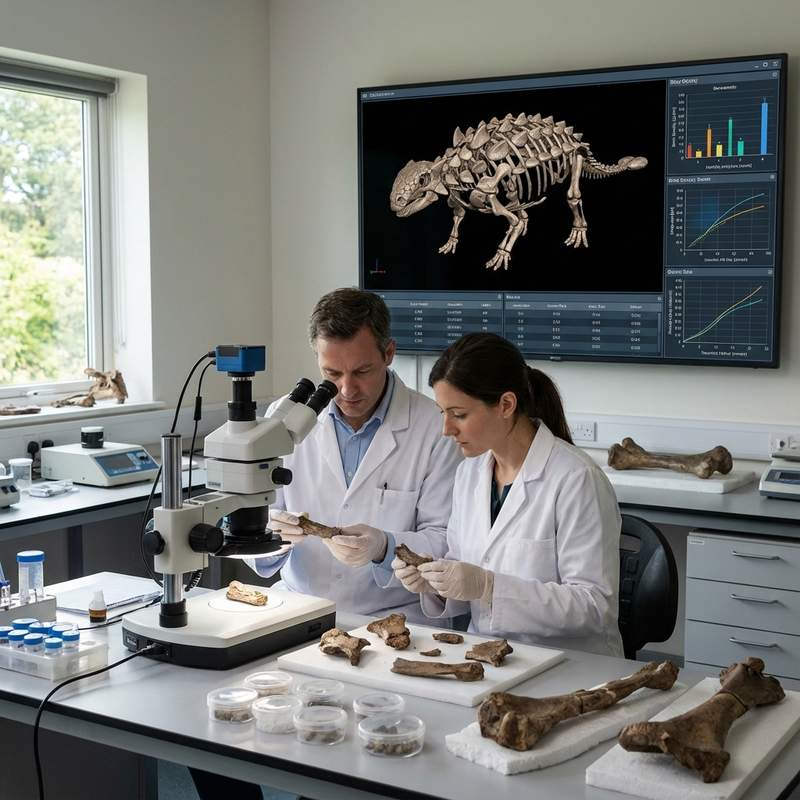
To solve the puzzle, researchers turned to the microscopic analysis of bone tissue. Like trees, bones grow in layers, forming growth lines that can indicate age. By examining thin sections of bone from both the largest and smallest *Liaoningosaurus* specimens, the team found a surprising result: neither bone showed any growth lines. This indicated that both dinosaurs were less than a year old at the time of their death. Further analysis of the smallest fossil revealed a key feature: a 'hatching line,' a ring-like structure formed in the bone at the time of hatching. This confirmed that the smallest specimen was a very recent hatchling, making it the youngest ankylosaur ever discovered.
This finding has significant implications for our understanding of ankylosaur development. Adult ankylosaurs are characterized by their extensive armor plating, composed of bony plates called osteoderms embedded in the skin. Because fossils of young ankylosaurs are rare and often lack visible armor, some scientists previously believed that armor developed later in life. That said, the reality is a bit more complicated. the *Liaoningosaurus* fossils show that even at a very young age, these dinosaurs already possessed early armor features. This suggests that the development of armor began soon after hatching, providing protection from predators from the earliest stages of life.
The exceptional preservation of fossils from Liaoning Province provides a unique window into the Cretaceous Period, a time when shallow lakes and frequent volcanic eruptions created ideal conditions for fossilization. Volcanic ash rapidly buried organisms, preserving fine details that are rarely seen elsewhere. This allowed researchers to observe the presence of early armor features in the *Liaoningosaurus* hatchlings, features that might have been lost in less well-preserved specimens. Understanding the ancient ecosystems like the one preserved in Liaoning Province is crucial to interpreting the fossil record and reconstructing the lives of extinct animals.
While this discovery sheds new light on ankylosaur development, it also raises further questions. For instance, what specific genes controlled the development of armor in these dinosaurs? How did the armor change as the animals grew into adulthood? Finding an adult *Liaoningosaurus paradoxus* specimen would be a major step forward, allowing scientists to compare the anatomy of adults and babies of the same species and track the development of key features over time. Until such a discovery is made, the *Liaoningosaurus* hatchlings remain a valuable source of information about the early life of these fascinating armored dinosaurs. The study also underscores the importance of studying bone microstructure, a technique that can reveal hidden details about the age and growth of extinct animals. This kind of analysis is vital for paleontologists as they work to piece together the complex story of life on Earth. For more information on dating fossils, see [Science basics explainer].
This research highlights how even seemingly insignificant fossils can hold vital clues to understanding the evolution and development of extinct creatures. By combining careful observation, advanced analytical techniques, and a deep understanding of geological context, paleontologists continue to unlock the secrets of the past and reveal the remarkable story of life on Earth. This study fits into the broader context of understanding dinosaur growth and development, a field that has seen many advancements in recent years. To learn more about related research, see [Prior research background].
Editor’s note: This article was independently written by the Scoopliner Editorial Team using publicly available information.