Unveiling the Physics Behind NASA's Cosmic Christmas Tree: A Multi-Wavelength Perspective
हिंदी में सुनें
Listen to this article in Hindi
NASA's 'Christmas Tree' nebula combines X-ray and optical data, revealing star formation processes and the power of multi-wavelength astronomy. We break down the science.
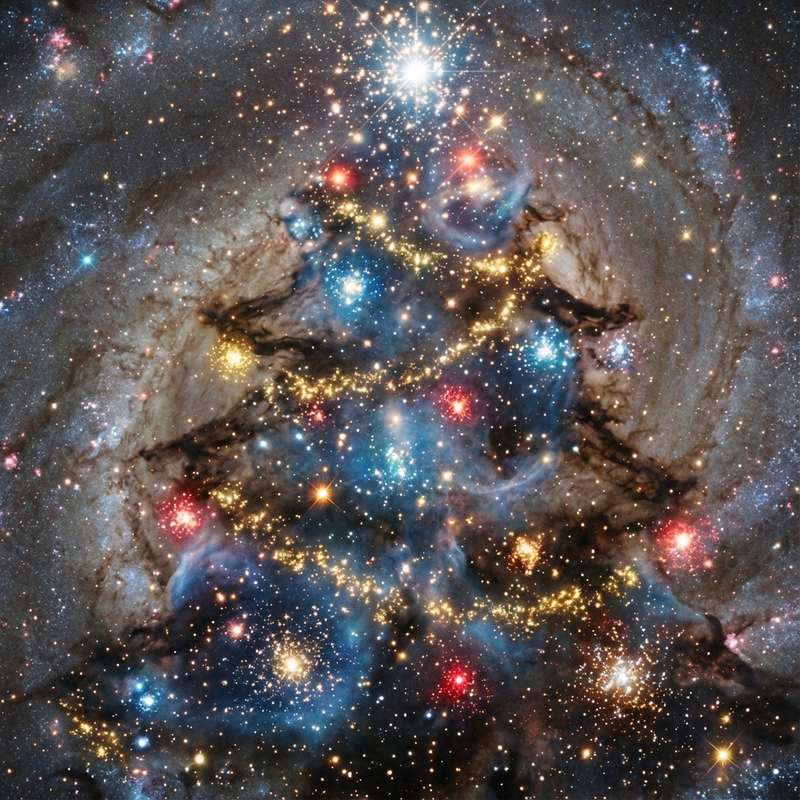
The holiday season brought a striking image from NASA: a cosmic 'Christmas Tree' formed by the nebula NGC 2264. This isn't just a pretty picture; it's a powerful demonstration of how combining different types of astronomical data can reveal hidden aspects of star formation and the dynamics of interstellar gas. The image merges data from the Chandra X-ray Observatory with optical data, showcasing the power of multi-wavelength astronomy. But what does this actually mean, and what can we learn from it?
At its heart, the image represents a region of active star formation. Nebulae like NGC 2264 are giant clouds of gas and dust, the birthplaces of stars. Gravity causes these clouds to collapse, and as the material compresses, it heats up and eventually ignites nuclear fusion, marking the birth of a star. This process isn't uniform; it happens in clumps and filaments, creating the intricate structures we observe in nebulae. Understanding star formation is key to understanding galactic evolution, as stars are the building blocks of galaxies and influence their surrounding environments. (See our explainer on Science basics explainer).
The 'Christmas Tree' image highlights two key types of light: optical and X-ray. Optical light is the kind we see with our eyes – the visible spectrum. The optical data in this image, captured by astrophotographer Michael Clow’s telescope, reveals the 'pine needle' formation of the nebula, composed of glowing hydrogen gas. This gas is ionized, meaning its atoms have lost electrons, usually due to the intense radiation from nearby young stars. These stars emit copious amounts of ultraviolet light, which strips electrons from the hydrogen atoms. When these electrons recombine with the atoms, they emit light at specific wavelengths, creating the vibrant colors we see.
X-rays, on the other hand, are a form of high-energy electromagnetic radiation that is invisible to the human eye. The Chandra X-ray Observatory is designed to detect these X-rays, which are emitted by extremely hot and energetic objects. In the 'Christmas Tree' image, the X-ray data reveals the locations of young, hot stars within the cluster. These stars emit X-rays from their coronas, the outermost layers of their atmospheres, which are heated to millions of degrees by magnetic activity. By studying the X-ray emission, astronomers can learn about the temperature, density, and magnetic fields of these stellar coronas, as well as the rate at which the stars are spinning. Because X-rays can penetrate through much of the interstellar gas and dust that blocks optical light, X-ray observations can also reveal stars that are hidden from view in optical images.
The combination of optical and X-ray data provides a much more complete picture than either type of data could provide alone. The optical data reveals the overall structure and composition of the nebula, while the X-ray data pinpoints the locations and properties of the young stars within it. This allows astronomers to study the relationship between the stars and the nebula, and to understand how the stars are shaping their environment. This kind of multi-wavelength approach is increasingly important in astronomy, as it allows us to study celestial objects in greater detail than ever before. The broader field of astronomy leverages data from radio waves to gamma rays to achieve the most comprehensive understanding possible. (Read more on related field context).
It's important to remember that this image is a representation of data, not a photograph in the traditional sense. The colors are chosen to highlight different aspects of the data, and the image is processed to enhance details. While visually stunning, it's crucial to understand the scientific information it conveys. The colors themselves are assigned based on the intensity of the detected radiation within specific energy ranges. Red, purple, and white in the X-ray data denote different energy levels of the X-ray emissions.
One limitation of this type of study is the difficulty in determining the precise distances to stars and nebulae. Distance estimates are crucial for determining the intrinsic luminosity (brightness) of stars and the overall size and mass of nebulae. Uncertainties in distance can therefore affect our understanding of these objects. Furthermore, the image only captures a snapshot in time. Star formation is a dynamic process that unfolds over millions of years, so a single image can only provide a glimpse of a particular stage. (Prior research background can be found here).
Ultimately, NASA's cosmic 'Christmas Tree' serves as a beautiful reminder of the power of science to reveal the wonders of the universe. It highlights the importance of multi-wavelength astronomy in understanding star formation and the complex interplay between stars and their environment. While the image is visually appealing, its true value lies in the wealth of scientific information it contains, offering insights into the processes that shape our galaxy and the universe beyond.
Editor’s note: This article was independently written by the Scoopliner Editorial Team using publicly available information.