Comet 3I/ATLAS soon to reach closest to Earth, increased visibility in December: Best telescopes, viewing guide, and equipment costs revealed
हिंदी में सुनें
Listen to this article in Hindi
Comet 3I/ATLAS nears Earth on December 19, 2025. This interstellar visitor displays an unusual green glow. Scientists are eager to study its composition and origin. Observing this comet requires advanced telescopes. For those without equipment, observatories and digital tools offer viewing alternatives. This event provides a unique chance to learn about objects from beyond our solar system.
Synopsis
Comet 3I/ATLAS nears Earth on December 19, 2025. This interstellar visitor displays an unusual green glow. Scientists are eager to study its composition and origin. Observing this comet requires advanced telescopes. For those without equipment, observatories and digital tools offer viewing alternatives. This event provides a unique chance to learn about objects from beyond our solar system.
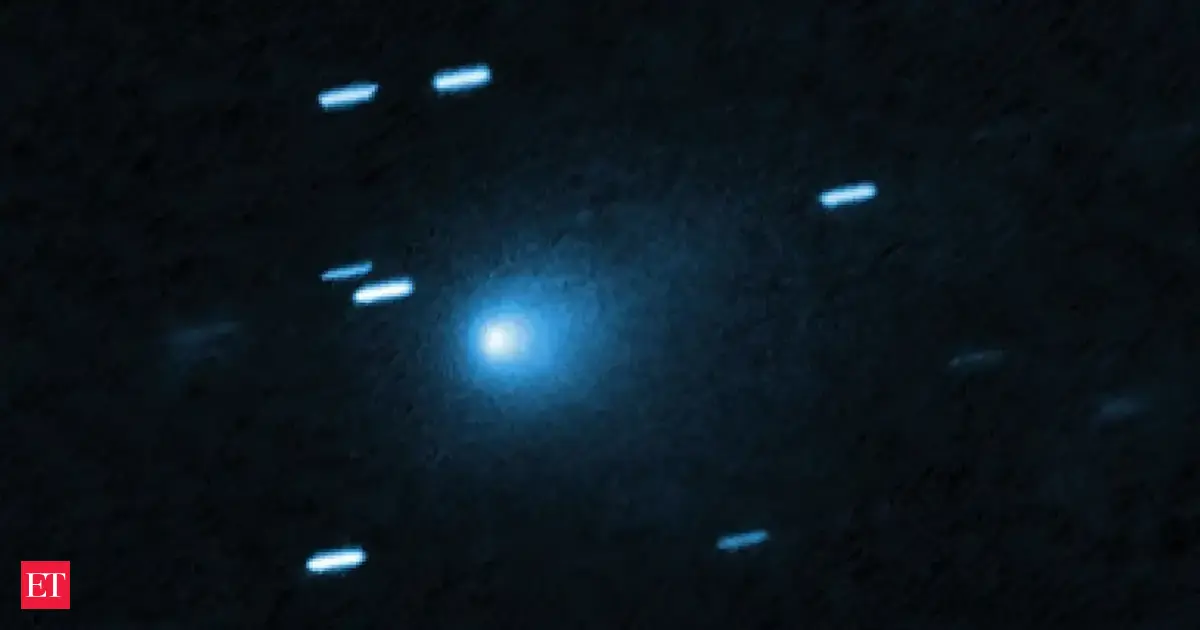
Comet 3I/ATLAS, discovered on July 1, 2025, by the ATLAS survey telescope in Rio Hurtado, Chile, nears its closest approach to Earth on December 19, 2025, at 270 million kilometers, over 700 times the Earth-Moon distance, sparking scientific intrigue with its unexplained green hue captured by astrophysicists Gerald Rhemann and Michael Jäger, atypical for interstellar objects. This interstellar visitor offers a rare observation window, prompting researchers to seek better images for insights into its origin and composition, distinct from solar system comets. Amateurs can join the quest, though its remoteness demands specific equipment for visibility.
Optimal telescopes for comet 3I/ATLAS observation
NASA recommends telescopes with at least a 30-centimeter aperture to spot 3I/ATLAS clearly, categorizing such devices as advanced for amateurs or semi-professionals due to their high costs and capabilities for deep-sky objects like galaxies, clusters, and nebulae.
The Celestron StarSense Explorer 12-inch Dobsonian telescope exemplifies suitability, integrating smartphone automation for guiding and delivering sharp images of faint targets, priced at approximately $1,599.
Comparable models generally range from $1,000–$2,000, while high-end, transportable or computerized systems can exceed $2,500, balancing aperture size, tracking precision, and portability for tracking the comet's trajectory.
Viewing alternatives and digital tools
For those unable to invest in hardware, observatories provide access to professional setups, ensuring safe and enhanced views without personal expense.
Live Events
NASA's ‘Eyes on the Solar System’ simulator offers real-time tracking of 3I/ATLAS's location and path, while apps like Stellarium and SkySafari display its position dynamically, aiding planning even from light-polluted areas.
The comet's green glow defies typical interstellar chemistry, fueling debates on its makeup as it hurtles through our system, with December 19 marking peak study potential before it recedes.
Observations contribute to global data pools, potentially resolving compositional puzzles via spectra from large apertures. Enthusiasts should prioritize dark skies and stable mounts for this transient event.
FAQs
Why a 30cm aperture minimum for 3I/ATLAS?
Its great distance dims it significantly; smaller scopes lack light-gathering power for interstellar faintness at 270 million km.
What makes the Celestron StarSense ideal?
12-inch Dobsonian offers ample aperture plus phone-guided tracking for precise comet following amid deep-sky distractions.
Are cheaper alternatives viable?
Basic scopes under 30cm may glimpse it poorly; opt for observatories or simulators like Eyes on the Solar System for reliable access.
How a star-studded IndiGo board preached governance, but failed to walk the talk
Kwality Walls is on its own now. Can it take on Amul, Hatsun?
When United Spirits’ spins off RCB, will it give stake to shareholders like CSK?
Costly courses, young minds misled by false promises: Sebi unmasks trading ‘guru’
Stock Radar: Bajaj Finserv stock bounces back after taking support above lower band of triangle formation; time to buy?
These large-cap stocks have ‘strong buy’ & ‘buy’ recos and an upside potential of more than 25%
1
2
3