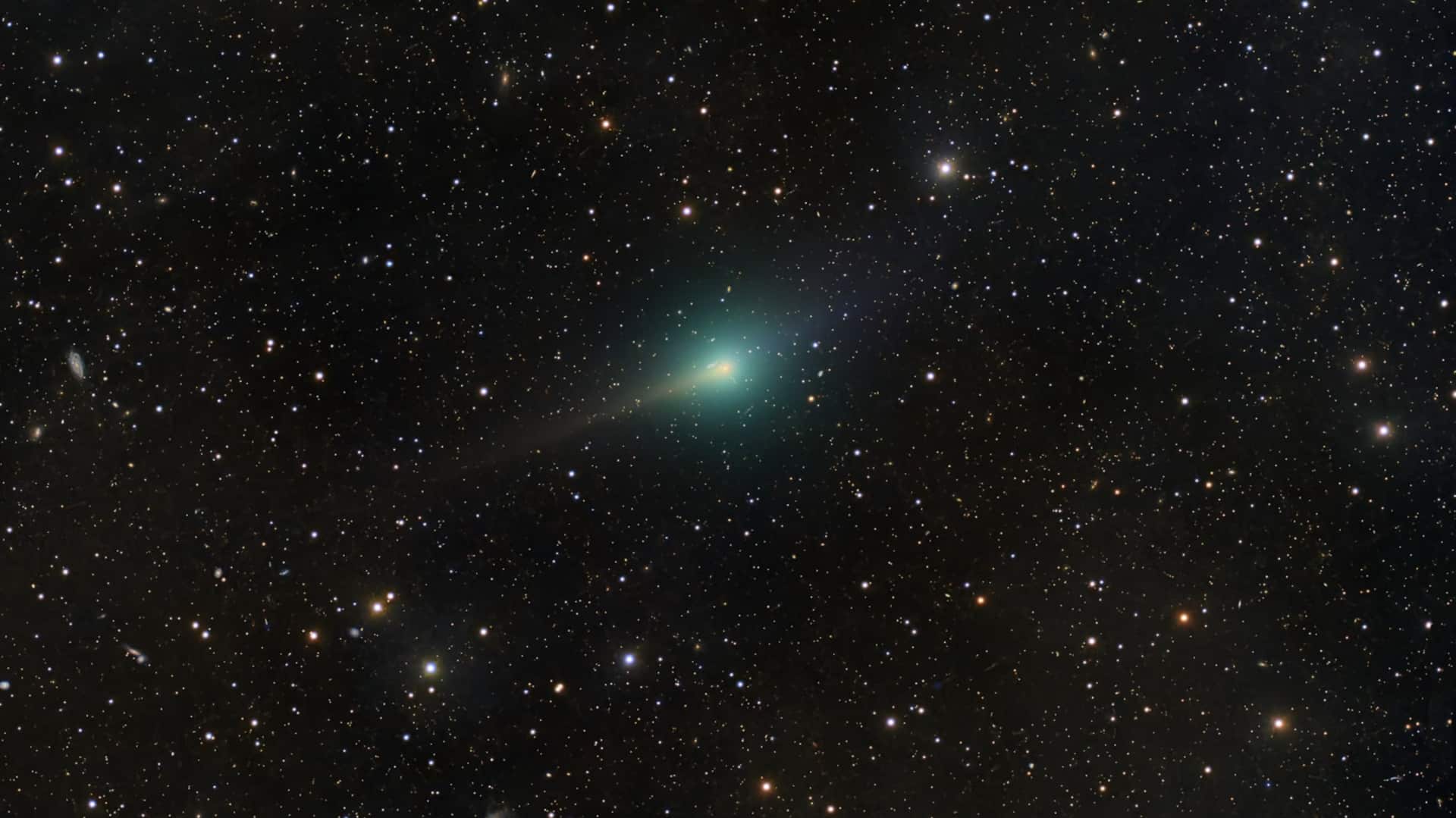
Comet 3I/ATLAS: NASA Details on the Interstellar Visitor That Briefly Passed Earth
हिंदी में सुनें
Listen to this article in Hindi
NASA shares facts about Comet 3I/ATLAS, an interstellar object that briefly visited our solar system, offering a rare glimpse into other star systems.
Comet 3I/ATLAS, an icy object originating from outside our solar system, recently made a brief visit, marking only the third time such an interstellar traveler has been observed. This rare occurrence provides scientists with a unique opportunity to study material from another star system. Discovered in July 2025, 3I/ATLAS has generated considerable interest due to its speed, trajectory, and composition, potentially offering insights into the formation and evolution of other solar systems.
According to experts, the comet posed no threat to Earth during its passage. That said, the reality is a bit more complicated. its short visit allowed for the collection of valuable data, bringing us closer to understanding the vast expanse of the Milky Way.
What is Comet 3I/ATLAS?
Comet 3I/ATLAS is classified as an interstellar comet, meaning it originated from a star system other than our own. It follows 'Oumuamua (2017) and 2I/Borisov (2019) as only the third such object ever detected. Astronomers identified it as a comet due to its icy nucleus and the presence of a coma, a cloud of gas and dust that forms as the comet heats up near the Sun. Its characteristics align with those predicted for comets, despite its origin in a different stellar system.
Discovery and Naming of 3I/ATLAS
The ATLAS survey telescope in Rio Hurtado, Chile, funded by NASA, discovered the comet on July 1, 2025. The discovery was then reported to the Minor Planet Center, which catalogs new space objects. The name 3I/ATLAS reflects the comet's significance. The '3' indicates it's the third interstellar object found, 'I' signifies its interstellar nature, and 'ATLAS' refers to the telescope system responsible for its discovery. ATLAS is part of NASA’s planetary defense network, which monitors the skies for potentially hazardous objects.
Size and Physical Properties
The precise size of 3I/ATLAS remains uncertain. That said, the reality is a bit more complicated. observations from the Hubble Space Telescope on August 20, 2025, suggest its nucleus is between 1,400 feet and 3.5 miles (approximately 440 meters to 5.6 kilometers) in diameter. As the comet approaches the Sun, the ice on its surface vaporizes, releasing gas and dust. This creates a visible coma around the nucleus, confirming its cometary nature and distinguishing it from an asteroid.
Speed and Trajectory
One key indicator of 3I/ATLAS's interstellar origin is its extreme speed. Initially observed traveling at 221,000 kilometers per hour (137,000 miles per hour), its speed increased as it neared the Sun due to gravitational forces, reaching approximately 246,000 kilometers per hour (153,000 miles per hour) at perihelion. The comet follows a hyperbolic orbit, indicating it's moving too rapidly to be bound by the Sun's gravity. Consequently, it's only a temporary visitor to our solar system and will eventually return to interstellar space at its original velocity.
Origin of 3I/ATLAS
Scientists believe 3I/ATLAS originated in another star system and was ejected into interstellar space due to gravitational interactions. It has likely been traversing the space between stars for an extended period. The comet entered our solar system from a distant region of space, specifically from the direction of the constellation Sagittarius, near the Milky Way's center. It was detected while still relatively far out, within Jupiter's orbit.
Significance of 3I/ATLAS
Comet 3I/ATLAS presents a rare opportunity to study the composition of a celestial object formed around a different star. Its composition and behavior may differ significantly from comets within our solar system. Analyzing these differences can provide valuable insights into the formation of planetary systems elsewhere in the galaxy. Although its journey through our solar system is fleeting, the data gathered during its flyby will significantly enhance our understanding of the diverse objects populating the universe beyond our Sun.