Maintaining Psychological Well-being: The Science of Holiday Celebrations in Space
हिंदी में सुनें
Listen to this article in Hindi
Exploring how holiday celebrations on the International Space Station support astronaut well-being and team cohesion during long-duration missions.
The vastness of space presents unique challenges, not just in engineering and physics, but also in psychology. For astronauts aboard the International Space Station (ISS), months spent orbiting Earth can lead to feelings of isolation and detachment. While mission control focuses on the technical aspects of keeping the station running, a crucial, often overlooked element is maintaining the crew's psychological well-being. Holiday celebrations, it turns out, play a vital role in this effort.
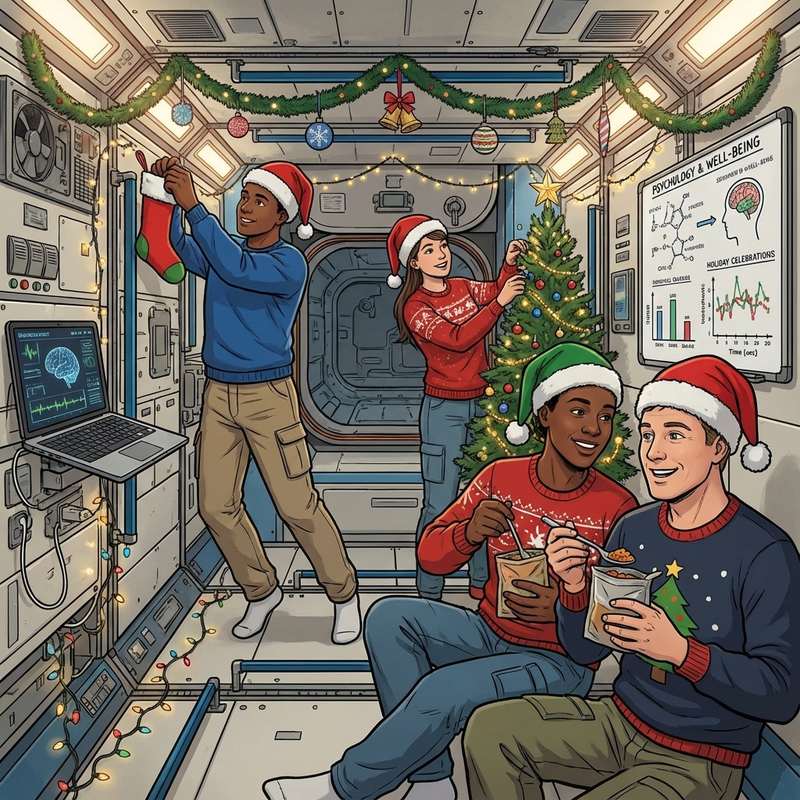
Imagine spending Christmas hurtling through space at nearly 18,000 miles per hour. The absence of familiar sights, sounds, and, most importantly, loved ones, can take a toll. NASA and its international partners recognize this and actively support holiday traditions on the ISS. These celebrations aren't just about festive decorations and special meals; they are carefully curated events designed to foster a sense of community, connection, and normalcy in an otherwise extraordinary environment.
The tradition dates back to the early days of space exploration. From Apollo 8 astronauts reading from Genesis on Christmas Eve in 1968 to Skylab crews constructing makeshift trees from food cans, the desire to mark these special occasions has been a constant. More recently, astronauts have exchanged small gifts, decorated modules with homemade decorations, and shared video calls with their families back on Earth. Special cargo deliveries often include holiday treats, providing a taste of home thousands of miles away.
But why are these celebrations so important? The key lies in understanding the psychological impact of long-duration spaceflight. Astronauts face numerous stressors, including confinement, isolation, altered day-night cycles, and the constant pressure of performing complex tasks in a high-stakes environment. These stressors can lead to decreased mood, impaired cognitive function, and strained interpersonal relationships within the crew. Holiday celebrations offer a much-needed respite from these pressures.
Rituals and traditions provide a sense of structure and predictability, which can be particularly valuable in the highly regimented environment of the ISS. They offer opportunities for crew members to connect with each other on a personal level, fostering a sense of camaraderie and shared identity. Sharing a meal, exchanging gifts, or even just decorating a module together can strengthen bonds and improve team cohesion. Moreover, these celebrations allow astronauts to maintain a connection to their lives and cultures back on Earth, mitigating feelings of isolation and homesickness. This is crucial for maintaining mental health during extended missions. Understanding the science of maintaining mental health is a key component of successful space exploration.
The impact of these celebrations extends beyond individual well-being. A cohesive and well-functioning crew is essential for mission success. Strained relationships and decreased morale can lead to errors, miscommunications, and even safety risks. By fostering a positive and supportive environment, holiday celebrations contribute to a more effective and resilient team. The principles of team dynamics in extreme environments are applicable in many contexts, from submarine crews to Antarctic research stations.
That said, the reality is a bit more complicated. it's important to acknowledge the limitations of these celebrations. While they can provide a temporary boost to morale and well-being, they are not a substitute for comprehensive psychological support. Astronauts undergo extensive pre-flight training and receive ongoing counseling throughout their missions. Mission control maintains constant communication with the crew, monitoring their physical and mental health. Holiday celebrations are just one component of a broader strategy to mitigate the psychological challenges of spaceflight. Furthermore, the effectiveness of these celebrations may vary depending on individual personalities, cultural backgrounds, and the specific dynamics of the crew.
Looking ahead, as space missions become longer and more ambitious, the importance of psychological well-being will only increase. Future missions to Mars, for example, will require astronauts to spend years in isolation, far from Earth. Understanding how to maintain mental health in these extreme environments will be critical for mission success. Continued research into the psychological effects of spaceflight and the effectiveness of various interventions, including holiday celebrations, will be essential. Understanding the challenges of adapting to new environments is also crucial for understanding human evolution and adaptation. [Related field context]
So where does that leave things? while it may seem like a small detail, celebrating holidays on the ISS is a scientifically sound strategy for maintaining astronaut well-being and promoting team cohesion. These traditions offer a sense of normalcy, connection, and community in the face of the unique challenges of spaceflight. As we continue to explore the cosmos, understanding and addressing the psychological needs of our astronauts will be paramount. [Science basics explainer]
Editor’s note: This article was independently written by the Scoopliner Editorial Team using publicly available information.