Chandrayaan-3’s RAMBHA-LP Instrument Delivers Critical Discoveries On Moon’s Surface
हिंदी में सुनें
Listen to this article in Hindi
The RAMBHA-LP experiment was designed and developed by the Space Physics Laboratory (SPL) and Vikram Sarabhai Space Centre (VSSC), Thiruvananthapuram.
Hyderabad: Indian Space Research Organisation (ISRO) scientists have discovered that the area around the Moon’s south polar region is much more electrically charged than previously thought. This data was collected from Chandrayaan-3’s Vikram lander, which carried an instrument called Radio Anatomy of the Moon Bound Hypersensitive ionosphere and Atmosphere-Langmuir Probe (RAMBHA-LP). It measures the electrically charged particles (plasma) near the Moon’s surface.
What is plasma and why does it matter?
Plasma is a mix of charged particles, including ions and free-floating electrons. Although plasma is electrically neutral overall, it is highly conductive and responds strongly to electromagnetic fields.
The Moon’s electrical environment is not constant. It changes due to two main reasons.
Moon does not have a real atmosphere of its own, but sunlight and solar wind constantly strike its surface, creating a thin layer of plasma. Through the photoelectric effect, high-energy light from the Sun knocks electrons out of atoms from the Moon’s surface, adding more charged particles.
The second reason is that the Moon at times enters Earth’s magnetotail (its elongated magnetic field). During this period, charged particles from the Earth also reach the Moon and change the plasma around it. Notably, this happens for 3 to 5 days every month, making the Moon’s surface electrically charged.
The Moon’s electrically charged plasma can affect the communication signals, dust movement, and future lunar equipment and habitats. So understanding it is significant for future lunar missions.
What do the latest findings show?
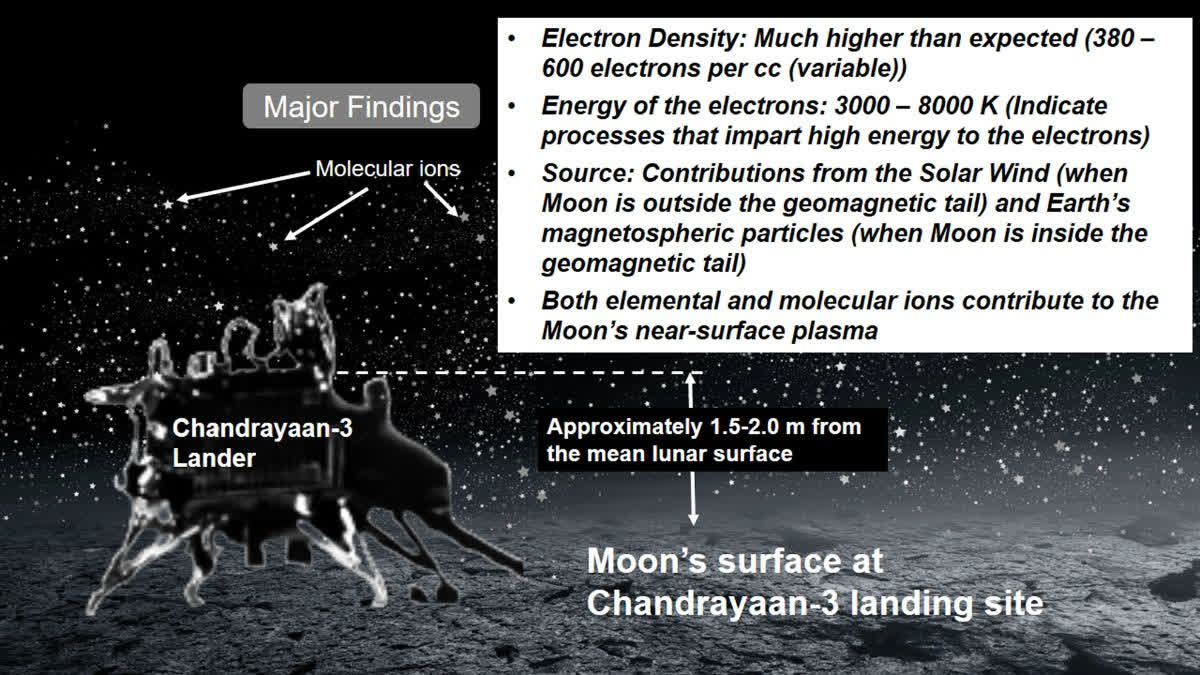
Chandrayaan-3 RAMBHA-LP’s latest findings are the first-ever direct low-altitude measurements of the lunar plasma. The key results showcase that the electron density near the landing site, Shiv Shakit point (69.3 degrees South, 32.3 degrees East), was measured between 380 and 600 electrons per cubic centimetre, which is much higher than earlier estimates from orbit.
RAMBHA-LP’s data also reveals that electrons close to the ground carry surprisingly high energies. Their kinetic temperatures were measured between 3,000 to 8,000 Kelvin, which is extremely hot in terms of energy, even though the Moon itself is cold.
Lunar plasma is dynamic
ISRO’s study uncovered that lunar plasma is not static but dynamic, because it is exposed to different sources of charged particles at different times.
When the Moon faces the Sun (lunar daytime), the lunar surface is directly hit by the solar wind, making its thin plasma layer more electrically charged.
When the Moon enters Earth’s magnetotail, it receives charged particles from this elongated magnetic field, adding more charged particles into the lunar plasma.
Lunar Ionospheric Model (LIM)
ISRO's Lunar Ionospheric Model (LIM) suggests that, apart from elemental ions, molecular ions (generated from gases like Carbon Dioxide, Water) also play a crucial role in creating the electrically charged layer near the lunar surface.