Cambodia counts the cost of its border war with Thailand
हिंदी में सुनें
Listen to this article in Hindi
Cambodia tallies the human and economic costs of its renewed border conflict with Thailand, including casualties, displacement, and economic disruption.
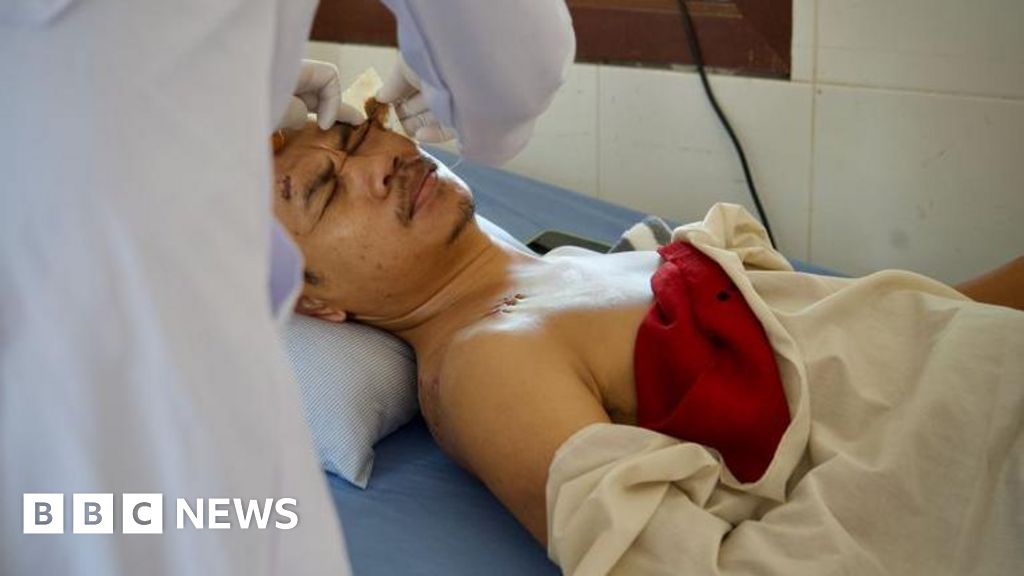
The human cost of the ongoing border war between Thailand and Cambodia is evident at the hospital in Mongkol Borei. In this breezy, tree-lined complex, wounded soldiers are recovering from their injuries.
One soldier who lost his arm sits with his wife, who offers him encouragement. Nearby, the family of another wounded soldier sits beside his bed. Anaesthetist Sar Chanraksmey, visibly shaken, shared graphic images of the blast injuries he has treated. "My heart aches," he said, pleading, "Please tell the world we just want peace."
This recent outbreak of fighting, the second in less than six months, has proven more destructive and lasted longer than the five-day war in July.
Fighting has included artillery exchanges along the 800km (500-mile) border and intense battles for control of hilltops. Thailand's air force has been bombing targets inside Cambodia, which lacks comparable air defenses. Cambodia has retaliated with BM21 rockets, which, despite early evacuations, killed a civilian and injured others on the Thai side of the border.
Casualty figures remain unclear. Cambodia has not released its military death toll since hostilities resumed on December 7th, but Thai estimates suggest it could be hundreds. Thailand has reported 21 soldier deaths, a disparity reflecting its larger and better-equipped armed forces.
The reasons behind the renewed conflict over disputed territory remain unclear. Thailand claims Cambodian forces ambushed a team of Thai engineers on December 7th, injuring two soldiers. The Cambodian government accuses Thai Prime Minister Anutin Charnvirakul of reigniting the war for political gain in the upcoming general election.
This time, the Thai military seems determined to continue fighting until the Cambodian army no longer poses a threat at the border. They have rejected ceasefire calls from Cambodia and appeals from international figures, including then-President Trump.
The Thai military insists that Cambodia cannot be trusted to honor a ceasefire without suffering greater losses than in July.
Evidence of Thailand's approach can be seen in Pursat province, where a bridge over the Me Teuk river was damaged. On December 13th, Thai F-16 jets bombed the Chinese-built bridge, destroying a 20-meter section. They also targeted an eight-story building near a casino, alleging it was used as a military command post.
This attack prompted an exodus of Chinese nationals. These individuals, seen hauling luggage and electronics across the old bridge, were likely fleeing scam compounds operating in the border area. Cambodian officials claimed they worked at a hydroelectric power station, but their appearance suggested otherwise. The Cambodian government's association with these scam operations undermines its calls for international sympathy, and Thailand has targeted these complexes in its military campaign.
While the Cambodian government claims to be addressing the scam centers, their proliferation and links to powerful Cambodian figures raise doubts about their sincerity.
Cambodia is actively seeking international sympathy and a return to the July ceasefire through international mediation. Peace appeals are visible throughout Cambodian cities, reflecting the sentiment of many Cambodians.
The conflict's economic impact is significant. Over 700,000 migrant workers have returned from Thailand due to fears of hostility. Approximately 480,000 Cambodians have been displaced. The $5 billion border trade with Thailand has ceased, impacting communities on both sides. Furthermore, the global crackdown on online fraud threatens a scam industry estimated to contribute significantly to Cambodia's economy.
Since President Trump's intervention in July, Thailand's attitude towards Cambodia has hardened. The leaking of a private phone call by Hun Sen, which ignited a political crisis in Thailand, and evidence of Cambodian soldiers laying landmines during the ceasefire soured public sentiment. Efforts to revive the ceasefire have been rejected by the Thai prime minister.
A restaurant owner in Surin, Thailand, noted the increased suspicion towards Cambodians compared to the conflict 14 years ago, attributing it to inflammatory social media posts. This makes it difficult for leaders to appear conciliatory, especially in Thailand, where elections are approaching. No party supports a ceasefire.
Thailand accuses Cambodia of playing the victim by seeking outside intervention, while Cambodia accuses Thailand of bullying. These long-standing stereotypes have intensified, making it difficult to rebuild trust between the two nations.