Bondi beach terror attack: father and son duo alleged to be behind shooting using licensed firearms
हिंदी में सुनें
Listen to this article in Hindi
Police allege a father and son used legally obtained firearms in a deadly terror attack at Bondi beach, killing 15 and injuring dozens.
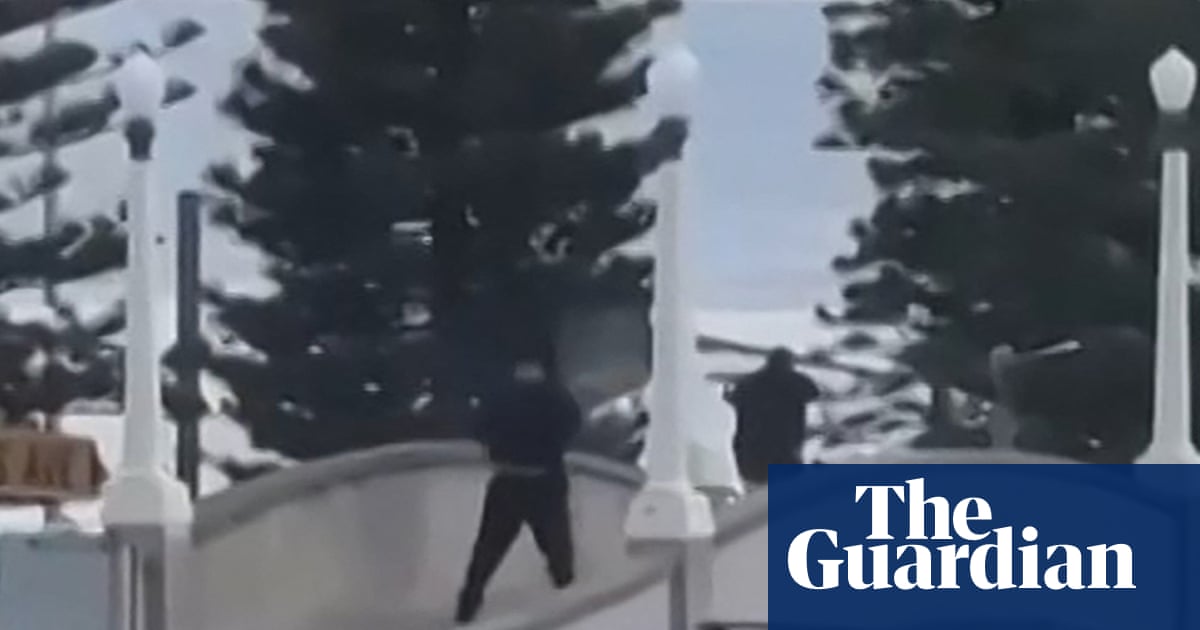
A father and son are suspected by police to be the gunmen responsible for the Bondi beach attack. Authorities believe they used legally acquired firearms in the massacre.
Naveed Akram, 24, was apprehended at the scene and is currently hospitalized in Sydney with critical injuries. His father, Sajid Akram, 50, was killed by police. The Sydney Morning Herald first reported the father's name, but police have not yet officially confirmed the identities of either man.
The pair allegedly killed 15 people and injured dozens more in the Sunday shooting, which occurred during a Hanukah celebration.
Authorities confirmed on Monday that the son was known to New South Wales police and other agencies. The father possessed a firearms licence and had six weapons registered to him. Police have recovered all six weapons.
At least three of the weapons, believed to be long arms including a rifle and shotgun, were seized at the Bondi crime scene. Additional weapons were discovered during a police raid at a house in Campsie, located in Sydney’s south-west.
NSW Police Commissioner Mal Lanyon stated that the men had previously resided in a house in Bonnyrigg, also raided on Sunday night.
Commissioner Lanyon said there was no prior indication that either man was planning the attack. He also confirmed that the elder Akram had held a gun licence for ten years.
NSW Premier Chris Minns indicated that changes to gun laws would “almost certainly” be implemented. Police are investigating potential failures in their systems regarding how licensed weapons could be used in a terror attack.
While police have released details about the ages of the suspects, the suburb where they lived, and information about the father’s firearms licence, they have not officially confirmed their names to Guardian Australia.
Police confirmed that Sajid Akram held a Category AB firearm licence. This type of licence requires the holder to demonstrate a “special need” for specific weapons, including muzzle-loading firearms (excluding pistols), centre-fire rifles (excluding self-loading), and shotgun/centre-fire rifle combinations.
Commissioner Lanyon declined to comment on ABC reports that Naveed Akram was identified in a 2019 counter-terror investigation involving an Islamic State cell. He also did not comment on reports that a manifesto or black Islamic State flag were found in the car used by the alleged attackers.
Premier Minns stated that it was too early to determine whether intelligence held by federal authorities was not properly shared with NSW police.
“There’s a sequence here that’s important. Firstly, community safety, secondly, the investigation – there’s an offender in custody that prosecution is hugely important in terms of justice for the victims. And of course, a comprehensive investigation as to what went wrong,” Minns said.
**Former Colleague Recounts Work Interactions**
Until recently, Naveed Akram worked as a bricklayer.
A former colleague told the Guardian that he had worked with Akram on various job sites for approximately five years, with their last interaction occurring a few months ago. He described Akram as a strange but diligent worker with an interest in hunting.
“No one was close to him,” the former colleague said, requesting anonymity.
“You spend a lot of time together, obviously bricklaying – [which is a] pretty mind-numbing job, so you do a lot of talking, but he was just a weird operator.
“He … worked hard, wouldn’t have days off.”
Although authorities have not confirmed that the son possessed a firearms licence, the colleague claimed that Akram regularly hunted and spoke about shooting rabbits and other game near Crookwell, located in the state’s southern tablelands.
They worked across Sydney, with their last job together being on a site in Penrith.
According to the colleague, Akram informed their boss just weeks ago that he had broken his hand and would be unable to work until 2026.
Unconfirmed reports also suggest that Akram was a member of a hunting club, with images circulating of what appears to be a membership card allegedly found in his wallet. Membership in the club has not yet been verified.
In a social media post on Sunday night, the club announced its closure until January 15.
When the Guardian visited the club's listed address on Monday morning, the building was empty except for a ute parked outside.
Shortly after the attack, an old photo of Naveed Akram, originally posted by Sheikh Adam Ismail, head of the Al-Murad Institute, went viral. Ismail distanced himself from Akram, stating that he had not seen him since 2022.
“As I’ve done with 1,000s of students over the years, I’ve taught him Qur’an recitation and Arabic only for a combined period of one year. These were the only subjects I taught him, and they are the areas I specialise in,” he said.
Ismail expressed his deep sadness regarding the events and offered his condolences to the victims and the Jewish community.
“What I find deeply ironic is that the very Qur’an … clearly states that taking one innocent life is like killing all of humanity. This makes it clear that what unfolded yesterday at Bondi is completely forbidden in Islam.”
**Community Reaction in Bonnyrigg**
On Monday morning, reporters and police gathered outside the Bonnyrigg home, which remained cordoned off with blue tape. Two police cars were parked in front.
Around noon, three people returned to the house, which is owned by Naveed’s mother. A young man and two women, shielding their faces with paper to avoid being filmed, exited a car and entered the house.
Glenn Nelson, a resident of 37 years who lives across the street, described the area as quiet.
“My wife [calls it] ‘boring old Bonnyrigg’,” he told Guardian Australia from his front lawn.
He was watching news coverage of the attack when he noticed a commotion on the street around 9:30 pm Sunday.
“I came into the lounge room to watch something else, and then saw traffic … and flashing lights,” he said.
Another resident said she received a phone call from her parents while at work, informing her of the activity on the street. She expressed shock upon learning that it was related to the Bondi attack.
“We’re so sad for what has happened,” she said. “I left a very dangerous country to be safe here.”
*In Australia, support is available at Beyond Blue on 1300 22 4636, Lifeline on 13 11 14, and Griefline on 1300 845 745. In the UK, the charity Mind is available on 0300 123 3393. Other international helplines can be found at befrienders.org*