Belarusian Leader Confirms Russia Deployed Nuclear-Capable Oreshnik Missile
हिंदी में सुनें
Listen to this article in Hindi
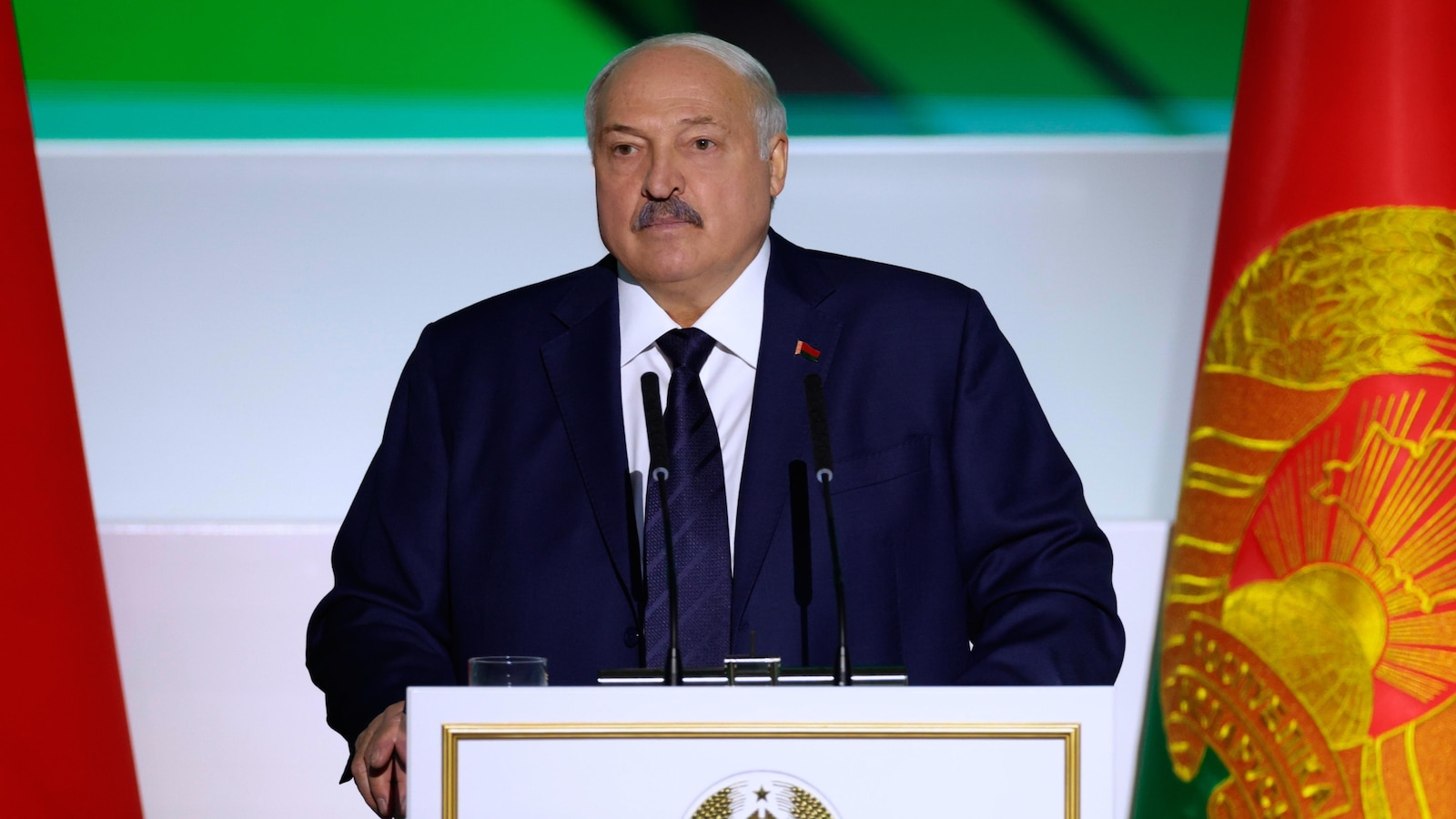
Belarusian President Lukashenko announced Russia has deployed its advanced Oreshnik missile system to Belarus amid tense Ukraine war negotiations.
Belarusian President Alexander Lukashenko stated on Thursday that Russia has positioned its newest nuclear-capable Oreshnik missile system within Belarus. This development occurs during a critical period in negotiations aimed at resolving the conflict in Ukraine.
According to Lukashenko, the Oreshnik intermediate-range ballistic missile system arrived in Belarus on Wednesday and has already been placed on combat duty. He did not specify the number of missiles deployed or provide further details.
Russian President Vladimir Putin had announced on Wednesday that the Oreshnik system would enter combat duty this month, also without elaborating. Putin's statement was made during a meeting with high-ranking Russian military officials, where he cautioned that Russia would seek to expand its territorial control in Ukraine if Kyiv and its Western allies reject the Kremlin's demands in ongoing peace talks.
The Oreshnik missile was initially tested by Russia in a conventional configuration in November 2024, targeting a Ukrainian factory. Putin has claimed the missile is impossible to intercept. He has also warned that Russia might use the Oreshnik against countries supporting Ukraine that permit strikes inside Russia using long-range missiles provided by those countries.
Putin has boasted about the Oreshnik's capabilities, stating that its multiple warheads can travel at speeds up to Mach 10 and are impervious to interception. He further claimed that a conventional strike using several Oreshnik missiles could inflict damage equivalent to a nuclear attack. Russian state media has claimed the missile could reach a Polish air base in 11 minutes and NATO headquarters in Brussels in 17 minutes. Currently, there is no way to determine whether the missile carries a nuclear or conventional warhead before impact.
Intermediate-range missiles have a range of 500 to 5,500 kilometers (310 to 3,400 miles). Such weapons were prohibited under a Cold War-era treaty that both the United States and Russia abandoned in 2019.
Previously, Russia has deployed tactical nuclear weapons to Belarus, using Belarusian territory as a launchpad for its full-scale invasion of Ukraine in February 2022. Lukashenko has stated that Belarus possesses several dozen Russian tactical nuclear weapons.
Putin and Lukashenko have previously indicated that the Oreshnik would be deployed to Belarus before the end of the year.
In December 2024, while signing a security agreement with Lukashenko, Putin stated that even with Russia maintaining control over the Oreshnik missiles, Belarus would be allowed to select targets. He noted that if the missiles were used against targets closer to Belarus, they could carry a significantly larger payload.
In 2024, the Kremlin updated its nuclear doctrine, stating that any conventional attack on Russia supported by a nuclear power would be considered a joint attack on Russia. This warning appeared intended to dissuade Western nations from allowing Ukraine to strike Russian territory with long-range weapons and seemingly lowers the threshold for potential Russian nuclear weapon use.
The updated Russian doctrine also extended Russia's nuclear umbrella to include Belarus.
Lukashenko has governed Belarus, a nation of 9.5 million people, for over three decades. His government has faced repeated sanctions from Western nations due to its human rights record and for enabling Moscow's use of Belarusian territory during the 2022 invasion of Ukraine.