Unraveling the Mysteries of Sagittarius B2: Insights from the James Webb Telescope
हिंदी में सुनें
Listen to this article in Hindi
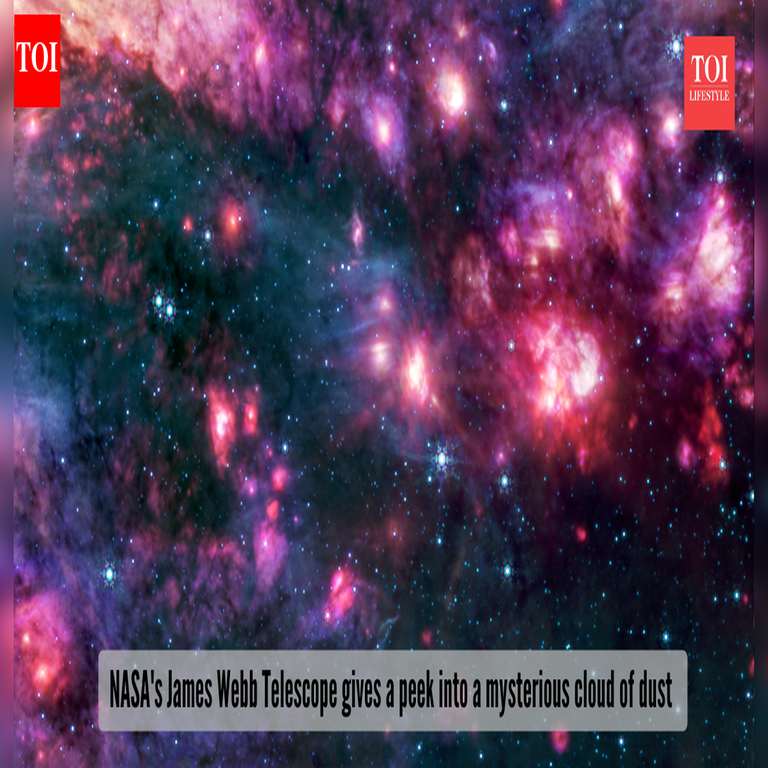
NASA's James Webb Telescope sheds light on the star-forming processes in Sagittarius B2, a molecular cloud near the Milky Way's center.
The recent observations made by the James Webb Space Telescope (JWST) have provided a clear view into Sagittarius B2, a massive molecular cloud located near the heart of the Milky Way. This region, situated approximately 26,000 light-years from Earth, is remarkable not only for its size—spanning about 150 light-years—but also for its significant role in star formation. Despite constituting only 10% of the gas in the galactic center, Sagittarius B2 is responsible for birthing roughly half of the stars in this area.
The findings from JWST challenge existing astrophysical theories that have long tried to explain star formation within our galaxy. This molecular cloud, which contains between 3 to 10 million solar masses of gas and dust, is a prime example of how certain regions can exhibit prolific star formation under conditions that are not entirely understood. The observations suggest that the physics governing star formation in environments like Sagittarius B2 may be more complex than previously thought.
One of the key insights from the JWST images is the identification of active star nurseries within Sagittarius B2. These areas are characterized by dense collections of gas and dust where new stars are being born. The telescope's infrared capabilities allow astronomers to see through the dust that typically obscures such processes, revealing the intricate structures and dynamics at play.
That said, the reality is a bit more complicated. while the JWST's findings are illuminating, they also raise important questions. For instance, what specific conditions within Sagittarius B2 enable such efficient star formation despite the low gas density compared to other regions? Additionally, how do these processes impact the broader galactic environment? These inquiries remain open for further investigation.
The implications of these observations extend beyond academic curiosity. Understanding star formation in regions like Sagittarius B2 can shed light on the life cycle of galaxies, including our own. As stars form and evolve, they contribute to the chemical enrichment of the galaxy, influencing the formation of planets and potentially supporting life.
Moreover, the extreme conditions near Sagittarius A*, the supermassive black hole at the center of the Milky Way, provide a unique laboratory for studying the limits of physics. The interplay between intense gravitational forces and star formation processes may offer insights into fundamental astrophysical phenomena.
In summary, the JWST's observations of Sagittarius B2 have not only provided stunning images but have also opened a new chapter in our understanding of star formation and galactic evolution. While the findings are significant, they also highlight the complexity of cosmic processes and the need for continued research in this area. As astronomers delve deeper into these questions, the hope is to uncover more about the universe's structure and the forces that govern it.
Editor's note: This article was independently written by the Scoopliner Editorial Team using publicly available information.