Triple Black Hole System Offers Window into Galaxy Evolution
हिंदी में सुनें
Listen to this article in Hindi
Astronomers discovered a rare triple black hole system, providing insights into galaxy mergers and black hole evolution. Learn about this unique cosmic arrangement.
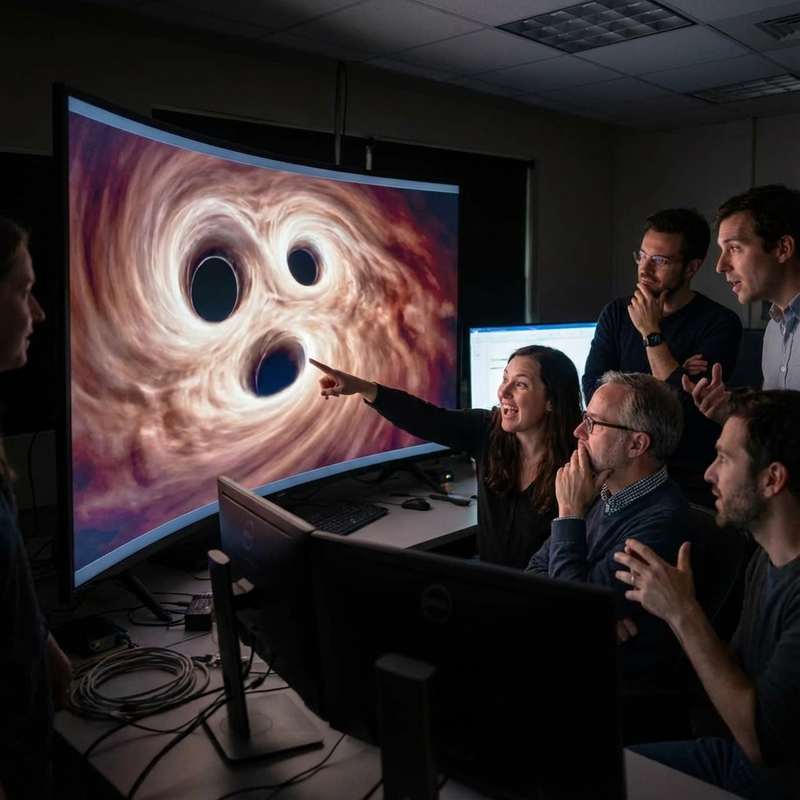
Galaxies, the sprawling islands of stars in the cosmos, are not static entities. They evolve, change, and often, collide. These galactic mergers are thought to play a crucial role in shaping the universe we see today, influencing star formation and the growth of supermassive black holes at galactic centers. Now, astronomers have discovered a rare and valuable cosmic laboratory for studying these processes: a triple black hole system residing within three merging galaxies.
The system, located approximately 1.2 billion light-years away and cataloged as J1218/1219+1035, consists of three galaxies locked in a gravitational dance. What makes this system particularly intriguing is that each of these galaxies hosts an active supermassive black hole, also known as an active galactic nucleus (AGN). These black holes are actively feeding on surrounding gas and dust, emitting intense radiation across the electromagnetic spectrum, including radio waves. It's this radio emission that allowed astronomers to confirm the existence of all three black holes.
Confirmation of this unusual configuration came through detailed observations using the National Science Foundation's Very Large Array (VLA) and Very Long Baseline Array (VLBA). These instruments detected compact radio cores within each galaxy, indicating the presence of actively accreting black holes. The radio spectra exhibited non-thermal synchrotron emission, a hallmark of AGN activity. By observing at multiple frequencies (3, 10, and 15 GHz), the team was able to distinguish the black hole activity from other potential radio sources, like star formation regions. Understanding how radio waves are used in astronomy is key to this type of discovery.
The significance of this discovery lies in the rarity of such triple AGN systems. While galaxy mergers are relatively common, directly observing three actively feeding supermassive black holes in a single system is exceedingly rare. This system provides a unique opportunity to test theories about galaxy evolution and the co-evolution of galaxies and their central black holes. The prevailing theory suggests that galaxy mergers funnel gas and dust towards the galactic centers, triggering bursts of star formation and fueling the growth of supermassive black holes. Observing three black holes simultaneously undergoing this process offers a richer dataset than studying single or binary systems.
The initial clues to this system's existence came from infrared data collected by NASA's Wide-field Infrared Survey Explorer (WISE). Unusual infrared emission signatures hinted at the presence of hidden, active black holes within the interacting galaxies. Optical spectroscopy confirmed activity in one galaxy but left the status of the other two uncertain. It was the detailed radio imaging that ultimately revealed the full picture. This highlights the importance of multi-wavelength astronomy – combining observations across different parts of the electromagnetic spectrum – to gain a complete understanding of complex astronomical phenomena. This discovery underscores the utility of surveys in astronomy for identifying unusual targets for follow-up studies.
While this discovery is exciting, it's important to acknowledge the limitations. The system is located 1.2 billion light-years away, meaning the light we observe today left the system 1.2 billion years ago. We are seeing a snapshot of the system's past, not its present state. Furthermore, while the radio observations confirm the presence of active black holes, further studies are needed to fully characterize their properties, such as their masses and accretion rates. Also, while this system is the first confirmed triple radio AGN, it's only the third known triple active nucleus system nearby. More such systems are needed to create a statistically meaningful sample for testing theoretical models. Understanding that science is a process is crucial in interpreting such findings.
Future observations are planned to further investigate this triple black hole system. Near-infrared imaging will be used to map the tidal structures of the merging galaxies, revealing the intricate gravitational interactions between them. X-ray observations will probe the high-energy emission from each black hole, providing insights into the accretion processes occurring around them. By combining these observations, astronomers aim to build a comprehensive picture of this rare and valuable cosmic laboratory.
So where does that leave things? the discovery of this triple black hole system represents a significant step forward in our understanding of galaxy mergers and black hole evolution. It underscores the power of multi-wavelength astronomy and the importance of large-scale surveys in uncovering rare and unusual astronomical objects. This system provides a unique opportunity to test theoretical models and gain deeper insights into the complex processes that shape the universe.
Editor’s note: This article was independently written by the Scoopliner Editorial Team using publicly available information.