Astronomers Spot Galaxies Moving in Sync Across a 50-Million-Light-Year Stretch
A global team has identified a 50-million-light-year cosmic filament with 14 galaxies rotating together—an enormous structure that challenges galaxy-formation models and reveals new insight into how galaxies gain their spin.
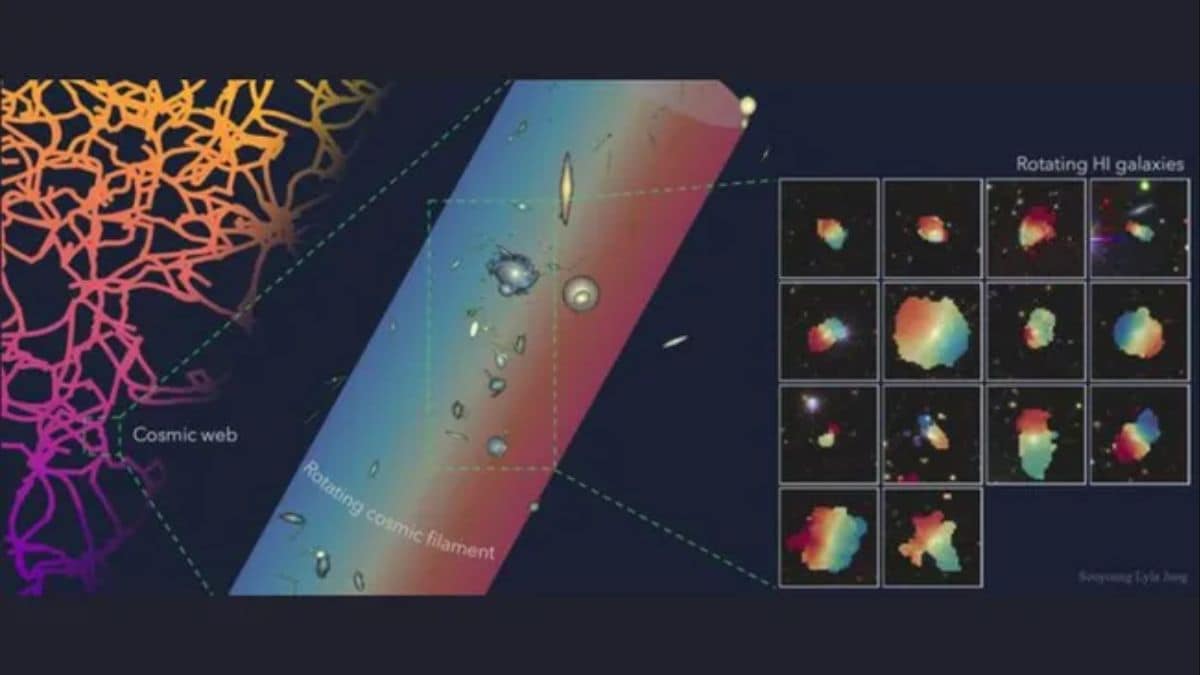
Scientists from across the globe have discovered one of the largest rotation systems in the cosmos: a 50-million-light-year-long cosmic filament with a chain of galaxies all spinning together. The 5.5 million light-year line of the cosmic filament, made up of dark matter and gas, is home to 14 gas-rich galaxies. The team followed the galaxies' movement and saw that the galaxies were all rotating along with the filament. The paper published in MNRAS today, the findings, changes the galaxy evolution models that are most widely accepted.
Discovery of a Giant Spinning Filament
According to the paper, astronomers have mapped a huge dark matter filament filled with galaxies about 140 million light years away. In the 50 million light-year structure, the team found 14 hydrogen-rich galaxies arranged in a 5.5 million light year chain. Incredibly, all these galaxies spin in the same direction as the filament, which is a lot of alignment for it to be just a coincidence. Galaxies on the far sides of the filament are going in opposite directions, which suggests the whole filament is spinning.
How Galaxies Gain Their Spin
This rotating filament offers a rare window into galaxy evolution. The filament appears young and “dynamically cold” – its galaxies are gas-rich, star-forming and moving slowly. Astronomers describe it as a “fossil record” of cosmic flows, which could reveal how angular momentum flows from the large-scale web into individual galaxies.