Cosmic Dust Storms Erupt After Major Celestial Crashes
हिंदी में सुनें
Listen to this article in Hindi
Astronomers have observed substantial dust clouds resulting from powerful collisions surrounding the star Fomalhaut, suggesting frequent planet formation events. Read more.
Violent impacts in a nearby star system have left behind enormous clouds of dust, according to recent astronomical observations. These findings provide insight into the tumultuous early stages of planetary formation. While major collisions are expected to be infrequent during the hundreds of millions of years it takes for planets to form, astronomers have now witnessed the aftermath of two such events near the star Fomalhaut within just a 20-year span.
These observations, if not coincidental, may indicate that collisions occur more often than previously thought as planets take shape. What makes these events particularly noteworthy is that they represent the first direct images of collisions between large objects outside of our own solar system. One event was initially detected in 2004, followed by another captured in 2023. The details of the 2023 observations have been published in the journal *Science*.
“We believe we’ve observed a collision between two comet-like bodies in the Fomalhaut system,” stated Maxwell Millar-Blanchaer, a coauthor and assistant professor of physics at UC Santa Barbara. He added that witnessing this fundamental evolutionary process in real-time within young planetary systems is quite rare.
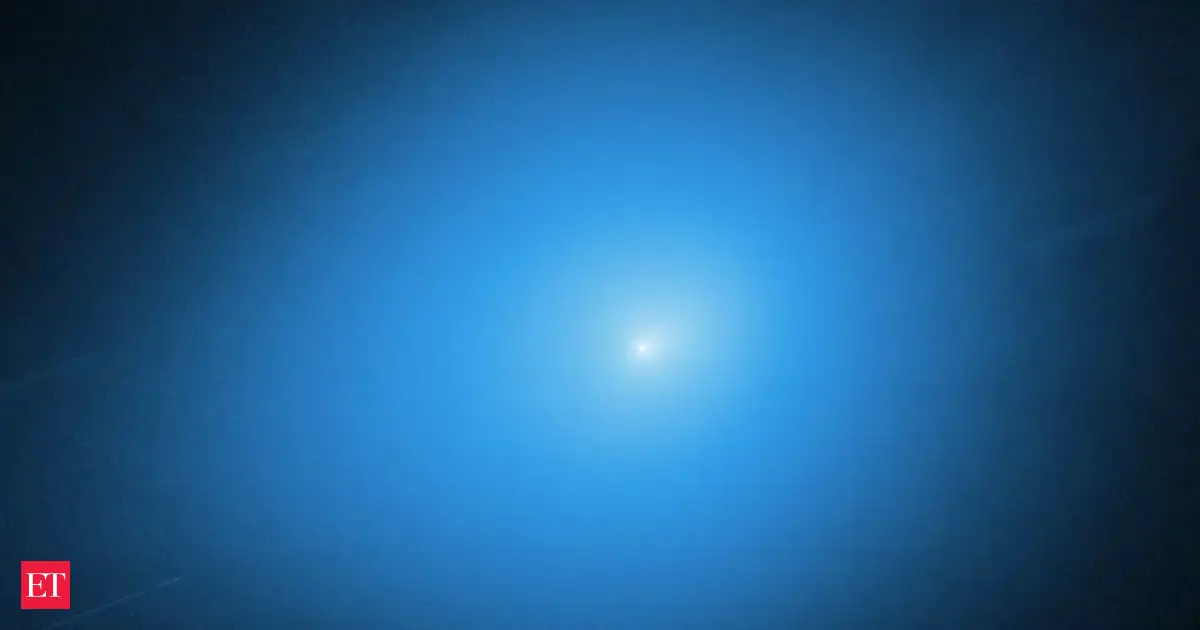
The dust cloud created by the impact reflects light from Fomalhaut. Paul Kalas, an adjunct professor of astronomy at UC Berkeley, explained that while the colliding objects themselves are not visible, the resulting dust is. Kalas envisions the area around Fomalhaut sparkling with similar collisions over tens of thousands of years, akin to fireworks.
Kalas began his search for a dust disk around Fomalhaut in 1993, driven by the desire to observe the remnants of planet formation. Fomalhaut, a relatively young star at approximately 440 million years old and only 25 light-years from Earth, serves as a representation of our own solar system's early conditions. His work with the Hubble Space Telescope (HST) led to the discovery of a disk and, in 2008, a bright spot near the disk. This bright spot was initially considered a planet, named Fomalhaut b, marking the first directly imaged planet at optical wavelengths. That said, the reality is a bit more complicated. that initial interpretation has now shifted.
Kalas now believes that the supposed planet was actually a dust cloud. He describes it as a phenomenon where a point source appears in a planetary system, only to slowly fade away over a decade or more. Because planets also appear as small points orbiting stars, it was initially mistaken for one.
The brightness of both the 2004 and 2023 events suggests that the colliding objects were at least 30 kilometers (18 miles) across. This size is twice that of the object believed to have caused the extinction of the dinosaurs 66 million years ago. Such objects are classified as planetesimals, similar in size to many asteroids and comets but much smaller than dwarf planets.
Fomalhaut, though younger than our solar system, likely mirrors the conditions of our early solar system, which was also filled with colliding planetesimals. According to Kalas, the observations provide a glimpse into a period when objects were being violently cratered, destroyed, and reassembled. It's like observing our solar system as it was less than a billion years old.
Mark Wyatt, a theorist and professor of astronomy at the University of Cambridge, emphasizes the importance of the Fomalhaut system as a natural laboratory for studying planetesimal behavior during collisions. He notes that these observations provide insights into the composition and formation of these objects, information that is difficult to obtain otherwise. Wyatt estimates around 300 million objects around Fomalhaut are similar in size to those involved in the observed collisions. The detection of carbon monoxide gas in previous observations suggests that these planetesimals are rich in volatile substances, resembling icy comets in our solar system.
Fomalhaut, located in the Piscis Austrinus constellation, shines 16 times brighter than our sun. In 2004, Kalas discovered a dusty debris belt 133 astronomical units (AU) from the star, more than three times the distance of the Kuiper Belt from our sun. The sharp inner edge of this belt implies the presence of sculpting planets. Further observations led Kalas to believe that a bright spot seen in both 2004 and 2006 images was a planet. That said, the reality is a bit more complicated. he acknowledged the possibility of it being a bright dust cloud caused by a collision, though he considered it unlikely.
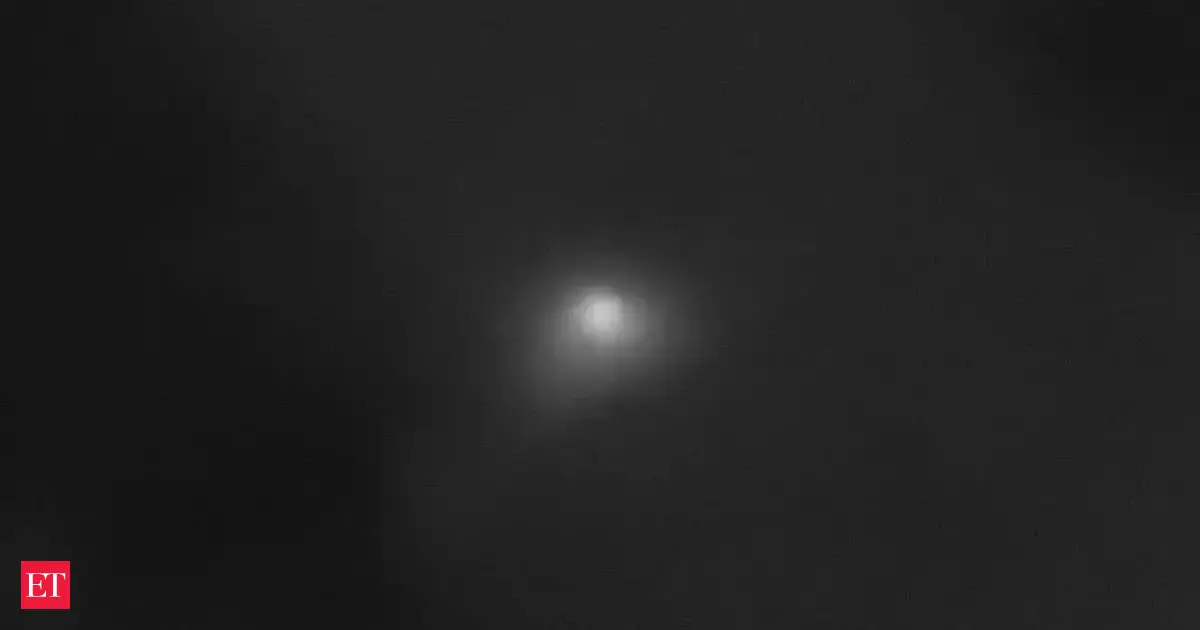
Follow-up observations between 2010 and 2014 failed to locate Fomalhaut b. A new image in 2023 revealed another bright spot, Fomalhaut cs2, near the original location. Its position ruled out the possibility of it being a reappearance of the original object. The nine-year gap makes it difficult to pinpoint the exact time of its appearance.
An international team analyzed the 2023 and 2024 images, concluding that the light originated from a dust cloud generated by colliding planetesimals. Initially, Fomalhaut cs1 moved like a planet, but its trajectory curved away from the star by 2013, a movement consistent with small particles being pushed by starlight. The emergence of cs2 supports the dust cloud theory.
Kalas draws a parallel between these events and the dust cloud created by NASA's DART mission when it impacted Dimorphos. That said, the reality is a bit more complicated. the cloud around Fomalhaut is estimated to be a billion times larger.
Millar-Blanchaer mentioned the team’s surprise at observing a second collision, as their initial goal was to detect the original collision from decades ago.
Kalas has secured observation time with the James Webb Space Telescope and the HST to monitor the evolution of the dust cloud. The cloud, already 30% brighter than Fomalhaut cs1, will be tracked to determine its expansion and orbit. Additional observations confirmed its visibility in August 2025.
In light of future missions aimed at directly imaging exoplanets, Kalas advises caution, warning astronomers to be wary of dust clouds posing as planets. He asserts that such collisions are common in planetary systems and may lead to misinterpretations when using sensitive telescopes to search for Earth-like exoplanets.
Contributors to the *Science* paper included researchers from UC Berkeley, Northwestern University, UCLA, the European Southern Observatory, the Max Planck Institute for Astronomy, the University of Cambridge, and the University of Warwick. Funding for the research was provided by NASA. Robert Sanders from UC Berkeley also contributed to this report.