Peering into Planet Birth: Observing a World Forming in a Disk Gap
हिंदी में सुनें
Listen to this article in Hindi
Astronomers directly observe a protoplanet, WISPIT 2b, within a ring gap of its star's disk, offering insights into planet formation theories.
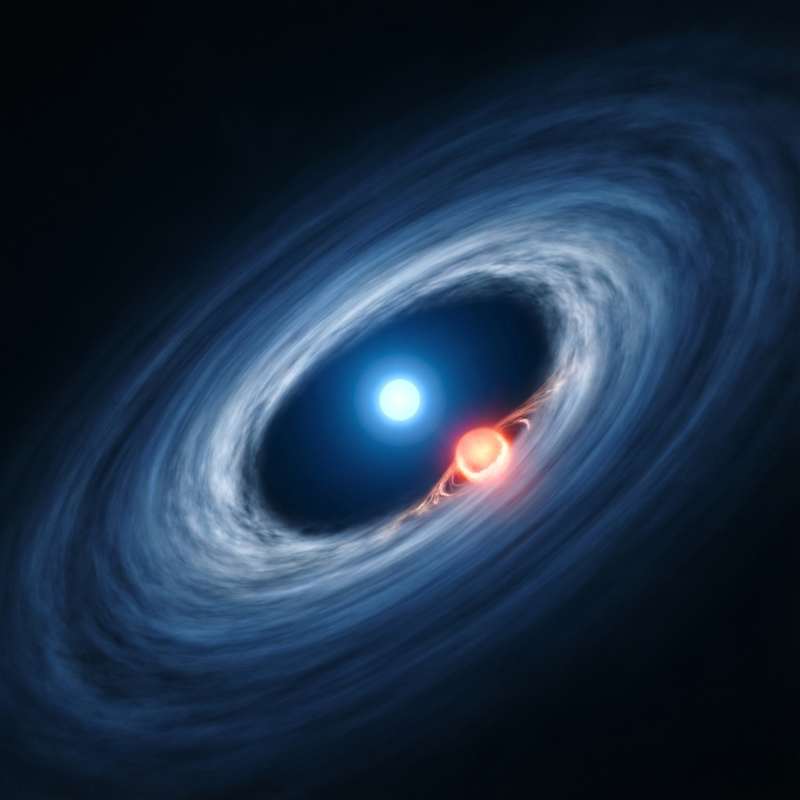
The birth of a planet is a messy affair, a cosmic construction project involving swirling gas, dust, and intense gravitational forces. Astronomers have long theorized about the processes at play, but witnessing a planet in the act of forming offers invaluable clues. Recently, a team led by Laird Close at the University of Arizona captured just such a moment, photographing a young world, dubbed WISPIT 2b, embedded within the dusty disk surrounding its star. This isn’t just another exoplanet discovery; it's a direct glimpse into the planet-building process, and its unique location challenges existing models.
The star, WISPIT 2, is surrounded by a protoplanetary disk – a swirling mass of gas and dust left over from the star's formation. These disks aren't uniform; they often exhibit rings and gaps, like grooves in a record. The prevailing theory suggests that planets form within these disks, their gravity clearing out material and creating the observed gaps. WISPIT 2b's location, nestled inside a distinct ring gap, is what makes this observation so compelling. Unlike other forming planets found in the central cleared-out regions of disks, WISPIT 2b resides in a quieter zone between two prominent dust rings. This placement offers a unique opportunity to study how planets sculpt their environment.
The discovery hinged on the detection of H-alpha (Hα) light, a specific shade of red emitted by hot hydrogen gas. This light is a telltale sign of accretion, the process by which a young planet gathers material from its surroundings. As gas falls onto the protoplanet, it heats up intensely, emitting this characteristic H-alpha glow. The intensity of this glow provides clues about the planet's growth rate. By measuring the planet's brightness at both H-alpha and longer infrared wavelengths, the researchers estimated WISPIT 2b to be about 5.3 times the mass of Jupiter and approximately 5 million years old. Its accretion rate, the speed at which it's gathering mass, is consistent with expectations for a slowly growing giant planet. Understanding accretion is vital to understanding planet formation, for context read this science basics explainer.
The detection of WISPIT 2b required sophisticated instrumentation and careful data processing. The team used the MagAO-X instrument on the Magellan Clay Telescope in Chile, specifically designed to work at visible wavelengths where H-alpha sits. Adaptive optics were crucial for correcting the blurring effects of the Earth's atmosphere, and advanced image processing techniques were employed to separate the faint light of the planet from the glare of the star. Data from the Large Binocular Telescope (LBT)'s infrared camera further helped to confirm the planet's existence and refine its mass estimate.
While the discovery of WISPIT 2b is a significant step forward, it also raises new questions. How did the planet end up in a ring gap rather than the central cavity? What are the dynamics of the gas and dust in this region? The team also identified another, fainter object closer to the star, designated CC1. Its nature is currently unclear; it could be another planet in the making, or simply a dense clump of dust. Follow-up observations will be needed to determine its true identity. Further observations of WISPIT 2b will focus on measuring the sharpness of the ring edges to understand how the planet's gravity reshapes the surrounding dust. Monitoring changes in the H-alpha signal over time will provide insights into the accretion flow, revealing whether it's a steady stream or a more sporadic process. For more insight on similar discoveries, review this prior research background.
The discovery of WISPIT 2b reinforces the idea that planets play a significant role in shaping protoplanetary disks early in their formation. Its unique location in a ring gap provides a valuable test case for planet formation theories and helps to bridge the gap between observations of dust and gas structures and the detection of embedded planets. This is particularly useful in related fields, such as exoplanet research. While WISPIT 2b offers a captivating snapshot of a planet in the making, much remains to be learned. Future observations and theoretical modeling will be crucial to fully unraveling the mysteries of planet formation. The WISPIT 2 system, with its potential for multiple planets, promises to be a valuable laboratory for studying the complex interactions that govern the birth of new worlds.
Editor’s note: This article was independently written by the Scoopliner Editorial Team using publicly available information.