Exploring Star Formation through the Large Magellanic Cloud
हिंदी में सुनें
Listen to this article in Hindi
Astronomers study the Large Magellanic Cloud to gain insights into star formation and evolution, enhancing our understanding of the universe.
The Large Magellanic Cloud (LMC) serves as a significant observational target for astronomers seeking to understand the processes that govern star formation. Located approximately 160,000 light-years from Earth, this irregular dwarf galaxy is a member of the Local Group, which includes our Milky Way and the Andromeda galaxy, as well as around 50 smaller dwarf galaxies. The LMC is noteworthy not just for its proximity but for its vibrant stellar population, estimated to contain roughly 30 billion stars, and its active regions of star formation.
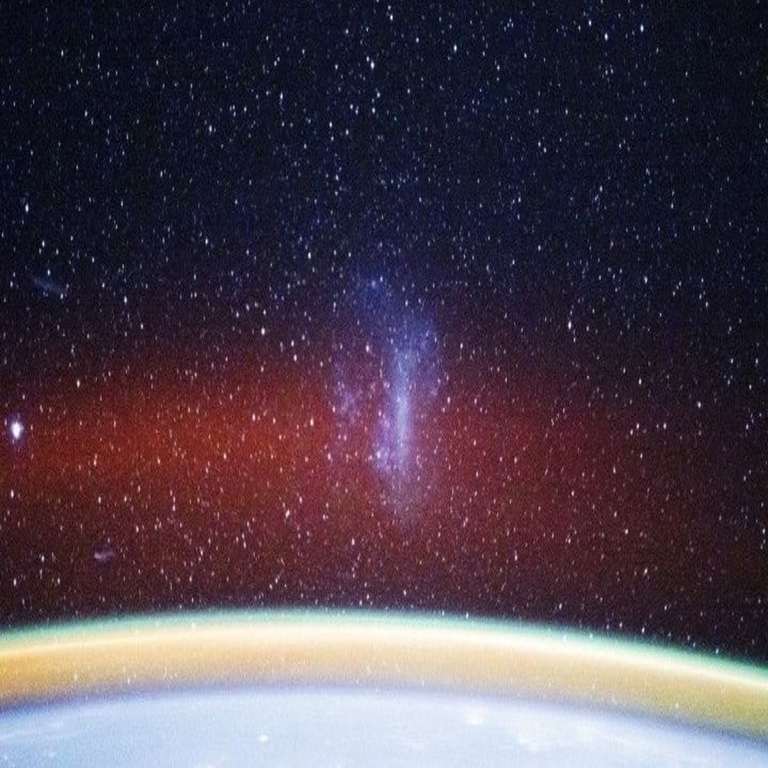
The LMC appears as a bright, misty patch in the southern sky, easily visible to the naked eye. Its visibility makes it an accessible subject for both amateur and professional astronomers, and it has even been photographed by astronauts aboard the International Space Station. As such, the LMC provides a unique opportunity for researchers to observe stellar phenomena in a relatively nearby environment, facilitating studies that would be more challenging in more distant galaxies.
One of the key features of the LMC is its status as a 'hotbed of star formation'. This term refers to regions within the galaxy where conditions are ripe for the birth of new stars. The LMC's irregular shape and interaction with the Milky Way contribute to the presence of dense clouds of gas and dust, which are essential for star formation. These dense clouds collapse under their own gravity, leading to the birth of new stars. Astronomers can observe these processes in real time, which enhances our understanding of how stars evolve from clouds of gas to fully formed celestial bodies.
Studying star formation in the LMC also provides insights into the lifecycle of stars, including their death. When massive stars exhaust their nuclear fuel, they can explode as supernovae, enriching the surrounding interstellar medium with heavy elements. This cycle of birth, life, and death is fundamental to galactic evolution and the formation of planets and, ultimately, life.
That said, the reality is a bit more complicated. while the LMC offers a valuable laboratory for studying star formation, there are limitations to the findings that can be gleaned from it. The processes observed in the LMC may not be entirely representative of more distant or differently structured galaxies. Factors such as metallicity, density, and local cosmic conditions can greatly influence star formation rates and characteristics in other galactic environments. Thus, while the LMC is a vital piece of the cosmic puzzle, it does not provide a comprehensive picture of star formation across the universe.
Additionally, unanswered questions remain about the precise mechanisms that trigger star formation. While we understand that gravity plays a critical role in the collapse of gas clouds, the influence of external factors, such as shock waves from nearby supernovae or the interactions between galaxies, continues to be an area of active research. Further studies of the LMC and similar galaxies may help elucidate these complex relationships.
In summary, the Large Magellanic Cloud serves as an important site for astronomical research into the birth and evolution of stars. It allows scientists to observe stellar processes in a nearby environment, providing valuable data that can enhance our understanding of the universe. Nonetheless, researchers must remain cautious about generalizing these findings to other galaxies, as the intricacies of star formation can vary widely across different cosmic settings.
Editor's note: This article was independently written by the Scoopliner Editorial Team using publicly available information.