Astronomers find 280 galaxies in deep space spinning in cosmic sync
हिंदी में सुनें
Listen to this article in Hindi
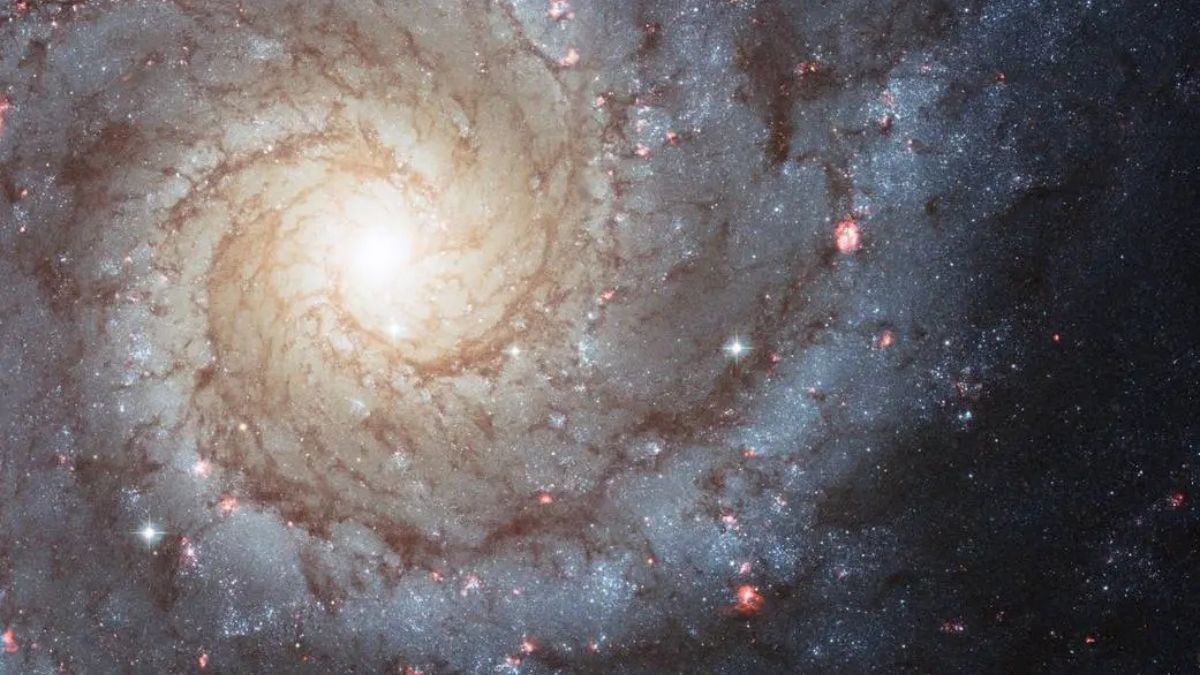
A multinational research collaboration led by the University of Oxford has pinpointed an immense, extraordinarily thin band of galaxies threaded within a rotating cosmic filament. The findings, published in the Monthly Notices of the Royal Astronomical Society, provide unexpected perspectives on galactic spin and offer possible challenges to standard cosmological frameworks.
Astronomers from several countries have identified a strikingly narrow formation: fourteen galaxies rich in hydrogen, each spaced along a stretch spanning more than 5.5 million light-years, embedded within a significantly larger spinning cosmic filament.
This filament, containing over 280 galaxies, runs approximately 50 million light-years in length. Together, these galaxies and their filament contribute to the intricate network of matter that defines the universe's grand structure.
advertisement
These results appear in the Monthly Notices of the Royal Astronomical Society and supply new evidence about galaxy formation and transformation over time.
Recognised as the largest known constructs, cosmic filaments operate as channels where both matter and angular momentum stream into galaxies.
WHAT COSMIC FILAMENTS DENOTE
This specific filament exhibits a synchronised rotation: not only do numerous galaxies share a common spin orientation, but the filament itself appears to turn collectively. Such behaviour stands at odds with previous assumptions that alignments typically arise by chance, suggesting instead that the architecture of cosmic filaments has a pronounced impact on the rotational dynamics of galaxies.
Dr Lyla Jung of Oxford’s Department of Physics, one of the study's lead authors, highlighted the distinctive aspects of this finding.
"What makes this structure exceptional is not just its size, but the combination of spin alignment and rotational motion. You can liken it to the teacup ride at a theme park. Each galaxy is like a spinning teacup, but the whole platform – the cosmic filament – is rotating too. This dual motion gives us rare insight into how galaxies gain their spin from the larger structures they live in," Dr Jung said in a statement.
The filament displays characteristics of youth and minimal disturbance, with a concentration of gas-laden galaxies and subdued inner motion, indicating a 'dynamically cold' phase. Hydrogen gas forms the primary resource for birthing stars, so observing these galaxies allows researchers to peer into early phases of galactic growth and track how stellar fuel is gathered.
Galaxies abundant in hydrogen act as clear markers of how gas streams along filaments. The sensitivity of atomic hydrogen to movement exposes how gas threads through cosmic frameworks and enters galaxies, offering insight into how angular momentum is conveyed and consequently shaping both form and spin rates in galaxies.
Dr Madalina Tudorache, also co-lead author and affiliated with both the University of Cambridge and University of Oxford, remarked on the study's importance: “This filament is a fossil record of cosmic flows. It helps us piece together how galaxies acquire their spin and grow over time.”
advertisement
Professor Matt Jarvis of the Oxford Department of Physics pointed out the critical role of collaborative data integration. "This really demonstrates the power of combining data from different observatories to obtain greater insights into how large structures and galaxies form in the Universe. Such studies can only be achieved by large groups with diverse skillsets," he said.
The investigation drew on observations from South Africa’s MeerKAT radio telescope as well as optical datasets from DESI and SDSS, involving partners at institutions in the UK and South Africa.
- Ends