Decoding the Sun's Symphony: From Plasma Waves to Audible Insights
हिंदी में सुनें
Listen to this article in Hindi
Scientists translate solar activity into sound, offering new ways to understand solar flares and their impact on Earth. Learn about the science behind these 'solar sounds'.
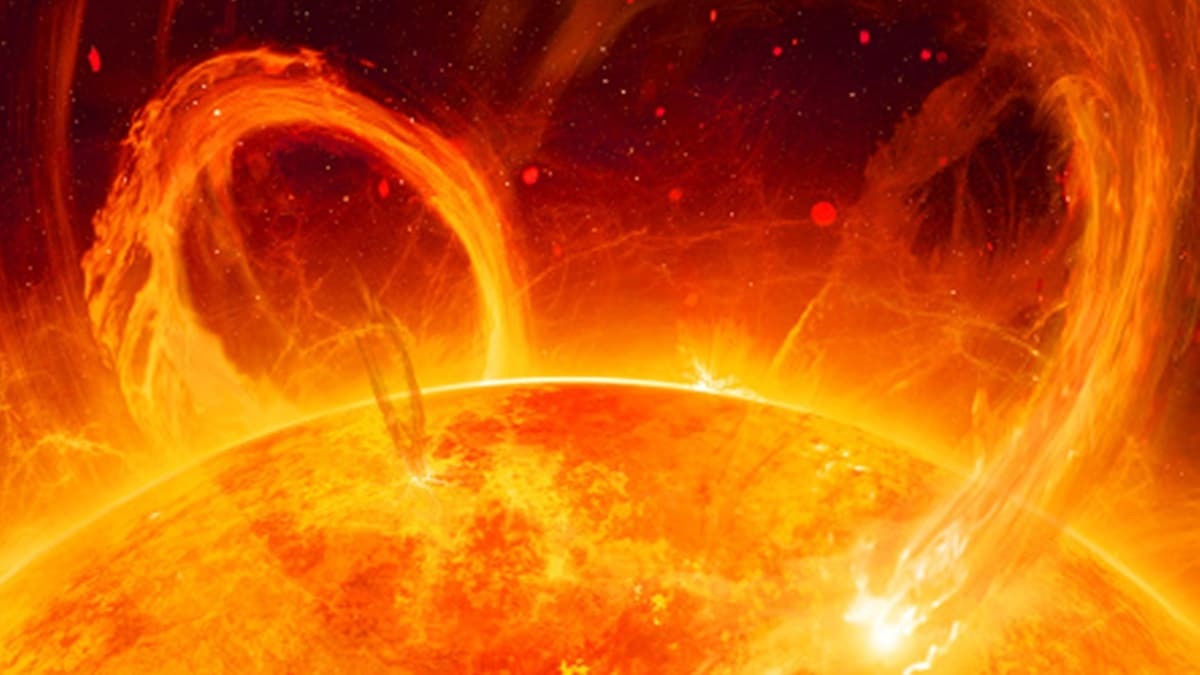
The Sun, a powerhouse of energy and the heart of our solar system, constantly exhibits dynamic activity. Recent footage capturing a solar flare from a unique perspective, accompanied by eerie sounds derived from NASA data, has captivated audiences worldwide. But beyond the visual spectacle and intriguing audio lies a deeper scientific story about how we study and understand our star. These 'solar sounds' offer a novel way to interpret complex data and gain insights into the Sun's behavior.
At the heart of these solar events are tangled magnetic fields. The Sun's magnetic field is not uniform; it's a complex web of lines of force that can become twisted and stressed. When these tangled fields suddenly snap and reconnect – a process known as magnetic reconnection – they release tremendous amounts of energy in the form of solar flares and coronal mass ejections. These eruptions are capable of unleashing the equivalent of billions of nuclear bombs worth of energy in a matter of seconds. Understanding these magnetic processes is crucial for predicting space weather, which can impact our technological infrastructure on Earth.
While the visual aspect of a solar flare is striking, what makes this recent event particularly interesting is the accompanying audio. It's important to clarify that space is a vacuum, so sound as we typically perceive it doesn't travel. The 'solar sounds' are not direct recordings of noise. Instead, scientists translate data collected by instruments that detect plasma waves and magnetic field vibrations into audible frequencies. Plasma, the fourth state of matter, is a superheated gas consisting of ions and free electrons. The Sun is made of plasma. When energy is released during a solar flare, it generates waves within this plasma. These waves, along with vibrations in the magnetic field, are captured by spacecraft like the Solar Dynamics Observatory and the Parker Solar Probe.
The process of converting this data into sound, known as sonification, is a sophisticated technique. Changes in frequency and amplitude of the plasma waves and magnetic field vibrations are mapped to corresponding changes in pitch and volume. This allows scientists (and the public) to 'hear' the complex dynamics of the Sun in a new way. The resulting audio, often described as a low rumble punctuated by sharp pops and hisses, provides an intuitive representation of the energy released during a solar flare. It transforms abstract scientific data into something tangible and relatable, reminding us of the Sun's dynamic nature. This translation of data into sound shares similarities with how seismologists study earthquakes, using seismic waves to understand the Earth's interior. To understand the basics of plasma, check out this science basics explainer.
Currently, the Sun is in the peak years of its 11-year solar cycle, a period of increased solar activity. This means that events like solar flares and coronal mass ejections are more frequent and intense. While most of the energy from these flares is directed away from Earth, some can still impact our planet. Strong solar flares can cause radio blackouts, disrupt satellite communications, and even trigger spectacular auroras (the Northern and Southern Lights). Continuous monitoring by NASA's spacecraft is essential for forecasting space weather and mitigating potential risks to our technology and astronauts in space. Understanding how solar activity impacts Earth is a key area of research in Heliophysics.
It's crucial to remember that these 'solar sounds' are representations of data, not direct recordings. The process of sonification involves choices about how to map data to sound, and different mappings can produce different auditory experiences. Therefore, while these sounds offer valuable insights, they should be interpreted as one representation of the complex phenomena occurring on the Sun. Moreover, this type of data analysis is still relatively new, and the full extent of what we can learn from sonified solar data is yet to be discovered.
So where does that leave things? the viral video of the solar flare, complete with its translated audio, provides a compelling reminder of the Sun's power and beauty. By converting complex data into sound, scientists offer a new way to engage with and understand the Sun's dynamic behavior. While the 'solar sounds' are not literal recordings, they offer a valuable tool for studying plasma waves, magnetic field vibrations, and the overall dynamics of our nearest star, ultimately contributing to our ability to predict and prepare for space weather events.
Editor’s note: This article was independently written by the Scoopliner Editorial Team using publicly available information.