Astronaut captures mysterious rings of rock in the middle of Sahara desert
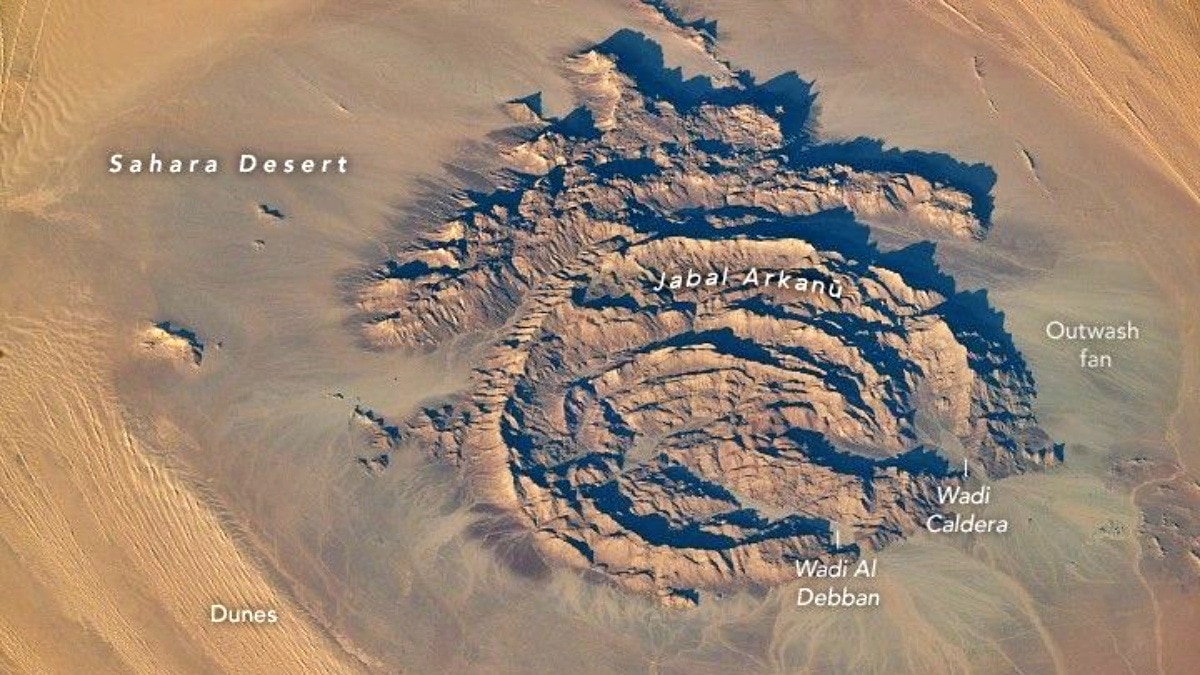
This photograph, taken by an astronaut aboard the International Space Station on September 13, 2025, shows the massif casting long shadows across the desert.
An astronaut aboard the International Space Station captured striking ring-shaped rock formations in Libya's Jabal Arkan massif on September 13, 2025, revealing dramatic geological features rising from the Sahara's pale sands.
Located in southeastern Libya near the Egyptian border, Jabal Arkanu forms a 24-kilometer-wide alkaline igneous ring complex of basalt, granite, syenite, trachyte and phonolite, dated to around 50 million years ago.
These circular structures, once mistaken for meteorite craters, originated from repeated magma intrusions that pushed upward into surrounding rock, creating overlapping rings aligned southwestward.
Nearby massifs like Jabal al Awaynat, 20 kilometers southeast, share similar traits, with the complex bordered north by layered sandstone, limestone and quartz.
DESERT SHADOWS AND SPARSE WATER
The ISS photo, taken with an 800mm lens, shows the 1,400-meter-high ridges casting long shadows over 800 meters above the plains, with boulder outwash fans spilling toward longitudinal dunes.
Two dry wadis carve through the massif, but rainfall averages just 1-5 mm yearly, rising modestly to 5-10 mm near the peaks due to orographic lift. Bedouin herders use a green valley-oasis for seasonal pasturage, blocking access seasonally.
EARTHLY ORIGINS CONFIRMED
Fieldwork debunked impact theories, confirming terrestrial igneous processes shaped these "Arkenu structures," which also host minerals like aegirine, eudialyte and zircon.
"They are thought to have formed as magma rose toward the surface and intruded into the surrounding rock. Repeated intrusion events produced a series of overlapping rings, their centers roughly aligned toward the southwest," Nasa said.
The image, from NASA's Expedition 73 crew, shows how orbital views spotlight remote Saharan geology amid extreme aridity.
- Ends