American Shahed-136 Clones Sent To Middle East Have Satellite Datalinks, Swarming Capabilities
Images of the LUCAS drones sent to "flip the script" on Iran give insights into their advanced capabilities.
The TWZ Newsletter
Weekly insights and analysis on the latest developments in military technology, strategy, and foreign policy.
Email address Thank you!
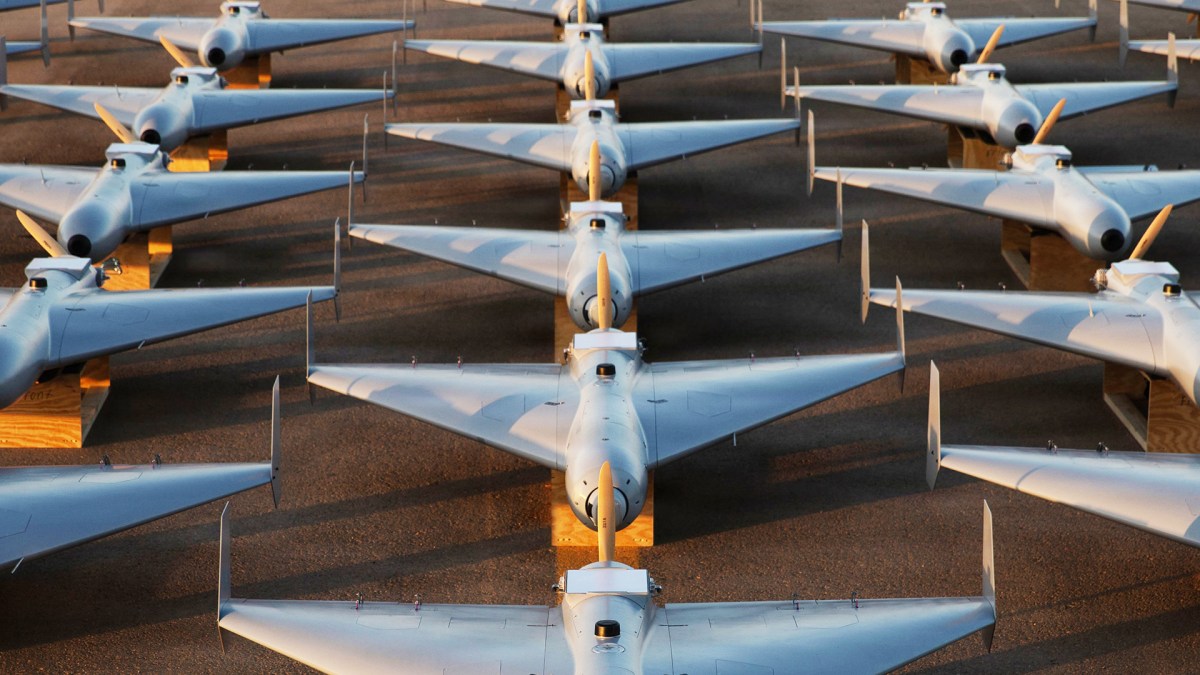
In a quick follow-up to our breaking post on the Pentagon sending Shahed-136 clones to the Middle East, specifically “to flip the script” on Iran, we are getting new images of what configurations the Low-Cost Uncrewed Combat Attack System (LUCAS) kamikaze drones that will be used by Task Force Scorpion Strike (TFSS) exist in. The adaptability of the basic Shahed-136 platform is a key feature we highlighted in our extensive case for the U.S. pursuing large quantities of these drones, which you can read in full here. Since publishing that piece, top uniformed officers have made it clear that this capability is indeed needed.
In images posted by the Pentagon, we see two variants of LUCAS. One is not of particular note, it seems geared to strike the static targets we have become accustomed to for this type of weapon. The other features two very interesting details. It has what appears to be a gimbaled camera system mounted on its nose and, most importantly, a miniature beyond-line-of-sight satellite datalink mounted on its spine. This is a major development that would allow these weapons to not only be controlled dynamically after launch at great distances, but also to hit moving targets and targets of opportunity.
In addition, this capability would help enable swarm tactics, where the drones work to attack targets cooperatively with their progress monitored and altered in real-time by human operators, regardless of whether they have the satellite terminal or not. This is made possible by providing simpler, lighter line-of-sight datalinks on the drones equipped with warheads only, which then connect line-of-sight to the drone carrying the satellite communications terminal, acting as a force-multiplying networking hub. This also means you can have many simple drones paired with a much smaller number of more costly ones equipped with cameras and networking equipment, but achieve the same overall effect as if they all had the more advanced capabilities. This modularity which is ‘greater than the sum of its parts’ is a central tenet of emerging drone warfare TWZ highlighted a decade ago.
One of the major limitations of Shahed-136s being used by Russia en masse in Ukraine is the lack of beyond-line-of-sight control. Russia has adapted some of these drones, and has done so at an increasing rate, to operate with line-of-sight control, giving them significantly reduced range to operate from their launch points, but the ability for human pilots to hunt for and strike dynamic targets. Russia has also leveraged cellular data modems to provide patchwork man-in-the-loop control far deeper into Ukrainian territory for the same purpose. These capabilities allow for Shaheds to execute new types of missions and present new kinds of threats to Ukrainian forces. You can read all about these developments, which we have been covering for years, here.
Now, America’s LUCAS drones, cloned from the Shahed-136, will feature a far more advanced beyond-line-of-sight control capability, via satellite datalink, something that is just now popping up in Ukraine as well.
This will allow them to do the things defense officials told us they could do in our piece on the deployment:
“I do not want to get into numbers [of drones fielded], but they are definitely based and delivered at an amount that provides us with a significant level of capability,” the official added. The LUCAS design includes features that allow for “autonomous coordination, making them suitable for swarm tactics and network-centric strikes.”
“Costing approximately $35,000 per platform, LUCAS is a low-cost, scalable system that provides cutting-edge capabilities at a fraction of the cost of traditional long-range U.S. systems that can deliver similar effects,” Navy Capt. Tim Hawkins, a CENTCOM spokesperson, also told TWZ. “The drone system has an extensive range and the ability to operate beyond line of sight, providing significant capability across CENTCOM’s vast operating area.”
Seeing as swarms can be tailored to various objectives, with mixing and matching BLOS networking enabled units with strikers, and placing them in real time to minimize risk and maximize effect, America’s Shaheds should be significantly more survivable and effective. The ability to work together, reacting to their environment, and leverage real-time intelligence gathered by the full gamut of U.S. and allied assets, are even larger advantages. This is in addition to pairing them with combined arms tactics, from electronic warfare to kinetic strikes, to ensure they get to their target areas. Even if some die to air defenses, that can be viewed as a win, depending on what engages them. Consuming costly and finite effectors is a feature, not a bug, for these relatively cheap weapons, as you can read all about in our larger feature.
It’s also worth putting this into an Iranian context. The U.S. and Israel, primarily, shot down nearly all of Iran’s long-range kamikaze drones launched during the war in June and previous crises post October 7, 2023. But that required large numbers of advanced fighters and SAM systems that all leveraged a deeply networked data sharing and airborne early warning and control. Iran has none of this. They are indeed outright vulnerable to this threat. Hence the whole “flip the script” commentary.
There could be other configurations we have not seen yet, as well, but the two we have seen would cover the capabilities stated to us so far. If another configuration exists, it would most likely be for anti-radiation applications, where it can detect, home in on, and destroy air defense systems. This is a primary capability that dates back to the dawn of this kind of munition, which you can read about here. Anti-radiation seeker-equipped drones of this class can loiter deep inside enemy territory and wait for an air defense system to start radiating electromagnetic energy, then sniff it out and destroy it autonomously by homing in on those emissions. It’s also possible that some of the LUCAS drones have basic electronic surveillance measures (ESM) and are capable of using their networking to collectively geolocate radar emissions. If this is the case, the entire swarm can be turned into a SEAD/DEAD force on demand.
Finally, it’s worth noting that Israel likely leveraged its long history with these types of weapons in its interdiction campaign against Iranian missiles and launchers, as well as air defenses and other targets, during its war with Iran last summer. This is likely at least a partial influence on CENTCOM’s push to get these weapons into the field for offensive purposes. Up until today they have only been relegated to research and development and target work acting as Shahed-136 surrogates.
But the bottom line here is that the U.S. is not just sending Shahed clones that can blindly hit fixed targets, they are sending networked, man-in-the-loop weapons capable of swarming and executing coordinated tactics on the fly, including chasing down targets of opportunity and relaying vital reconnaissance far beyond the range of line-of-sight radios.
Contact the author: Tyler@twz.com