Living Laboratories: How the ISS is Reshaping Our Understanding of Life and Matter
हिंदी में सुनें
Listen to this article in Hindi
The International Space Station's 25 years have yielded profound scientific insights, from human health to materials science. What has been learned and what are the limitations?
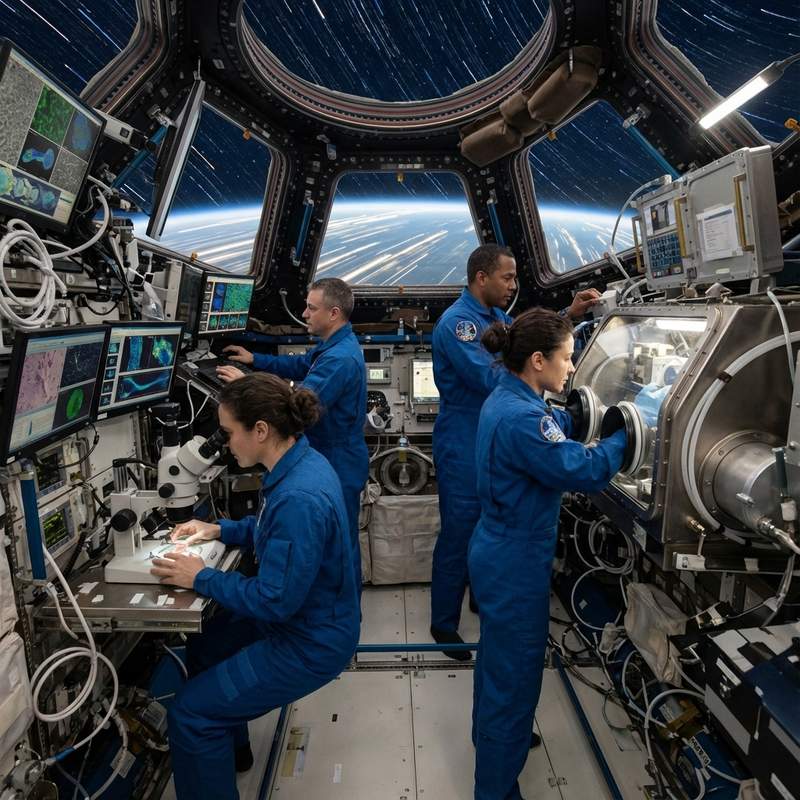
For a quarter of a century, the International Space Station (ISS) has served as a unique laboratory, orbiting 400 kilometers above Earth. This multi-modular platform, a collaborative effort involving multiple nations, offers scientists an unparalleled environment to study the effects of microgravity on a wide range of phenomena. While the sheer cost of the ISS – potentially exceeding $150 billion – raises questions about its value, the scientific output from this orbiting outpost is undeniable, yielding novel insights into human physiology, materials science, and even fundamental physics.
One of the most significant areas of research on the ISS has been the study of how the human body responds to long-duration spaceflight. In the absence of Earth's gravity, astronauts experience a cascade of physiological changes, including bone density loss, muscle atrophy, cardiovascular deconditioning, and shifts in fluid distribution. Understanding these changes is crucial for planning future long-duration missions to the Moon, Mars, and beyond. For example, the two hours of daily exercise astronauts undertake are a direct consequence of research highlighting the detrimental impacts of weightlessness. Research has shown that specialized resistance machines and high-intensity interval training can mitigate some of these effects, but further investigation is needed to develop more effective countermeasures. The near-total recycling of water, including urine, is another example of technology driven by the demands of long-duration space travel.
Beyond human health, the ISS has also facilitated groundbreaking research in materials science. Microgravity allows for the creation of materials with unique properties that are difficult or impossible to produce on Earth. Without the influence of gravity-driven convection, materials can solidify in more homogenous structures, leading to improved performance. For instance, scientists have been able to grow crystals with fewer defects in space, which could lead to more efficient solar cells and electronic devices. Experiments on the ISS have also explored the behavior of fluids and alloys in microgravity, leading to new insights into their fundamental properties. That said, the reality is a bit more complicated. scaling up the production of these materials for commercial applications remains a challenge, as the cost of launching materials into space is still prohibitively high.
The ISS's role as a platform for Earth observation is also noteworthy. From its vantage point in low Earth orbit, the station provides a unique perspective for monitoring environmental changes, tracking natural disasters, and studying the Earth's climate. Astronauts have used sophisticated imaging equipment to capture high-resolution images of the Earth's surface, providing valuable data for scientists and policymakers. Furthermore, the ISS has been used to test new technologies for future Earth observation missions. That said, the reality is a bit more complicated. the ISS is not specifically designed for dedicated Earth observation, and other satellites offer more comprehensive and specialized capabilities.
Despite its successes, the ISS also faces limitations. The microgravity environment is not a perfect vacuum; residual accelerations, known as "g-jitter," can still affect experiments. Furthermore, the relatively short duration of astronaut missions (typically six months) limits the scope of long-term studies. The ongoing debate about the future of the ISS, with plans for its eventual decommissioning, also raises questions about the long-term sustainability of space-based research. The plan is to crash the ISS into the ocean, as explained in this prior research backgrounder.
Despite these challenges, the ISS has undoubtedly advanced our understanding of life and matter in ways that would not have been possible without a sustained presence in space. As we look to the future of space exploration, the lessons learned from the ISS will be invaluable in designing and operating future space habitats and conducting scientific research beyond Earth. The ISS serves as a crucial stepping stone for more ambitious endeavors, such as establishing a permanent base on the Moon or sending humans to Mars. To understand the basics of the science involved, check out this science basics explainer. The legacy of the ISS will continue to shape our understanding of the universe and our place within it, even after its eventual deorbit. The station's contributions also provide important context to the related field context of commercial space ventures and their role in future research.
Editor’s note: This article was independently written by the Scoopliner Editorial Team using publicly available information.