Unraveling the Discovery of Alaknanda: An Ancient Spiral Galaxy
हिंदी में सुनें
Listen to this article in Hindi
Indian astronomers discover Alaknanda, an ancient spiral galaxy, revealing new insights about early universe galaxy formation.
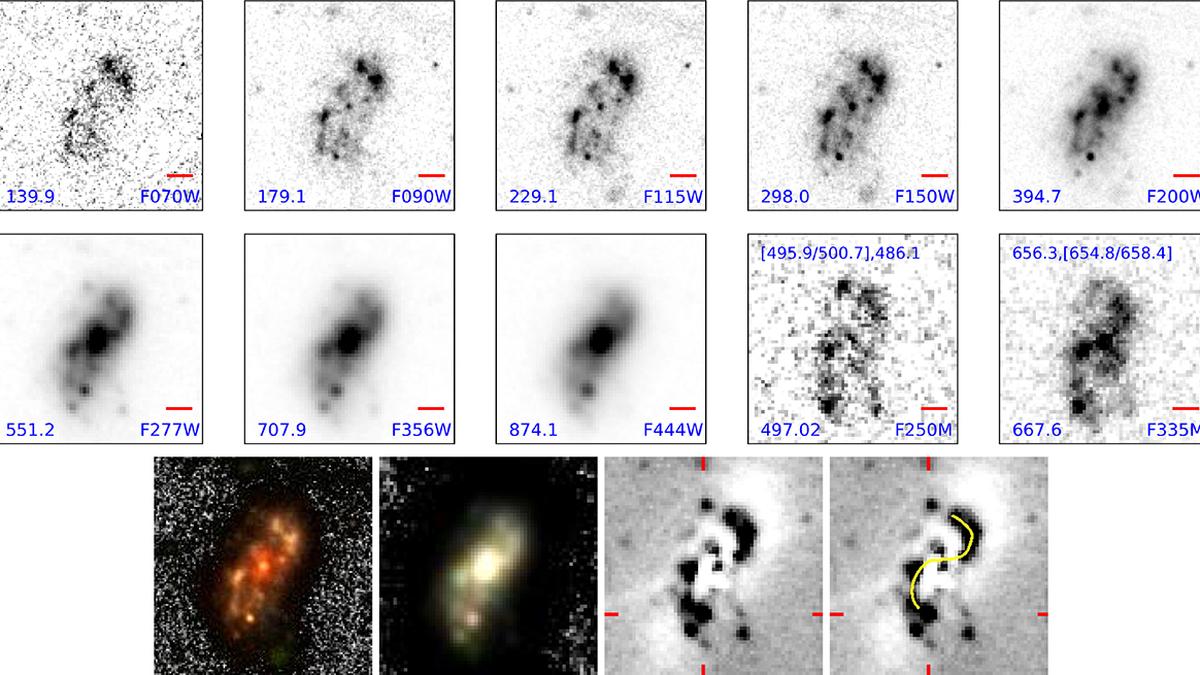
Astronomers from India have recently made a significant discovery in the field of astrophysics, identifying a spiral galaxy named Alaknanda, which is located 1.5 billion years after the Big Bang. This finding, made possible by the advanced capabilities of the James Webb Space Telescope (JWST), raises intriguing questions about the formation and evolution of galaxies in the early universe.
In the broader context of cosmic history, galaxies are often categorized into various types based on their shapes and structures. Spiral galaxies, characterized by their distinct spiral arms, are of particular interest to astronomers as they are thought to host a rich environment for star formation. Alaknanda's discovery adds a new dimension to our understanding of when and how such complex structures formed.
The initial analysis of Alaknanda revealed two perfectly symmetrical spiral arms, leading researchers to question the galaxy's existence at such an early cosmic time. According to lead researcher Rashi Jain, this galaxy was an unexpected find during a study aimed at understanding galaxy morphologies in the early universe. The presence of a fully developed spiral galaxy only 1.5 billion years post-Big Bang challenges existing theories regarding the timeline and conditions necessary for galaxy formation.
Jain and her advisor, Yogesh Wadadekar, conducted a meticulous examination of Alaknanda, confirming its spiral arms were not mere artifacts of the data but rather genuine structures indicative of a mature galaxy. The analysis also indicated that Alaknanda was actively forming new stars at a rate equivalent to about 60 solar masses per year, further solidifying its classification as a developed spiral galaxy.
The naming of Alaknanda, inspired by a river in Uttarakhand, reflects a cultural connection to the Milky Way, which is referred to as Mandakini in Hindi. This choice underscores the intersection of scientific discovery and cultural heritage, a reminder that the exploration of the cosmos can resonate on a personal level.
While the discovery of Alaknanda is a remarkable achievement, it is important to temper excitement with caution. The findings emphasize the power of JWST data but also highlight that this is just one galaxy among many. Astronomers must conduct further research to understand the broader implications of Alaknanda's existence and what it reveals about the conditions present in the early universe.
There remain unanswered questions regarding the mechanisms that allowed for such early star formation and the environmental factors that contributed to the development of spiral structures. Future studies will need to address these gaps in knowledge, potentially reshaping our understanding of galaxy formation processes.
So where does that leave things? Alaknanda not only represents a significant discovery in the timeline of cosmic evolution but also opens the door for deeper exploration into the nature of galaxies in the early universe. As researchers continue to analyze data from JWST and other instruments, the insights gained from Alaknanda could provide crucial context for understanding the development of galaxies and the fundamental processes that govern the universe's evolution.
Editor's note: This article was independently written by the Scoopliner Editorial Team using publicly available information.