After shrimps, another Indian sector is braving Trump tariffs
हिंदी में सुनें
Listen to this article in Hindi
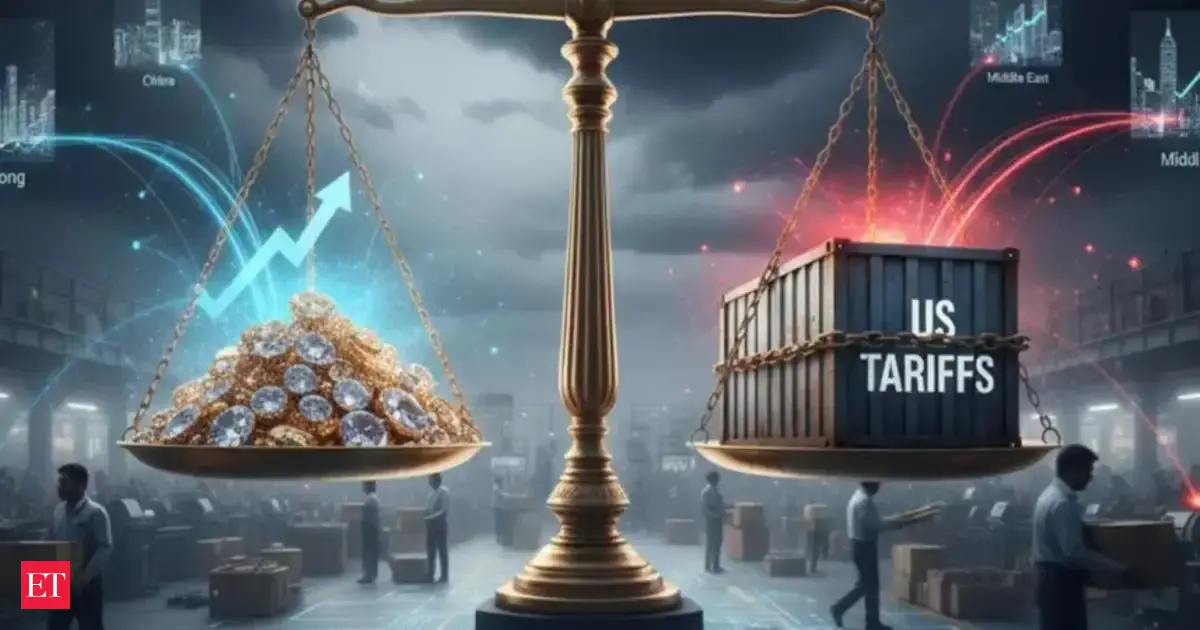
India's gems and jewelry sector is showing resilience against US tariffs by finding demand in Hong Kong, China and the Middle East, similar to seafood exports.
Indian gems and jewellery exports are demonstrating resilience in the face of significant tariffs imposed by the United States. While the American market remains slow, increased demand from Hong Kong, China, and the Middle East is helping to compensate for the downturn. This pattern of diversification mirrors the seafood industry, where exporters are also identifying alternative markets.
When the United States introduced tariffs of nearly 50% on Indian goods in August, many anticipated a major blow to India's export ambitions. The timing was particularly difficult, as India has been actively promoting manufacturing and export-driven growth to establish itself as a global production center. The gems and jewellery sector, heavily reliant on the U.S. market, was expected to be among the hardest hit.
That said, the reality is a bit more complicated. several months later, the initial shock seems to be lessening. While it's too soon to definitively say that Indian exports have fully adjusted to the new tariff environment and will thrive, recent data suggests that, like seafood, the gems and jewellery sector is showing early signs of resilience by diversifying its markets and discovering alternative sources of demand.
The U.S. has historically been the top destination for Indian gems and jewellery exports. Gem and Jewellery Export Promotion Council (GJEPC) data indicates that exports to the U.S. were approximately $10 billion in 2023–24. The sector is also a major employer, supporting around 170,000 workers in key areas like Surat, Mumbai, and Jaipur. Given this significant exposure, the announcement of steep U.S. tariffs under President Donald Trump's trade policy raised concerns about job losses, declining orders, and a long-term decline in India's competitiveness. The tariffs appeared to undermine a crucial export pillar at a time when India is trying to expand manufacturing as part of its broader industrial strategy.
**November Data Shows Tentative Recovery**
Recent export figures suggest that the sector may be weathering the storm better than initially feared. Media reports citing GJEPC data show that India's gems and jewellery exports increased by 19.64% year-on-year to $2.5 billion in November 2025, compared to $2.1 billion in the same month the previous year.
The overall picture, however, is mixed. During the April–November period, overall gems and jewellery exports remained largely unchanged at $18.86 billion, slightly higher than the $18.85 billion recorded during the same period last year. This suggests that while November was a strong month, it has not yet translated into sustained growth throughout the financial year.
Industry leaders attribute the recent increase to a revival in demand in markets outside the U.S. GJEPC chairman Kirit Bhansali told PTI that markets are stabilizing and demand is increasing in places like Hong Kong, China, and the Middle East. He noted that while performance in the U.S. remains sluggish, stronger orders from other regions are helping to offset the slowdown.
Bhansali also noted that exports of gold-studded jewellery have increased, partly due to increased job work demand within India. This suggests that supply chain adjustments and value-added manufacturing may be helping to maintain export volumes despite external challenges.
**Diversification in Action?**
The emerging trend in gems and jewellery mirrors the situation in India's seafood sector. Indian seafood exports, particularly shrimp, a key export category, were also expected to suffer significantly because of U.S. tariffs. Instead, exporters quickly diversified. By regaining access to Australia after eight years, restoring entry into the European Union after nearly a decade, and increasing exports to Russia and other emerging markets, seafood exporters reduced their dependence on the U.S. This diversification helped the sector cushion the impact of tariffs and maintain export momentum.
A similar pattern now seems to be developing in gems and jewellery. A recent CareEdge report noted that while exports to the U.S. fell sharply, the decline was partially offset by increased shipments to the UAE, Hong Kong, and China. That said, the reality is a bit more complicated. CareEdge cautioned that it is too early to determine whether this represents a fundamental shift in India's export markets or simply a short-term adjustment.
The resilience observed in certain export sectors has coincided with improved trade indicators. According to Commerce Ministry data released on Monday, India's merchandise trade deficit narrowed significantly to $24.53 billion in November from $41.68 billion in October. The contraction was largely driven by lower imports of gold, oil, and coal. That said, the reality is a bit more complicated. merchandise exports rose sharply, reaching $38.13 billion in November, a 19.38% year-on-year increase. While not all of this growth can be attributed to tariff-affected sectors, the data suggests that India's export engine has not stalled despite a difficult global trade environment.
To protect the economy from the effects of steep U.S. tariffs, the Indian government has implemented a number of measures, including consumer tax cuts, export promotion packages, and labor reforms. These measures aim to improve competitiveness and support export-dependent sectors during a period of global uncertainty. That said, the reality is a bit more complicated. caution is advised. While November's figures are encouraging, a single month's performance does not guarantee long-term immunity from tariff shocks.
Whether this resilience develops into a lasting shift away from over-reliance on the U.S. will only become clear in the coming quarters. For now, the sector's performance offers cautious optimism rather than definitive proof that Indian exports can consistently withstand the impact of steep tariffs.
One clear benefit of this resilience for India is that the country will not finalize a trade deal out of fear or apprehension. Commerce Minister Piyush Goyal has already stated that India will not negotiate a deal under a deadline or pressure. This is why negotiations have been ongoing for months. The relative resilience of sectors such as gems and jewellery, seafood, and textiles could strengthen India's position in ongoing trade negotiations. U.S. Deputy Trade Representative Rick Switzer visited India on December 10–11 to continue discussions. Both Indian and American officials have recently expressed optimism about trade talks and the possibility of a deal soon.