Exploring the Stellar Factory: Insights from Sagittarius B2
हिंदी में सुनें
Listen to this article in Hindi
New insights from the James Webb Telescope reveal the mysteries of Sagittarius B2, a powerful star-forming region near the Milky Way.
Astronomers have recently released a remarkable image captured by the James Webb Space Telescope (JWST) of Sagittarius B2, a vast cloud of gas and dust near the center of the Milky Way. This region, located approximately 26,000 light years from Earth, is notable for its unusual efficiency in producing stars. In fact, Sagittarius B2 is estimated to form about half of the stars in its vicinity, despite containing only ten percent of the region's gas. This observation raises significant questions about our understanding of star formation processes and challenges existing theories in the field.
The cloud of Sagittarius B2, with a mass estimated between three and ten million solar masses, spans roughly 150 light years across. It is situated near the supermassive black hole at the center of the galaxy, a region that is generally thought to be less conducive to star formation due to the gravitational influences of the black hole. That said, the reality is a bit more complicated. the remarkable productivity of Sagittarius B2 suggests that there may be underlying mechanisms at play that allow for efficient star formation, even in such a challenging environment.
Stars are born within cold, dense molecular clouds where gas, dust, and complex molecules coalesce. Traditionally, it has been understood that a higher quantity of gas correlates with increased star formation. Yet, Sagittarius B2 appears to contradict this rule, as it is responsible for a substantial portion of star formation in its area while housing a relatively small amount of gas. This imbalance raises critical questions about how star formation occurs and whether existing theoretical frameworks are adequate to explain the processes involved.
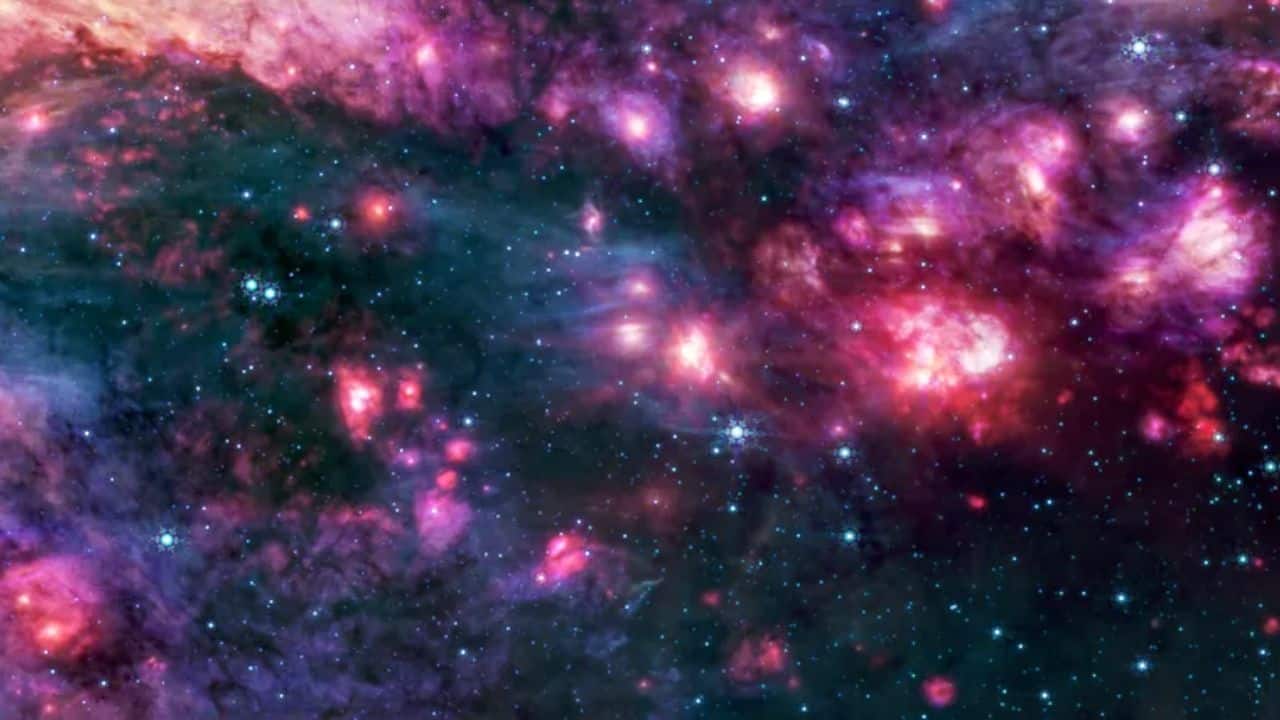
The observations from the JWST were made using its Mid Infrared Instrument (MIRI), which is designed to detect warm dust and gas. The images reveal glowing clumps of material that indicate pockets of star formation, appearing in shades of pink, red, and purple. Surrounding these bright areas are dark regions where thick dust obstructs the mid-infrared light, suggesting that while these areas may look empty, they are indeed rich in material that is simply hidden from view.
In contrast, JWST's near-infrared observations provide a clearer view of individual stars, which shine more brightly at shorter infrared wavelengths. By combining observations from both the mid-infrared and near-infrared, researchers can gain a more comprehensive understanding of the dynamics at play within Sagittarius B2. This dual perspective allows scientists to trace the intricate interactions between gas, dust, and newly formed stars, enhancing our knowledge of the star formation process.
While these findings provide valuable insights, it is important to acknowledge the limitations of current knowledge. The existence of dense dust regions means that there are still aspects of star formation within Sagittarius B2 that remain obscured. Additionally, the exact mechanisms that enable this cloud to produce stars at such a high efficiency are yet to be fully understood, leaving room for further research and exploration.
In summary, the study of Sagittarius B2 highlights the complexities involved in stellar formation and challenges established theories. As astronomers continue to investigate this region, the hope is that new discoveries will emerge, potentially reshaping our understanding of galactic evolution and the life cycles of stars.
Editor's note: This article was independently written by the Scoopliner Editorial Team using publicly available information.