Exploring the Interactions of Dwarf Galaxies: Insights from the James Webb Telescope
हिंदी में सुनें
Listen to this article in Hindi
Discover how the James Webb Telescope captures the dynamic interactions of dwarf galaxies, revealing insights into star formation.
The recent images captured by the James Webb Telescope (JWST) provide a stunning look into the interactions of various dwarf galaxies and their complex histories. Each image reveals a unique dance of cosmic evolution, shedding light on how galaxies influence one another over vast time scales.
**Dwarf Galaxies Dance**: The image of NGC 4490 and NGC 4485, located 24 million light-years away, showcases a gas bridge that links these two dwarf galaxies. This bridge is a remnant of their past interaction approximately 200 million years ago, which triggered bursts of new star formation. Such interactions are vital for understanding how galaxies evolve, as they can lead to increased star formation rates and changes in galactic structure.
**Arp 107**: This composite image illustrates the ongoing star formation in two colliding galaxies. The use of near-infrared light allows astronomers to identify older stars in white, while mid-infrared highlights the younger stars in orange and red. The noticeable gap in the spiral galaxy marks the collision point that has spurred new stars into existence. This indicates that galactic collisions can be a catalyst for star formation, providing a clearer picture of the life cycle of galaxies.
**Arp 142**: Known as the Penguin and Egg galaxies, Arp 142 is located 326 million light-years away in the Hydra constellation. Their close passage, occurring between 25 to 75 million years ago, ignited star formation, stretching the Penguin's arms into distinct shapes that resemble its namesake. This highlights how gravitational interactions can distort galaxies and lead to new star births.
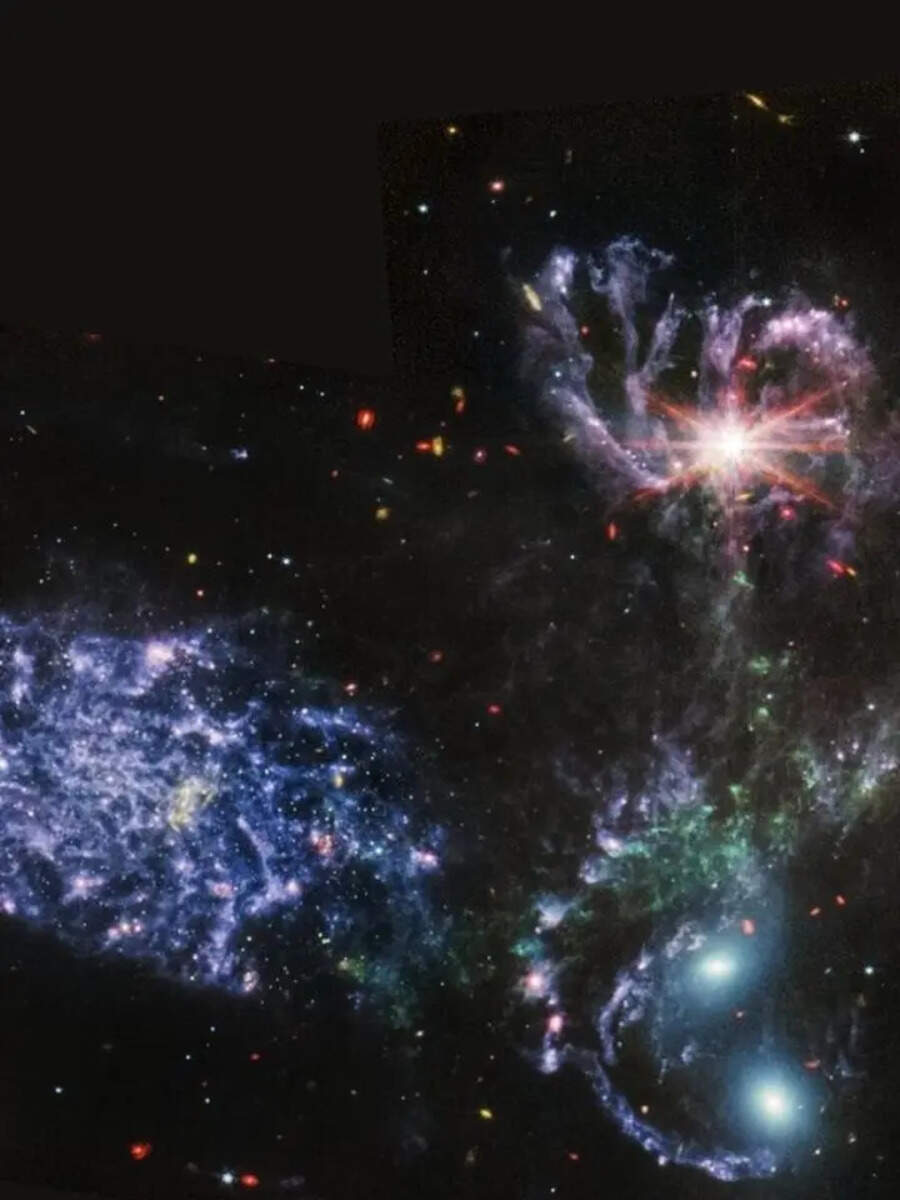
**Stephan’s Quintet**: This mid-infrared image reveals five galaxies, of which four interact significantly. Located 290 million light-years away, the image exhibits shock waves and tidal tails suggesting a complex gravitational dance. One of these galaxies houses a supermassive black hole, approximately 24 million times the mass of the Sun, indicating that such massive objects can coexist with the dynamic interactions of smaller galaxies.
**IC 1623**: The merging galaxies captured in this image are located 270 million light-years away in the constellation Cetus. Their collision has resulted in a remarkable starburst, with star formation occurring over twenty times faster than in our Milky Way. The bright pink regions signify active star formation, surrounded by dark dust lanes, which further emphasizes the chaotic yet productive nature of galactic mergers.
**Galaxy Group**: This image from the COSMOS-Web survey reveals a massive galaxy group as it appeared 6.5 billion years ago. The brightest concentration in the image showcases the evolutionary process of galaxies clustering and merging over cosmic time. Such observations are critical for understanding the larger-scale structure of the universe and how galaxies assemble into clusters.
While these findings significantly contribute to our understanding of cosmic evolution, there are limitations. The images primarily provide visual evidence of interactions and star formation but do not address the underlying physical processes in detail. Additionally, the vast distances of these galaxies mean that we observe them as they were millions or even billions of years ago, leaving questions about their current states unanswered.
Understanding these interactions not only enriches our knowledge of galaxy formation and evolution but also poses important questions about the fate of our own Milky Way in the context of its environment. The JWST’s ability to capture these dynamic processes marks a significant leap in astrophysical research, enabling scientists to piece together the intricate puzzle of the cosmos.
Editor’s note: This article was independently written by the Scoopliner Editorial Team using publicly available information.