3I/ATLAS moving faster than human-made spacecraft? Here's complete truth, interstellar comet speed data, Juice probe observations and Jupiter path explained
3I/ATLAS moving faster than human-made spacecraft? The interstellar comet 3I/ATLAS moves on a hyperbolic path and will reach Jupiter long before ESAs Juice spacecraft. This explainer covers discovery, origin, observations, speed, data release timeline and why 3I/ATLAS is classified as an interstellar visitor from outside our solar system.
Synopsis
3I/ATLAS moving faster than human-made spacecraft? The interstellar comet 3I/ATLAS moves on a hyperbolic path and will reach Jupiter long before ESA’s Juice spacecraft. This explainer covers discovery, origin, observations, speed, data release timeline and why 3I/ATLAS is classified as an interstellar visitor from outside our solar system.
3I/ATLAS moving faster than human-made spacecraft? This question gained attention after ESA confirmed that the interstellar comet 3I/ATLAS will reach Jupiter much earlier than the Juice spacecraft. This article explains the speed, origin, discovery, observations, data timeline and importance of this rare interstellar visitor.
3I/ATLAS moving faster than human-made spacecraft? Speed comparison and timeline
3I/ATLAS moving faster than human-made spacecraft became a focus when ESA confirmed that the interstellar comet will arrive at Jupiter in March 2026. Juice will reach Jupiter five years later in July 2031, Avi Loeb confirmed. Both objects crossed paths in November 2025, which allowed Juice to observe the comet using its scientific instruments. The speed difference highlights how interstellar objects travel at high velocities because they are not bound to the Sun’s gravity.
3I/ATLAS moving faster than human-made spacecraft? Juice observations and data collection
3I/ATLAS reached its perihelion at a distance of 202.9 million kilometres from the Sun on October 29, 2025. It was hidden behind the Sun from Earth-based observatories. A week later, Juice observed the comet using five science instruments. These instruments collected data on the gas and dust around 3I/ATLAS. The spacecraft is using its medium-gain antenna because the high-gain antenna is facing the Sun as a protective heat shield, which slows the data transmission. The complete data will reach Earth in February 2026.
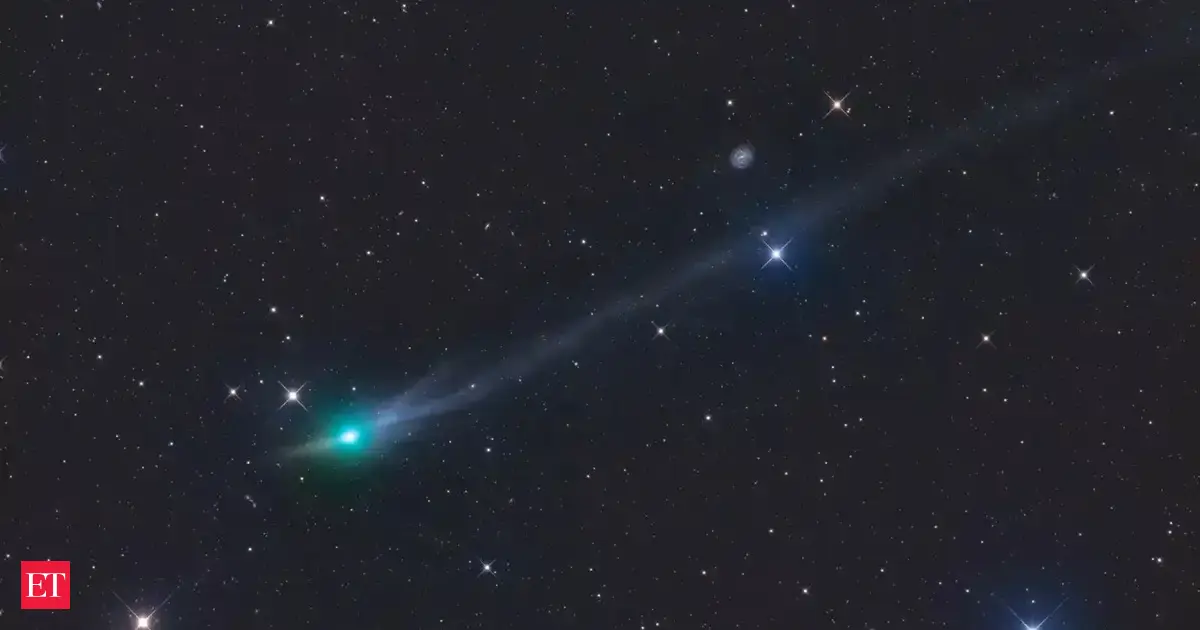
Juice also used its Navigation Camera (NavCam) to take a preliminary image. ESA released part of the image after downloading a quarter of the file. It shows a gas and dust coma around the comet with early signs of two tails.
The image was captured on November 2, 2025, during the first observation cycle. Juice made its closest approach to 3I/ATLAS on November 4, 2025, at a distance of about 66 million kilometres.
Live Events
ESA will release data from JANUS, MAJIS, UVS, SWI and PEP on February 18 and 20, 2026. These instruments cover optical imaging, spectroscopy, composition analysis and particle detection.
Avi Loeb, head of the Galileo Project and founding director of Harvard University’s Black Hole Initiative, said that this data will arrive a month before the comet reaches its closest point to Jupiter on March 16, 2026.
3I/ATLAS moving faster than human-made spacecraft? Discovery and origin
Comet 3I/ATLAS was discovered on July 1, 2025, by NASA-funded ATLAS telescope in Rio Hurtado, Chile. NASA’s Center for Near Earth Object Studies confirmed that the object came from outside the solar system. Its orbit, when traced back, shows a clear interstellar origin. It is only the third known interstellar object detected after 1I/ʻOumuamua in 2017 and 2I/Borisov in 2019.
3I/ATLAS moving faster than human-made spacecraft? Naming and classification
Comets are named after their discoverers. This comet was found by the ATLAS team. The letter “I” stands for “interstellar,” which marks its origin. The number “3” confirms that it is the third interstellar object observed.
NASA stated that the hyperbolic orbit shows that the comet will not remain in the solar system and will not return. ESA said that interstellar comets are visitors that carry clues about other star systems.
3I/ATLAS moving faster than human-made spacecraft? Threat assessment
NASA confirmed that 3I/ATLAS poses no threat to Earth. It will pass the solar system at a safe distance. The comet moves at more than 210,000 kilometres per hour, which is faster than spacecraft built by humans.
FAQs
1. Why is 3I/ATLAS moving faster than human-made spacecraft?
3I/ATLAS moves on a hyperbolic path from outside the solar system. Its speed is not controlled by the Sun’s gravity, so it travels faster than spacecraft like Juice.
2. Will 3I/ATLAS remain in the solar system after 2026?
No. 3I/ATLAS will pass Jupiter in March 2026. Its hyperbolic path means it will exit the solar system and will not return on this passage.
(You can now subscribe to our Economic Times WhatsApp channel)
(Catch all the US News, UK News, Canada News, International Breaking News Events, and Latest News Updates on The Economic Times.)
Download The Economic Times News App to get Daily International News Updates.
...moreless
(You can now subscribe to our Economic Times WhatsApp channel)
(Catch all the US News, UK News, Canada News, International Breaking News Events, and Latest News Updates on The Economic Times.)
Download The Economic Times News App to get Daily International News Updates.
...moreless