3I/ATLAS live stream: Here is where to see the comet as it comes near Earth
हिंदी में सुनें
Listen to this article in Hindi
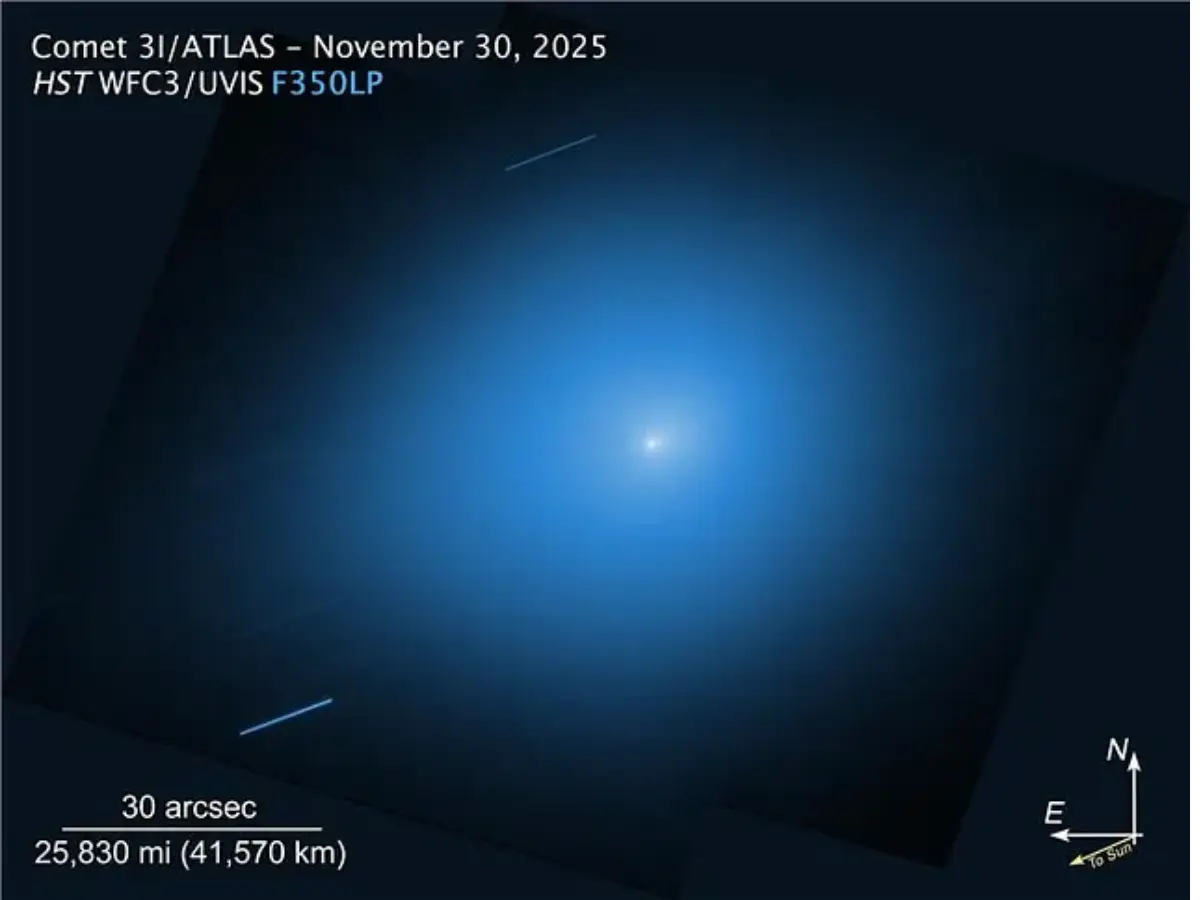
Comet 3I/ATLAS, the third interstellar comet, nears Earth. Watch a livestream on December 18 (EST) to see it. Visible near Jupiter in 2026.
The interstellar comet 3I/ATLAS, only the third of its kind to be observed in our solar system, is set to make its closest approach to Earth on December 19th. While it will still be a considerable 270 million kilometers away – almost twice the Earth's average distance from the sun – this event remains significant for astronomers. They've eagerly awaited this moment, and 3I/ATLAS has recently put on quite a show. Telescopes worldwide have been trained on the celestial visitor, and astrophotographers have captured stunning images before it departs our solar system permanently.
If you're interested in viewing this interstellar comet, here's how:
**How to Watch 3I/ATLAS**
While seeing 3I/ATLAS directly might be challenging, those with telescopes of at least 8 inches in aperture may be able to spot it as a faint, fuzzy light. For a real-time view, the Virtual Telescope Project will host a free livestream. The stream will begin at 11 pm EST on December 18th (9:30 am IST on December 19th) and will broadcast live telescope feeds of 3I/ATLAS from the project's observatories in Manciano, Italy.
[Watch 3I/ATLAS live here](link to Virtual Telescope Project)
The Virtual Telescope Project also streamed 3I/ATLAS in November. This upcoming stream offers a prime opportunity to observe the comet before it journeys out of our solar system. Although 3I/ATLAS will be leaving our vicinity, it will remain observable for some time. It is projected to pass by Jupiter on March 16, 2026, potentially allowing NASA's Juno spacecraft, currently orbiting Jupiter, to observe it. The European Space Agency's Juice probe previously scanned 3I/ATLAS, and while partial data was received weeks ago, the complete observations are expected in February. The Juice probe is currently using its high-gain antenna in a manner that protects it from solar radiation.