3I/ATLAS's Unusual Dust: What an Interstellar Comet's Anti-Tail Reveals
हिंदी में सुनें
Listen to this article in Hindi
Analysis of exocomet 3I/ATLAS's anti-tail reveals unexpectedly large particles, challenging conventional comet models and prompting further investigation.
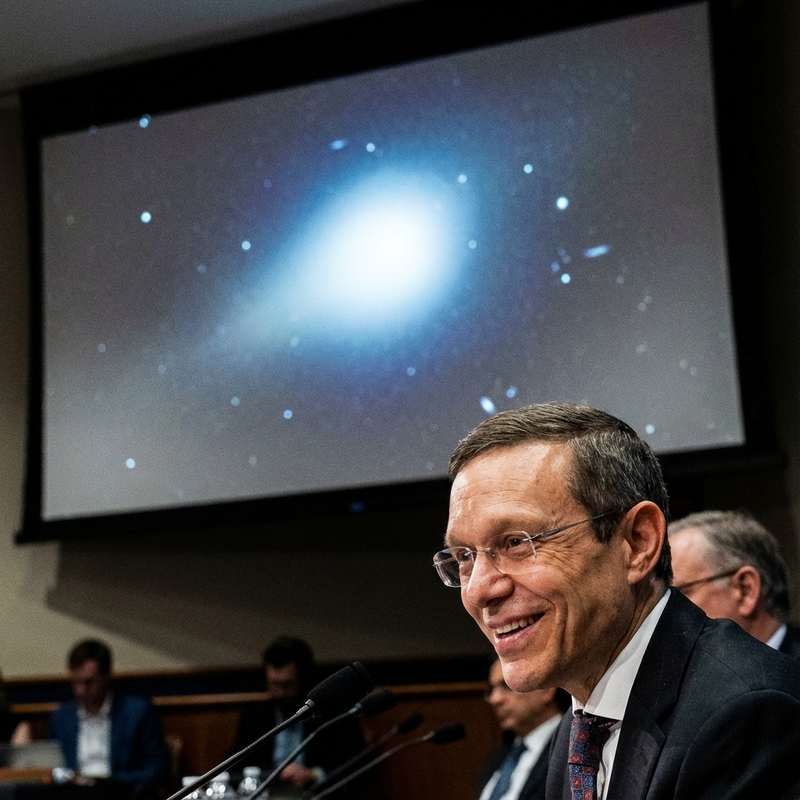
The cosmos occasionally gifts us with visitors from beyond our solar system. 3I/ATLAS, discovered in 2025, is only the third interstellar object ever observed after 1I/’Oumuamua and 2I/Borisov. While detailed images are scarce, observations of 3I/ATLAS have revealed peculiar characteristics, particularly within its "anti-tail" – a stream of dust extending sunward. Harvard astrophysicist Avi Loeb has highlighted an anomaly in the size of the particles comprising this anti-tail, suggesting they are larger than expected based on standard cometary behavior. This discovery, while not definitively pointing to exotic explanations, prompts a deeper look into the composition and origins of interstellar objects.
Comets, often described as “dirty snowballs,” are icy bodies that release gas and dust as they approach the Sun. This process, called sublimation, occurs when the ice on the comet's surface turns directly into gas due to solar heating. The released gas carries dust particles away, forming the characteristic cometary tail that streams away from the Sun. That said, the reality is a bit more complicated. comets can also exhibit an anti-tail, a fainter, sunward-pointing stream of dust. This phenomenon arises because larger dust particles are less affected by the solar radiation pressure (the force exerted by sunlight) than smaller particles. Larger particles tend to lag behind the comet's motion, creating the illusion of pointing towards the Sun from our perspective on Earth. (Related: Learn more about the [basics of comets and their tails](insert_link_to_comet_explainer)).
Loeb's analysis focuses on the size of the particles within 3I/ATLAS's anti-tail. His calculations suggest that the particles must be larger than 1 micron (one-millionth of a meter) to reach the observed length of the anti-tail. At the same time, they must be smaller than 100 microns to achieve the necessary speed via drag from the outflowing gas. The problem is that typical cometary dust is expected to be much smaller, around 0.5 microns – a size where the effect of solar radiation pressure is maximized. Smaller particles have a larger surface area per unit mass, making them more susceptible to being pushed away from the Sun. The presence of larger-than-expected particles in 3I/ATLAS's anti-tail, therefore, represents an anomaly.
The implications of this finding are significant. It suggests that the mechanism responsible for releasing dust from 3I/ATLAS might be different from that of typical solar system comets. Loeb proposes that the observed anti-tail could be sustained if the larger particles are released from a very small area on the comet's surface, creating a tightly focused jet. This could mean that 3I/ATLAS's surface composition or structure differs significantly from what we typically observe in comets within our solar system. (Related: Explore the [composition of comets in our solar system](insert_link_to_solar_system_comets)).
It's important to note the limitations of this analysis. The conclusions are based on observations of the anti-tail's appearance and calculations of particle dynamics. Without high-resolution images or direct sampling of the comet's composition, the precise nature of the dust particles remains uncertain. While Loeb's analysis raises intriguing questions, it doesn't definitively prove the existence of any exotic phenomena. He himself acknowledges that the unusual particle size could be explained by a natural, albeit unusual, cometary process. The anomaly warrants further investigation, potentially through more detailed observations of 3I/ATLAS as it continues its journey through our solar system, or through future missions designed to study interstellar objects. (Related: Read about the [challenges of studying interstellar objects](insert_link_to_interstellar_research)).
Ultimately, the study of interstellar objects like 3I/ATLAS provides a unique opportunity to learn about planetary formation and the distribution of materials in other star systems. The anomalous particle size in 3I/ATLAS's anti-tail serves as a reminder that our understanding of cometary behavior is still evolving, and that the universe continues to surprise us with its diversity.
Editor’s note: This article was independently written by the Scoopliner Editorial Team using publicly available information.