3I/ATLAS coma is expanding? New images reveal new unusual features of interstellar object. Here's raw frame details
3I/ATLAS coma is expanding? New images show unusual details of the interstellar object. The frames reveal a symmetric glow, smooth gradients and no tail. The object shows micro-jets, changing coma form and clear activity patterns. Scientists study its path, origin and behaviour to understand this interstellar visitor.
Synopsis
3I/ATLAS coma is expanding? New images show unusual details of the interstellar object. The frames reveal a symmetric glow, smooth gradients and no tail. The object shows micro-jets, changing coma form and clear activity patterns. Scientists study its path, origin and behaviour to understand this interstellar visitor.
3I/ATLAS coma is expanding? This question rises after new images show clear changes in the interstellar object 3I/ATLAS. The frames reveal a symmetric coma, no visible tail and smooth gradients across the structure. The features help scientists study the 3I/ATLAS coma, its origin, its activity and its path as the object moves away from the Sun. The new updates also support research on interstellar comets and how 3I/ATLAS behaves compared with other interstellar visitors.
3I/ATLAS coma is expanding? An explainer
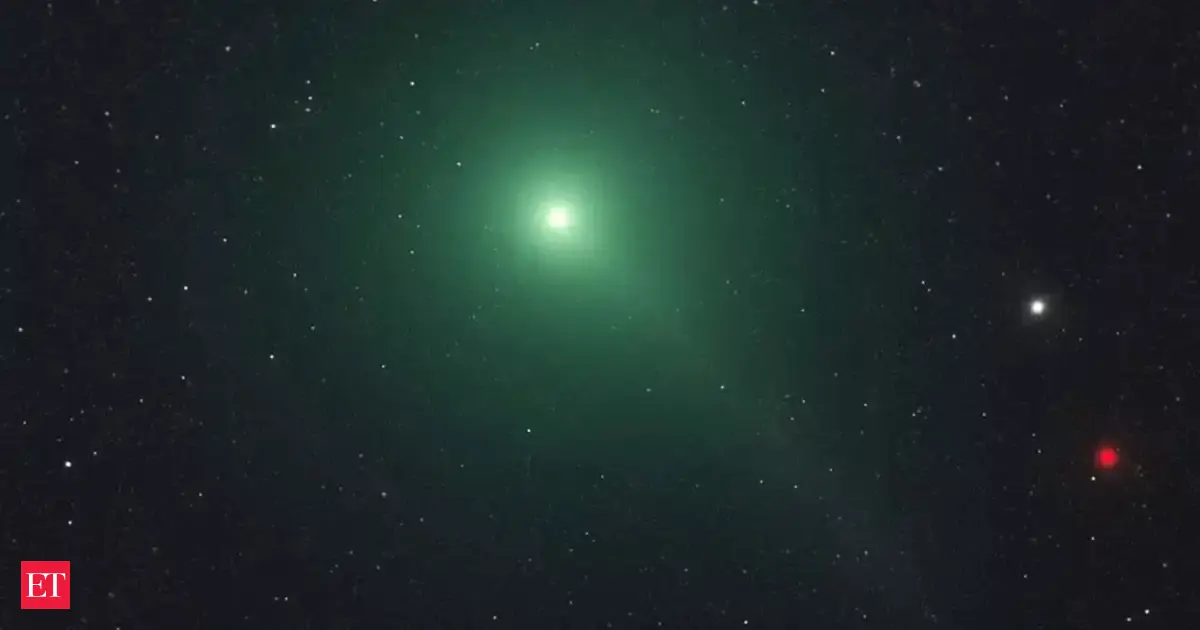
3I/ATLAS coma is expanding? This question gained attention after new images captured by Chuck’s Astrophotography on 2 December showed features that do not match typical comet behaviour. The processed frames reveal a symmetric glow with no visible tail. The coma shows a smooth spread, even gradients and a sharp central point. There is no sign of solar-wind shaping, which is common in normal comets. The coloration appears even across the entire coma. These details triggered new interest in the interstellar object.
3I/ATLAS coma is expanding? Raw frame details
The raw frame shows the object among background stars. Stabilised and refined images show an expanding coma with clear internal gradients. The images show patterns that remain consistent with an interstellar visitor. The coma looks thicker and more isotropic than before. Exposures show repetition traces that indicate a strong coma that hides short tails. New features also include faint micro-jets that point in specific directions.
The object shows signs of mild activity changes. Long exposures reveal small spikes linked with the spin of the nucleus. These features support the idea that the coma continues to expand as the object moves outward. The claims made by users are still unverified.
Live Events
3I/ATLAS coma is expanding as interstellar traits appear
The behaviour matches known interstellar objects such as ʻOumuamua (1I) and Borisov (2I). The coma profile is different from long-period comets in our Solar System. The object shows a halo made of dust but no ion tail. Faint finger-shaped jets point to sublimation from its rotating surface. The evolution appears slow but steady. Each frame shows small growth in coma thickness.
The interstellar nature is confirmed by its non-bound path. The object travels fast at near 60 km/s relative to the Sun while moving toward the outer region. It passed perihelion on October 29, 2025, and now moves outward from the inner Solar System.
Its approximate distance from Earth is 2.4 AU and from the Sun is 2.9 AU. It continues along a hyperbolic orbit. This means it will not return on this path.
3I/ATLAS coma is expanding and why new data matters?
Each new observation helps scientists study the behaviour of interstellar nuclei under solar heating. The new images also help track dust coma evolution, especially in objects with high speed and low binding. They also help understand possible fragmentation events. The object shows no confirmed break or flare, but activity spikes suggest slow changes.
The ASCII sketch shared by observers shows the intensity pattern across the coma and the direction of micro-jets. Metrics shared online show coma intensity near 88 percent and tail visibility around 22 percent. Stability remains low, indicating mild fluctuations.
Social media users shared claims about sudden changes, but none of these claims are verified. Scientists continue to watch the object for activity shifts.
3I/ATLAS discovery
Comet 3I/ATLAS was discovered on July 1, 2025, by the ATLAS survey telescope in Chile. NASA’s Center for Near Earth Object Studies stated that the comet came from outside the Solar System. When the orbit is traced back, the path shows a clear interstellar origin. It is the third known interstellar object after ʻOumuamua and Borisov.
The name follows the standard comet naming system. “ATLAS” credits the discoverer. The letter “I” marks it as interstellar, and the number “3” shows its order of discovery among interstellar visitors.
NASA confirmed that 3I/ATLAS poses no threat to Earth. The object will pass safely and leave the Solar System after this visit. It travels at more than 210,000 kilometres per hour, making it too fast to remain bound by the Sun.
FAQs
1. Why do observers ask if the 3I/ATLAS coma is expanding?
New frames show thicker coma layers, smooth gradients and mild activity spikes. These patterns indicate slow outward spread of the coma as the object moves away from the Sun.
2. What makes the 3I/ATLAS coma different from normal comets?
The coma shows symmetry, no tail, uniform colour and faint micro-jets. These features differ from typical solar-system comets and match traits seen in interstellar objects.
(You can now subscribe to our Economic Times WhatsApp channel)
(Catch all the US News, UK News, Canada News, International Breaking News Events, and Latest News Updates on The Economic Times.)
Download The Economic Times News App to get Daily International News Updates.
...moreless
(You can now subscribe to our Economic Times WhatsApp channel)
(Catch all the US News, UK News, Canada News, International Breaking News Events, and Latest News Updates on The Economic Times.)
Download The Economic Times News App to get Daily International News Updates.
...moreless
Explore More Stories
Amazon warns over 300 million users of major Black Friday impersonation scams targeting personal data
What is Canada’s new colour-coded alert system and how it will ensure public safety during extreme weather
Canada launches new alert system for extreme weather; Colour-coded system marks shift to impact-based forecasting
Canadian Olympic swimming champion Penny Oleksiak suspended for two years over anti-doping whereabouts failures
Who is Colleen Jones? Two-time World champion curler and veteran Canadian broadcaster dies at 65
What exactly is the Canada Pension Plan? New CPP payments rolling out nationwide on November 26; Check all the payment dates of 2025-26 - Why is Quebec not part of CPP?
Madeleine Poulin, Radio-Canada’s first female correspondent in Ottawa and Paris, dies at 87
Yoplait recalls 'Yop yogurt' drinks in Canada over plastic contamination fears under Class 1 category - Check out which flavor and best-before dates beverage are subject to recall
CMA Awards: Vince Gill honored with prestigious Willie Nelson Lifetime Achievement Award at 59th CMA Awards in Tennessee
MGK rocks Canadian fans with explosive Grey Cup halftime show; Are Megan Fox, MGK really working on their relationship post daughter’s birth?
Roughriders end 12-year drought, beat Alouettes for 5th Grey Cup title
Who is Dr Sanjeev Sirpal? Trouble mounts for New Brunswick doctor accused of sexual assault in hospitals as he faces additional charges; what do we know so far
Russian humanoid robot 'AIDOL' shockingly faceplants during much-hyped public debut - WATCH
1
2
3