3I/ATLAS: Harvard's Avi Loeb Highlights 14 Anomalies Ahead of Exocomet's Earth Flyby
हिंदी में सुनें
Listen to this article in Hindi
Harvard astrophysicist Avi Loeb has identified 14 unusual characteristics of exocomet 3I/ATLAS before its upcoming Earth flyby, raising intriguing questions.
As exocomet 3I/ATLAS approaches its Earth flyby, Harvard astrophysicist Avi Loeb has pointed out 14 anomalies that distinguish it from typical comets. These observations raise questions about its origin and behavior.
One striking point involves 3I/ATLAS's upcoming encounter with Jupiter. On March 16, 2026, the exocomet's predicted perijove distance—53.445 million kilometers (with a margin of error of +/- 0.06 million kilometers)—nearly matches Jupiter's Hill radius of 53.502 million kilometers. According to Loeb, this close alignment is made possible by the non-gravitational acceleration 3I/ATLAS exhibited near perihelion. He suggests this rare coincidence could indicate a deliberate attempt by 3I/ATLAS to deploy technological devices as artificial Jovian satellites, potentially at Jupiter’s Lagrange points L1 and L2 where minimal orbital corrections and fuel would be needed.
Loeb also notes that the nucleus of 3I/ATLAS dwarfs those of other interstellar objects. It is roughly a million times more massive than 1I/`Oumuamua and a thousand times more massive than 2I/Borisov, while also exhibiting greater speed. Loeb argues that the scarcity of rocky material in interstellar space makes it improbable for an object of this size to randomly arrive in the inner solar system as frequently as observed (once per decade). This leads him to believe that 3I/ATLAS may have been intentionally directed toward the inner solar system.
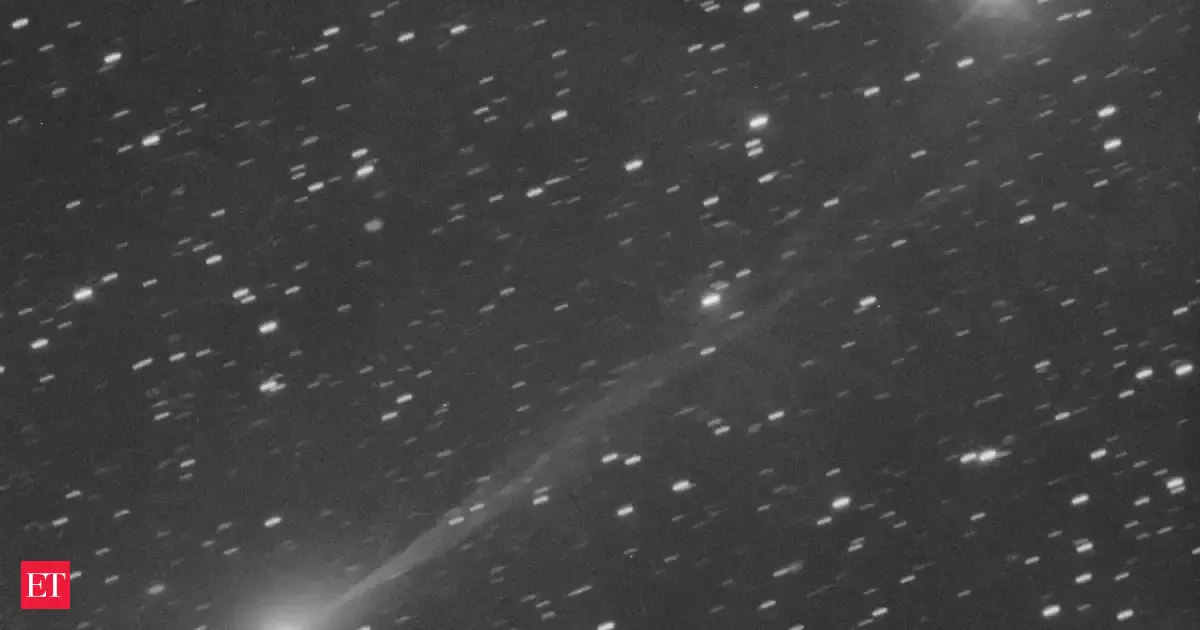
Further adding to the intrigue, 3I/ATLAS displayed a sunward jet (anti-tail) during July, August, and November of 2025. This phenomenon is not simply a geometric optical illusion, unlike what is observed in thousands of other comets. Images taken by HiRISE during 3I/ATLAS's closest approach to Mars confirmed a luminous extension ahead of the object, aligning with its direction of travel. Loeb proposes that for a technological object, a beam of light or particles could serve to mitigate the risk of impacts from micrometeorites or rocks, which could strike its surface at roughly 60 kilometers per second, releasing significant energy.
Chemical composition also sets 3I/ATLAS apart. The gas plume surrounding it contains a much higher concentration of nickel than iron, resembling industrially produced nickel alloys. Additionally, the ratio of nickel to cyanide is orders of magnitude greater than that found in thousands of known comets, including 2I/Borisov. Loeb posits that these unusual abundances might suggest an artificial origin.
In contrast to typical solar-system comets, water accounts for only 4% of the mass of the gas plume surrounding 3I/ATLAS. Loeb suggests that the plume might be the result of sunlight releasing ice and dust that accumulated on the surface of a technological object as it traversed the cold interstellar medium.
3I/ATLAS also exhibits non-gravitational acceleration near perihelion. For a natural comet, this would require substantial evaporation. That said, the reality is a bit more complicated. initial images suggest that the object remained intact without fragmentation. Loeb proposes that an engine could be responsible for this acceleration.
Finally, Loeb highlights the low probability of 3I/ATLAS's nucleus rotation axis being aligned within 8 degrees of the Sun's direction as it approached the Sun at a heliocentric distance exceeding five times the Earth-Sun separation (AU). The random chance of such alignment is only 0.005. Without this specific alignment, the anti-tail jet directed towards the Sun would have been oriented at a much larger angle relative to the rotation axis, resulting in a more significant wobble in its position angle than the observed 8 degrees. A larger misalignment angle could have led to noticeable gaps in activity as its base moved between the dayside and nightside of 3I/ATLAS.