3I-ATLAS Exocomet Latest Images Explained By Astrophysicist: Clearest Photos, Tail Features, And Upcoming Observations
The newly released images of exocomet 3I/ATLAS reveal its clearest structure yet, including a bright nucleus and a dramatic dust tail. Researchers believe the exocomet may have come from another star system, making its passage extremely rare.
The interstellar exocomet 3I/ATLAS has become a global fascination as astronomers and space enthusiasts race to capture its rare passage through our cosmic neighborhood. Recent images shared online especially the remarkably clear shots by astrophotographer Paul Craggs have reignited debates about the object’s unusual features and origins. As scientists, including Harvard astrophysicist Avi Loeb, analyze these visuals with growing interest, 3I/ATLAS continues to spark excitement and curiosity. With its closest approach to Earth just weeks away, the world is eagerly watching for new data that may finally unravel the mysteries surrounding this enigmatic visitor from beyond our solar system.
Paul Craggs’ Viral Image of 3I/ATLAS Stuns the Internet
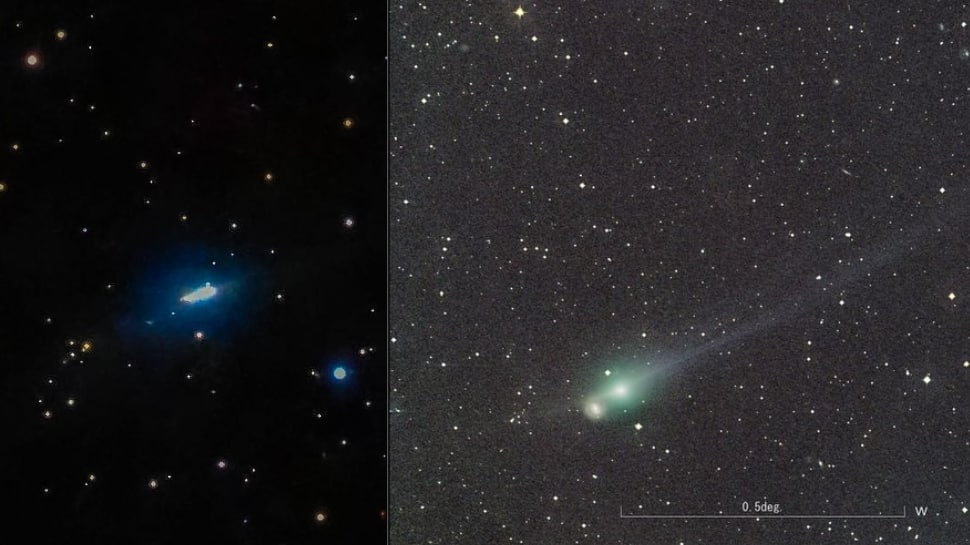
Canadian astrophotographer Paul Craggs recently captured what many consider the clearest images yet of the interstellar exocomet 3I/ATLAS on November 22. Taken with a budget-friendly Dwarf 3 portable smart telescope, his photos quickly went viral, impressing netizens with their clarity. Craggs’ image stood out because it showcased two features rarely missing in a natural comet—its tail and anti-tail—with far more detail than NASA’s earlier HiRISE image, which had disappointed viewers expecting sharper visuals. Although NASA clarified the technical limitations behind its image, stargazers continue to share striking photographs of the exocomet, and Craggs’ detailed snapshot only fueled the excitement.
Avi Loeb Analyzes the Image and Points to Motion Smearing
Harvard astrophysicist Avi Loeb, who has previously listed 13 anomalies in 3I/ATLAS hinting at a possible technological origin, analyzed Craggs’ image in his latest blog. He noted that the comet’s unusually elongated appearance might be due to motion smearing during the capture. Commenting on another standout photograph taken by Mitsunori Tsumura using a 0.5-meter telescope, Loeb highlighted that at its current distance of 300 million kilometers from Earth, the comet’s tail stretches nearly 5 million kilometers, while the sunward anti-tail spans about a million kilometers—distances that would take a month to traverse at 400 meters per second.
Astronomers Await High-Resolution Images Ahead of Closest Approach
Loeb added that astronomers worldwide are eagerly awaiting higher-resolution images from Earth’s largest telescopes, along with those from Hubble and the James Webb Space Telescope, as 3I/ATLAS approaches its closest point to Earth on December 19, 2025, at 269 million kilometers. With crucial data expected to arrive in December, Loeb believes the upcoming observations will be key to determining the true nature of 3I/ATLAS—and that the most revealing insights are still ahead.
As the world’s leading observatories prepare for 3I/ATLAS’ closest approach, anticipation continues to build within the scientific community and among skywatchers worldwide. The recent images captured by amateur and professional astronomers alike have opened new doors of curiosity, but the true identity and nature of this mysterious interstellar visitor remain unanswered. With December’s high-resolution data expected to offer the clearest view yet, the coming weeks may finally deliver the insights needed to understand 3I/ATLAS—whether it is an ordinary cosmic wanderer or something far more extraordinary.