2.8 days to disaster: Scientists warn of a disastrous satellite chain collision in low Earth orbit
हिंदी में सुनें
Listen to this article in Hindi
A new study warns that satellite mega-constellations face catastrophic collision risks in just 2.8 days if a solar storm disrupts control systems.
A new study published on December 16, 2025, raises concerns about the vulnerability of satellite mega-constellations. Researchers warn that a powerful solar storm could trigger a chain reaction of collisions in low Earth orbit, potentially within a matter of days. The increasing number of active satellites in this region makes it particularly susceptible to such a disaster.
Currently, data indicates that satellites in low Earth orbit pass within one kilometer of each other every 22 seconds. Satellite operators on Earth constantly adjust spacecraft trajectories to prevent collisions, a delicate operation reliant on uninterrupted communication and navigation systems.
Solar Storms: A Threat to Satellite Control
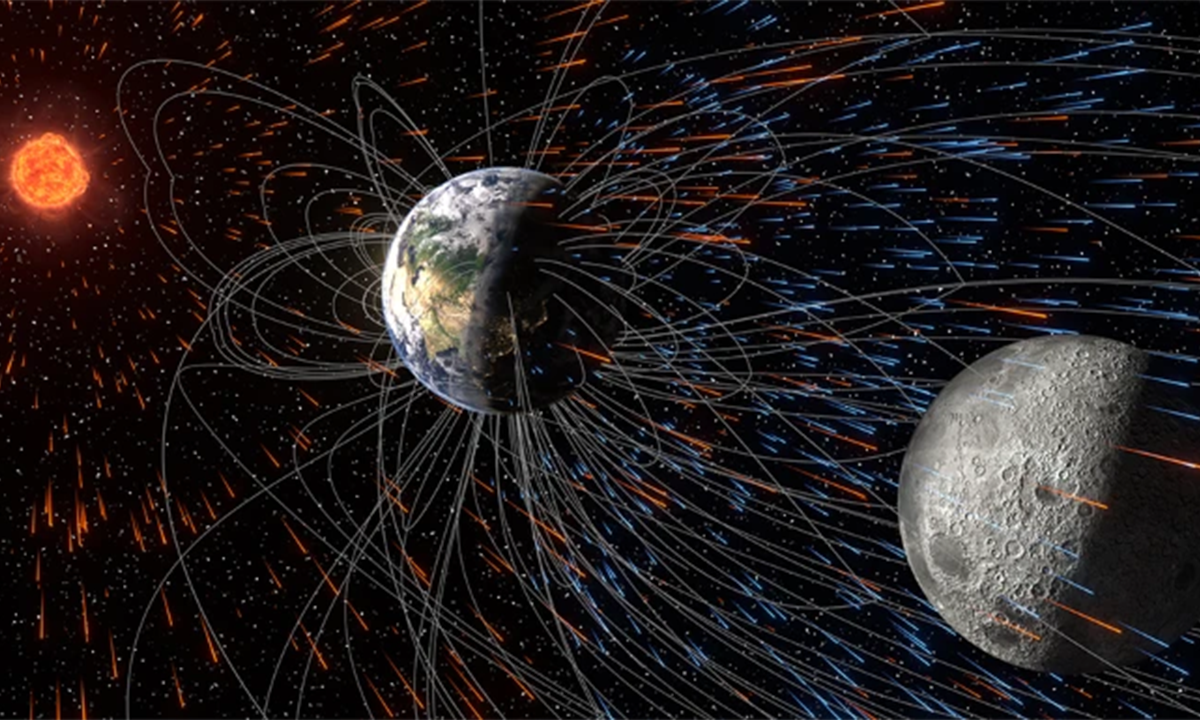
Sarah Thiele, a PhD student at Princeton, led the research team that examined potential system failure scenarios. Their work, highlighted this week by Universe Today, focused on the impact of intense solar storms. These storms increase atmospheric drag, potentially pushing satellites onto collision courses and requiring operators to perform frequent avoidance maneuvers.
The most significant danger lies in the disruption of satellite control capabilities. Solar storms can damage the navigation and communication networks essential for sending maneuvering commands. Losing these systems could mean a complete loss of real-time control over satellites.
Rising Collision Risks in Congested Orbit
The researchers introduced a new risk assessment tool called the CRASH Clock (Collision Realization and Significant Harm). Using this metric, they modeled scenarios involving a loss of control. The study indicated that if commands cannot be transmitted to satellites, a catastrophic collision could occur in approximately 2.8 days.
This timeframe is based on conditions expected in June 2025. To illustrate the increasing risk, the researchers noted that the equivalent window in 2018 was 121 days. Even a 24-hour control outage poses a significant threat, with the study estimating a 30% probability of a collision. Such an event could potentially trigger the Kessler Syndrome, a cascading effect of collisions creating space debris.
Worst-Case Scenario: A Carrington-Scale Solar Storm
The Kessler Syndrome describes a scenario where cascading collisions generate clouds of debris, rendering satellite operations and new launches unsafe. The researchers emphasized that responding to solar storms demands constant, real-time action, as recovery time is severely limited in the event of system failures.
The study also considered the impact of a Carrington-scale solar storm, similar to the historically powerful event of 1859. Researchers concluded that such a storm would overwhelm satellite control systems, potentially causing a loss of command for over three days. This scenario could devastate much of today's satellite infrastructure.